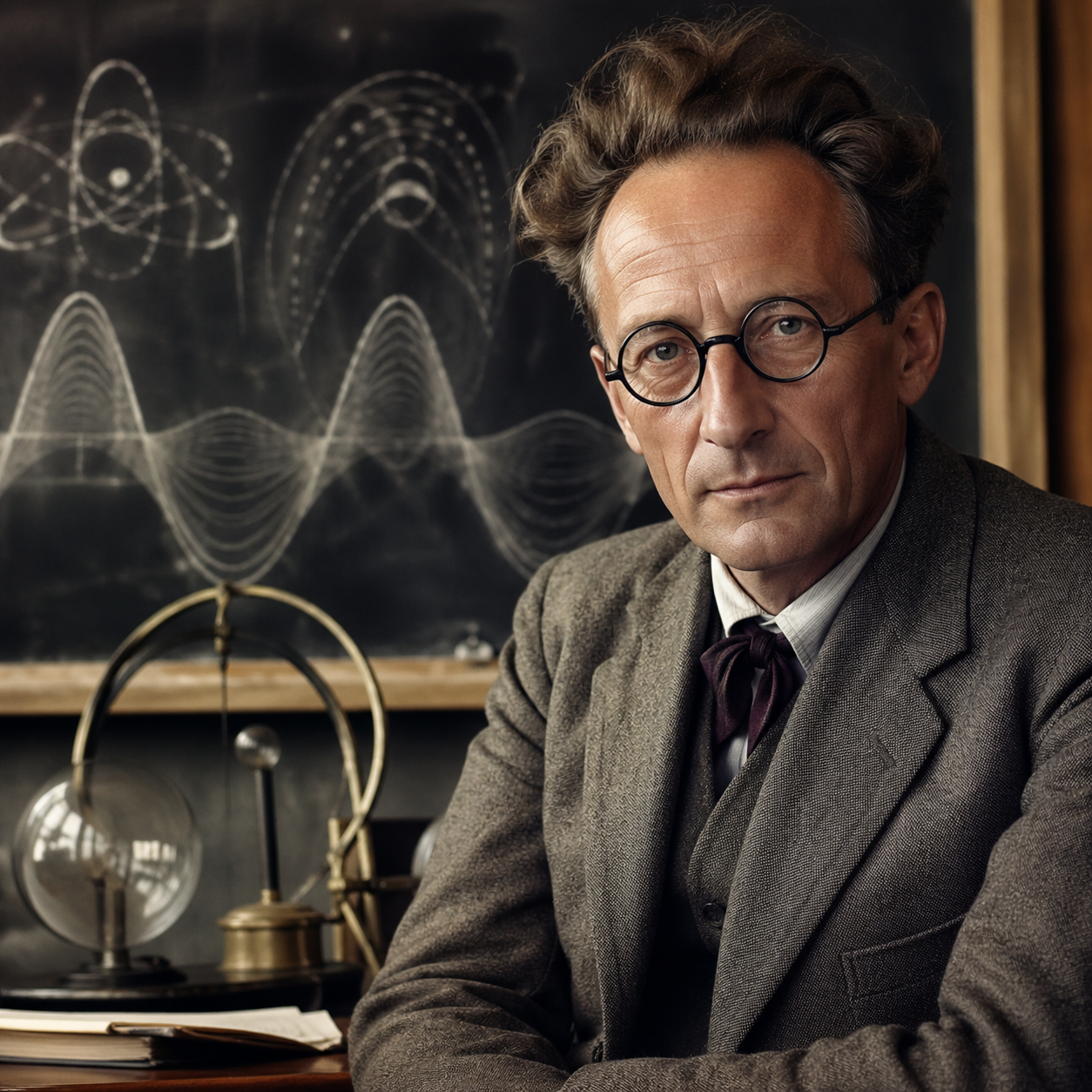
Erwin Schrodinger — "If you cannot explain it simply, you do not understand it well enough."
If you cannot explain it simply, you do not understand it well enough.
If you cannot explain it simply, you do not understand it well enough.
Click any product to generate a realistic preview. Up to 3 at a time.
* Initial load can take up to 90 seconds — revising the preview in another color is nearly instant.
"The human mind is a universe in itself."
"The scientific picture of the world is very successful, but it is incomplete. It leaves out something essential, something that is very close to us, namely, our own consciousness."
"The only constant in life is change."
"The quantum theory is an 'unpleasant' theory, which I should have liked to assume to be true only if I were forced to do so by the facts."
"The world is not a collection of independent objects, but a single, indivisible whole."
Austrian physicist who shared the 1933 Nobel for the wave equation that bears his name and the famous cat thought-experiment. Closely associated with Werner Heisenberg (matrix-mechanics rival who reached the same physics by different math) and Albert Einstein (his pen-pal on quantum interpretation). For an intellectual contrast, see Niels Bohr, Danish physicist and architect of the Copenhagen interpretation — Schrödinger's cat thought-experiment was specifically designed to ridicule Bohr's 'observer-dependent reality' reading of quantum mechanics — Schrödinger thought the Copenhagen interpretation was absurd; the cat was meant as reductio ad absurdum.
Attributed to various people, including Einstein, but not definitively Schrodinger.
Date: Unknown
GeneralFound in 1 providers: grok
1 source checked
True mastery of an idea shows in your ability to strip it down to its essentials and convey it to someone outside the field. If you can only describe a concept using jargon, formulas, or borrowed phrasing, you are likely leaning on memorized scaffolding rather than genuine comprehension. Clarity of expression is the real test of clarity of thought, and complexity in explanation usually betrays gaps in the underlying grasp.
Schrodinger embodied this through his 1944 book What Is Life?, which translated dense quantum and biological ideas into prose accessible to non-physicists and famously inspired the discoverers of DNA. Beyond his wave equation, he wrote on color theory, philosophy, Vedanta, and consciousness, repeatedly demanding that physics speak to broader human understanding. His thought-experiment cat shows the same instinct: collapsing abstract superposition into one vivid, teachable image.
Schrodinger worked during the 1920s-1950s upheaval of quantum mechanics, when matrix algebra, uncertainty, and probability waves alienated even trained physicists. Public anxiety after two world wars and the atomic bomb made science feel dangerous and remote, while figures like Einstein, Bohr, and Feynman pushed popularization. Universities expanded, radio and paperbacks democratized ideas, and intellectuals felt a duty to explain breakthroughs plainly so citizens could weigh nuclear-age decisions intelligently.
AI-generated insights based on extensive research and information for context. Factual errors? Email [email protected].
Your cart is empty