Richard Feynman — "If you thought that science was certain — well, that is just an error on your pa…"
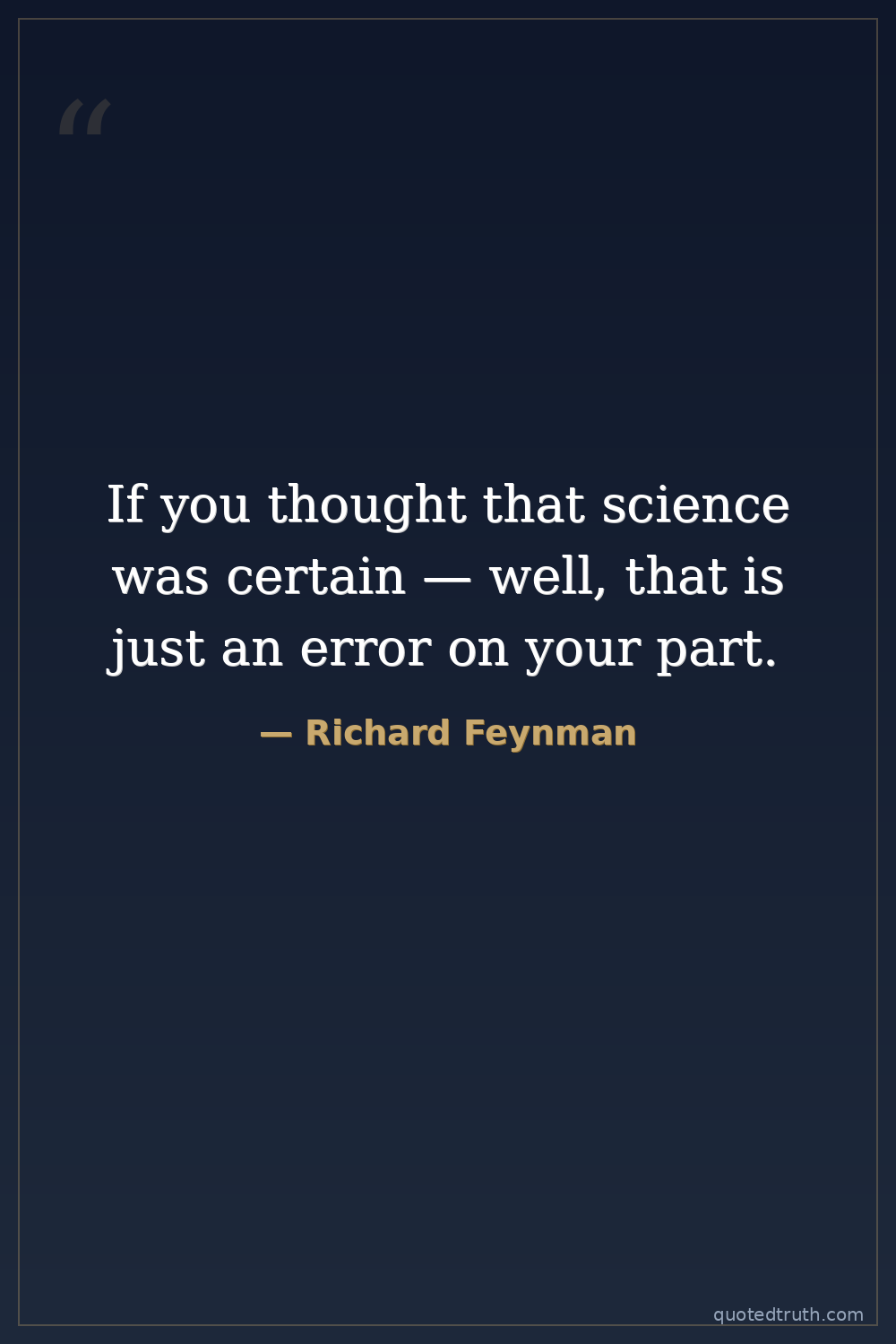
If you thought that science was certain — well, that is just an error on your part.
If you thought that science was certain — well, that is just an error on your part.
Click any product to generate a realistic preview. Up to 3 at a time.
* Initial load can take up to 90 seconds — revising the preview in another color is nearly instant.
"For a successful technology, reality must take precedence over public relations, for nature cannot be fooled."
"I would rather have a world with five billion people that didn't know how to read than a world with five billion people that all knew how to read and all thought the same thing."
"Oh. That's interesting. (This entire scene is very typical of Dirac. In fact, that is comparatively a lot of words for him to have said to a stranger.)"
"I was never a very good student, and I always had trouble with math. I was always in the bottom of the class in math."
"There is no harm in doubt and skepticism, for it is through these that new discoveries are made."
American theoretical physicist who shared the 1965 Nobel for QED, developed Feynman diagrams, and wrote the Feynman Lectures on Physics. Closely associated with Julian Schwinger (co-Nobelist for QED) and Murray Gell-Mann (Caltech rival and Eightfold-Way physicist). For an intellectual contrast, see Deepak Chopra, physician and quantum-mysticism author — Feynman's Caltech 'cargo cult science' commencement address is the precise template for what he saw as misuse of physics terminology — Chopra-style appropriation of quantum vocabulary for metaphysical claims is the canonical example of what Feynman called 'fooling yourself'.
Found in 2 providers: grok,gemini
2 sources checked
Science does not deliver absolute certainty — it delivers the best current explanation based on evidence, always open to revision. Thinking otherwise mistakes the nature of scientific knowledge entirely. Science thrives on doubt, not dogma. Its power comes precisely from willingness to be wrong, to test, to revise. Certainty is the enemy of inquiry, and inquiry is the whole point.
Feynman built his career on probing the deepest uncertainties in physics — quantum electrodynamics deals with probabilities, not certainties, at the subatomic level. He famously celebrated not knowing as intellectually honest and productive. His Caltech lectures and public talks consistently attacked false certainty in science education. He believed pretending to know what you don't is the most dangerous intellectual sin a scientist can commit.
Feynman worked through the Cold War era when science carried enormous public prestige — nuclear power, space race, medical breakthroughs created a cultural myth of science as omniscient authority. Governments and institutions often presented scientific conclusions as settled fact to justify policy. Feynman pushed back against this, insisting scientific literacy meant embracing uncertainty rather than treating experts as infallible oracles delivering absolute truth.
AI-generated insights based on extensive research and information for context. Factual errors? Email [email protected].
Your cart is empty