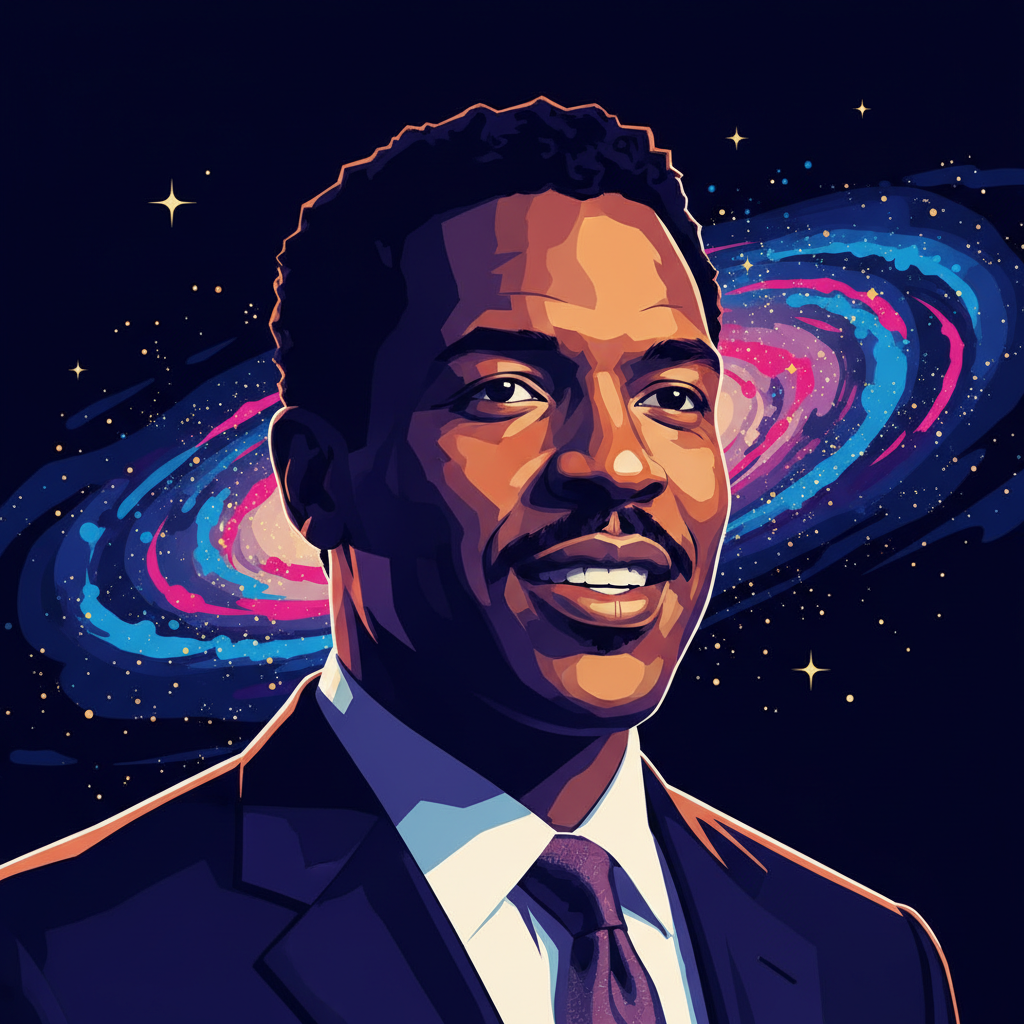
Neil deGrasse Tyson — "If you're not failing, you're not pushing your limits, and if you're not pushing…"
If you're not failing, you're not pushing your limits, and if you're not pushing your limits, you're not maximizing your potential.
If you're not failing, you're not pushing your limits, and if you're not pushing your limits, you're not maximizing your potential.
Click any product to generate a realistic preview. Up to 3 at a time.
* Initial load can take up to 90 seconds — revising the preview in another color is nearly instant.
"I think the universe is trying to tell us something, and we're just not listening."
"I don't believe in magic. I believe in physics."
"The universe is not just a bunch of stuff. It's a story, and we're all part of it."
"I'm not a fan of dogma. I prefer to let the evidence speak for itself."
"The universe is expanding, and so should our minds."
American astrophysicist, Hayden Planetarium director, and Cosmos: A Spacetime Odyssey host who carries the Carl Sagan public-science mantle. Closely associated with Bill Nye (fellow science communicator) and Brian Greene (theoretical physicist and string-theory popularizer). For an intellectual contrast, see Ken Ham, founder of Answers in Genesis and the Creation Museum — Ham's career has been organized around defending biblical 6-day creationism — exactly the science-education position Tyson's mainstream-science communication is structured to refute.
Found in 1 providers: grok
1 source checked
Failure isn't shameful—it's proof you're attempting things beyond your current capability. Playing it safe means operating inside a comfort zone where success is guaranteed but growth is impossible. True potential only reveals itself at the outer edge of your ability, where falling short is a real risk. Without accepting that risk, you'll never discover what you're truly capable of.
As an astrophysicist, Tyson operates in a field where failed hypotheses are the engine of discovery—the scientific method literally requires falsifiable experiments that often don't pan out. He frequently discusses how science advances through wrong answers, not just right ones. His own career, built by pushing into public science communication when few researchers did, reflects a deep personal belief that growth lives beyond familiar territory.
Tyson became a prominent public voice as two contradictory forces shaped American culture: Silicon Valley's 'fail fast' philosophy glamorized risk-taking, while standardized testing and social media simultaneously made failure more visible and costly. The early 2000s saw STEM education become a national priority alongside intense debate about how schools discourage risk and creativity. His message reframes failure as productive at exactly the moment the culture needed that reframe.
AI-generated insights based on extensive research and information for context. Factual errors? Email [email protected].
Your cart is empty