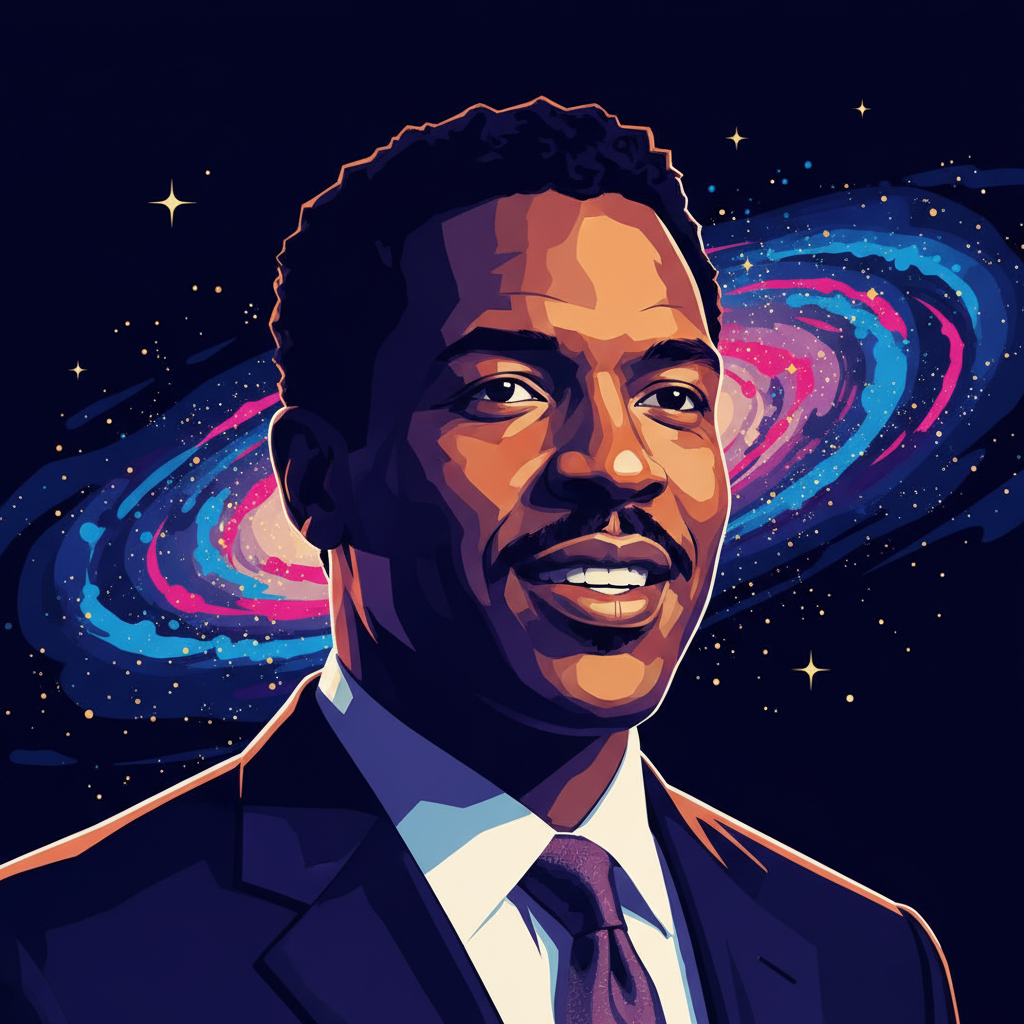
Neil deGrasse Tyson — "If you're religious, you already have a book of answers. The problem is, it's no…"
If you're religious, you already have a book of answers. The problem is, it's not a book of questions.
If you're religious, you already have a book of answers. The problem is, it's not a book of questions.
Click any product to generate a realistic preview. Up to 3 at a time.
* Initial load can take up to 90 seconds — revising the preview in another color is nearly instant.
"I've never been able to get into science fiction as much as I'd like, because I find that most of it breaks the laws of physics."
"I'm not a fan of the idea of 'alternative facts.' Facts are facts. There's no alternative to them."
"The most important thing about the scientific method is that it's self-correcting. You don't have to trust anyone. You can verify everything for yourself."
"The universe is not just out there. It's in here."
"The greatest story ever told is the story of the universe."
American astrophysicist, Hayden Planetarium director, and Cosmos: A Spacetime Odyssey host who carries the Carl Sagan public-science mantle. Closely associated with Bill Nye (fellow science communicator) and Brian Greene (theoretical physicist and string-theory popularizer). For an intellectual contrast, see Ken Ham, founder of Answers in Genesis and the Creation Museum — Ham's career has been organized around defending biblical 6-day creationism — exactly the science-education position Tyson's mainstream-science communication is structured to refute.
Found in 1 providers: grok
1 source checked
Religious texts provide ready-made conclusions, but genuine understanding requires relentless questioning. Science advances by asking what we don't know, not confirming what we think we do. Intellectual growth demands sitting with uncertainty and pursuing evidence. Treating any text as having final answers closes the mind to discovery — the very process that has unlocked everything humanity actually knows about the universe and our place in it.
As director of the Hayden Planetarium and America's most visible science communicator, Tyson built his career challenging comfortable certainties. Raised in the Bronx and shaped by Carl Sagan's influence, he repeatedly navigated the tension between faith communities and empirical cosmology. His public debates and writing consistently defend the scientific method's core demand: question everything, especially your own assumptions.
Tyson rose to prominence during the post-9/11 era and the New Atheism wave of the 2000s-2010s, when figures like Dawkins and Hitchens made science-versus-religion a cultural flashpoint. Simultaneously, creationism battles in American schools, climate denial, and vaccine skepticism made scientific literacy a genuine political battleground — making Tyson's message about questioning over certainty urgently relevant beyond abstract philosophy.
AI-generated insights based on extensive research and information for context. Factual errors? Email [email protected].
Your cart is empty