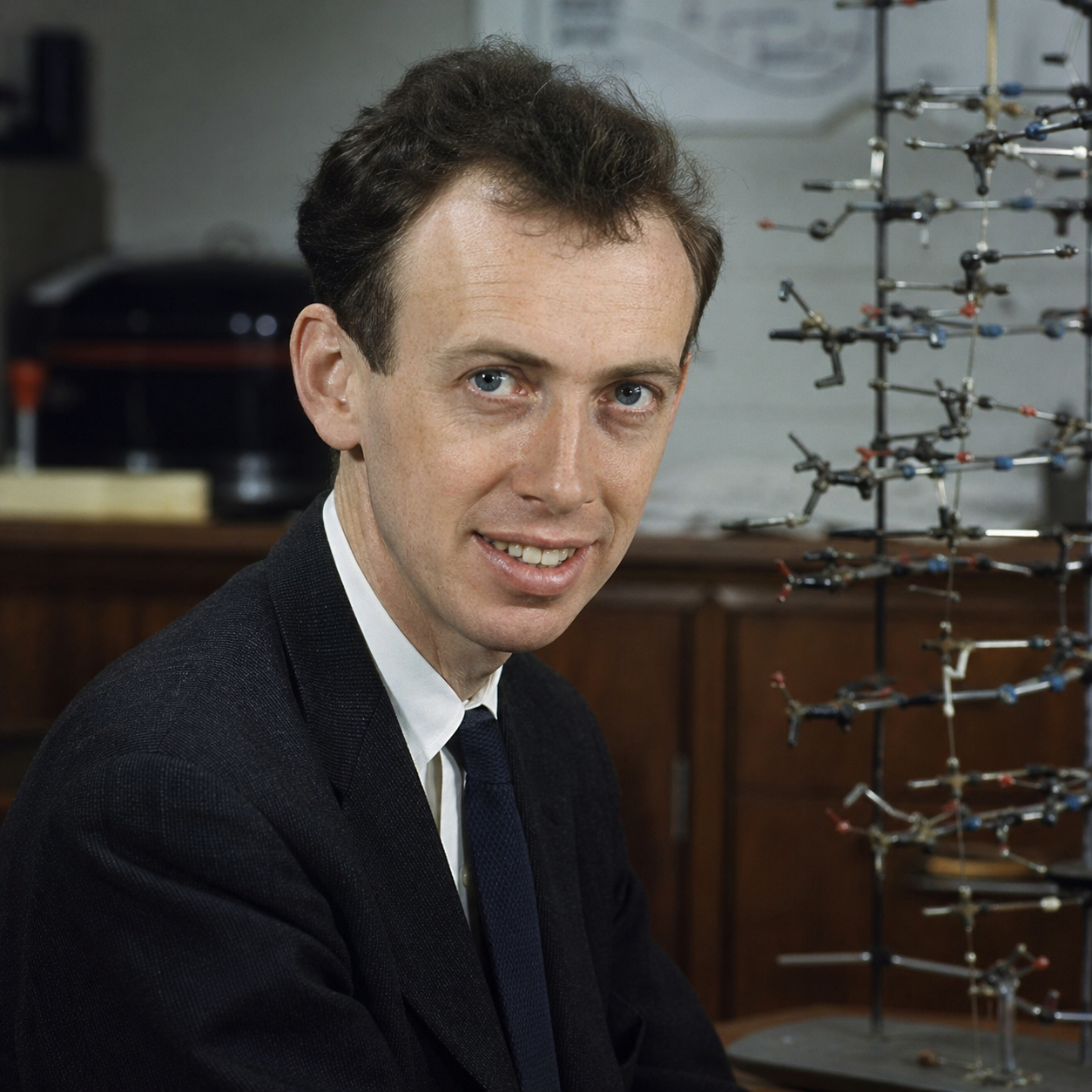
James Watson — "I'm a Darwinian. I believe in natural selection."
I'm a Darwinian. I believe in natural selection.
I'm a Darwinian. I believe in natural selection.
Click any product to generate a realistic preview. Up to 3 at a time.
* Initial load can take up to 90 seconds — revising the preview in another color is nearly instant.
"If you're not offending someone, you're not doing your job."
"There's a difference between a scientist and a politician. A scientist wants to know the truth, a politician wants to get elected."
"We have to cure stupidity."
"I’m not a racist in a conventional way. I’ve never been a racist. I’ve never been anti-Semitic. I’m not prejudiced."
"People say, 'What about the poor people?' I say, 'They're not going to be any poorer.'"
Found in 1 providers: grok
1 source checked
The quote expresses straightforward commitment to Charles Darwin's theory that organisms with advantageous traits survive and reproduce more successfully, driving adaptation and diversification. It signals a materialist, science-grounded worldview rejecting supernatural explanations for life's complexity. Watson is declaring that biology operates through impersonal selective pressure, not design or divine intention — a foundational stance in modern biology that shapes how he approaches genetics, heredity, and human variation.
Watson's career was built on the molecular mechanism underlying Darwinian heredity — DNA itself. Co-discovering the double helix in 1953 with Francis Crick revealed exactly how genetic information is copied, giving natural selection its molecular substrate. He led the Human Genome Project and repeatedly applied evolutionary logic to human populations, controversially arguing that genetics shapes cognitive differences between groups — a direct, if troubling, extension of his Darwinian identity.
Watson worked in the era when the Modern Synthesis merged Darwinian evolution with genetics, culminating in DNA's discovery. By the 1990s–2000s, evolutionary biology extended into sociobiology and evolutionary psychology, sparking fierce debates about race, intelligence, and genetic determinism. Watson's controversial 2007 comments about race and IQ — which cost him his Cold Spring Harbor directorship — showed how declaring oneself a Darwinian carried explosive sociopolitical weight beyond pure science.
AI-generated insights based on extensive research and information for context. Factual errors? Email [email protected].
Your cart is empty