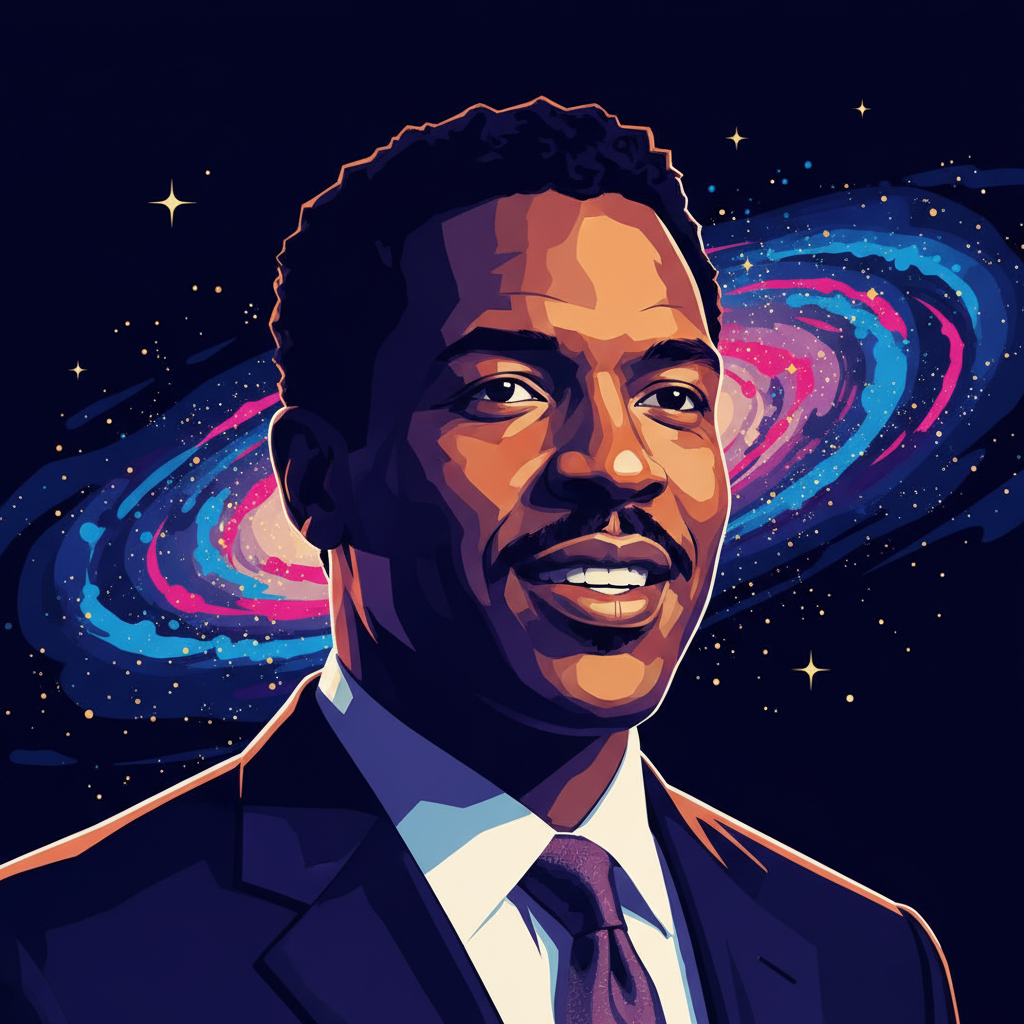
Neil deGrasse Tyson — "I'm not a philosopher. I'm a scientist. I'm interested in what is, not what shou…"
I'm not a philosopher. I'm a scientist. I'm interested in what is, not what should be.
I'm not a philosopher. I'm a scientist. I'm interested in what is, not what should be.
Click any product to generate a realistic preview. Up to 3 at a time.
* Initial load can take up to 90 seconds — revising the preview in another color is nearly instant.
"I would be a lot more comfortable if I could be assured that the people who say 'I'm a Christian' actually lived by the tenets of Christianity."
"The universe is full of answers. You just have to know how to ask the questions."
"The universe is an amazing place, and it's full of surprises."
"The universe is a vast and lonely place. But it's also beautiful."
"The greatest discovery in science is the discovery of ignorance."
American astrophysicist, Hayden Planetarium director, and Cosmos: A Spacetime Odyssey host who carries the Carl Sagan public-science mantle. Closely associated with Bill Nye (fellow science communicator) and Brian Greene (theoretical physicist and string-theory popularizer). For an intellectual contrast, see Ken Ham, founder of Answers in Genesis and the Creation Museum — Ham's career has been organized around defending biblical 6-day creationism — exactly the science-education position Tyson's mainstream-science communication is structured to refute.
Found in 1 providers: grok
1 source checked
Science deals in observable reality and measurable facts, not idealized visions of how things ought to be. This statement draws a hard boundary between empirical inquiry and moral or normative reasoning. A scientist's job is to describe the universe accurately, not prescribe how humanity should behave or what values we should hold. The two disciplines require fundamentally different tools and methods.
Tyson built his career on rigorous astrophysics while also becoming America's foremost science communicator through StarTalk, Cosmos, and constant media presence. He consistently resists letting political or philosophical agendas color scientific findings, famously refusing to label himself an atheist despite his secular worldview. His blunt, empirical style reflects this boundary between description and prescription throughout his public work.
In the early 21st century, science faces unprecedented politicization—climate denial, vaccine skepticism, and culture-war battles over curriculum. Scientists like Tyson operate in an environment where their findings are filtered through ideological lenses. This statement pushes back against pressure to make science serve predetermined conclusions, asserting that empirical inquiry must remain separate from political and philosophical advocacy regardless of cultural pressure.
AI-generated insights based on extensive research and information for context. Factual errors? Email [email protected].
Your cart is empty