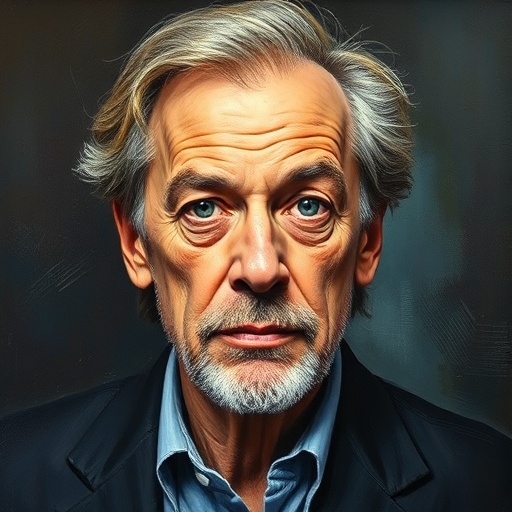
Richard Feynman — "I'm not a popularizer. I'm not trying to tell the public what to think. I'm just…"
I'm not a popularizer. I'm not trying to tell the public what to think. I'm just telling them what I think.
I'm not a popularizer. I'm not trying to tell the public what to think. I'm just telling them what I think.
Click any product to generate a realistic preview. Up to 3 at a time.
* Initial load can take up to 90 seconds — revising the preview in another color is nearly instant.
"If you're going to be a scientist, you don't need to be a genius. You just need to be able to work hard and be curious."
"The easiest way to fool yourself is to believe something because you want it to be true."
"There are no rules in science, only facts."
"I don't know anything, but I know that I know nothing. And that's the beginning of wisdom."
"If you think you understand quantum mechanics, you don't understand quantum mechanics."
American theoretical physicist who shared the 1965 Nobel for QED, developed Feynman diagrams, and wrote the Feynman Lectures on Physics. Closely associated with Julian Schwinger (co-Nobelist for QED) and Murray Gell-Mann (Caltech rival and Eightfold-Way physicist). For an intellectual contrast, see Deepak Chopra, physician and quantum-mysticism author — Feynman's Caltech 'cargo cult science' commencement address is the precise template for what he saw as misuse of physics terminology — Chopra-style appropriation of quantum vocabulary for metaphysical claims is the canonical example of what Feynman called 'fooling yourself'.
Found in 1 providers: grok
1 source checked
The speaker distinguishes between two very different roles: someone who shapes public opinion versus someone who simply shares their own perspective honestly. They refuse to carry the weight of being a public intellectual who tells audiences what conclusions to reach, insisting instead on authentic self-expression—offering their genuine thoughts without any agenda to persuade or direct how others should think.
Feynman spent decades translating complex physics—quantum electrodynamics, path integrals, nanotechnology—into accessible language through books like The Feynman Lectures and TV appearances. Yet he famously distrusted authority and groupthink, earning a Nobel Prize partly through unconventional thinking. This quote captures his ethos: intellectual honesty over influence, curiosity over dogma, personal truth over manufactured consensus.
Mid-to-late 20th century America saw science increasingly politicized and popularized—Carl Sagan built a media empire, think tanks shaped public opinion, and television turned experts into celebrities with persuasive platforms. Feynman, working through Cold War weapons research and the Challenger disaster investigation, witnessed how expert authority could mislead. His insistence on speaking only for himself was a deliberate resistance to that culture.
AI-generated insights based on extensive research and information for context. Factual errors? Email [email protected].
Your cart is empty