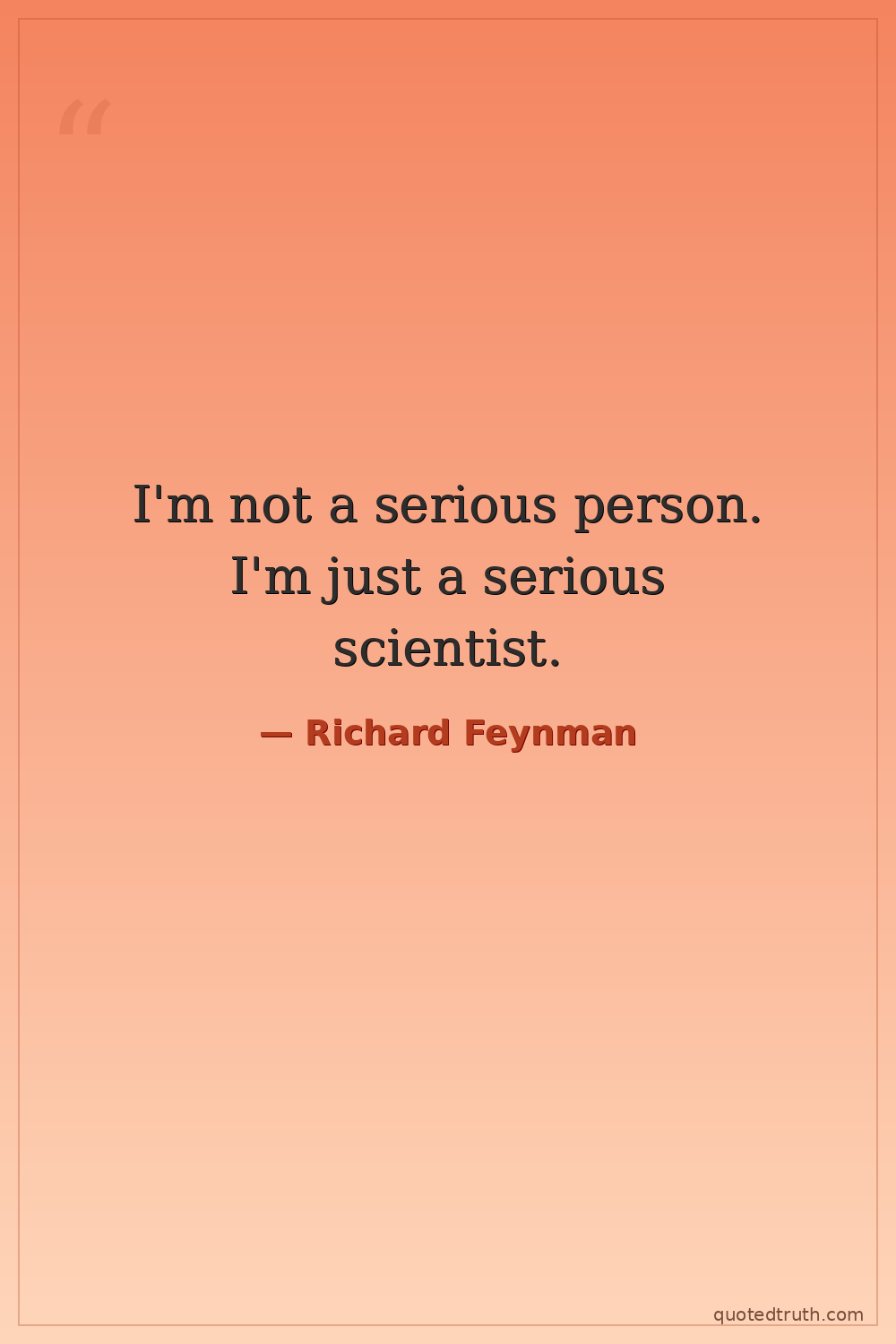
Richard Feynman — "I'm not a serious person. I'm just a serious scientist."
I'm not a serious person. I'm just a serious scientist.
I'm not a serious person. I'm just a serious scientist.
Click any product to generate a realistic preview. Up to 3 at a time.
* Initial load can take up to 90 seconds — revising the preview in another color is nearly instant.
"I simply want to find out more about the world, and I find that the best way to do that is to do science."
"I bet you anything that if you asked a hundred physicists, they would all say that the most beautiful equation in physics is Maxwell's equations."
"I just can't stand people who are so sure of themselves."
"I can live with doubt and uncertainty and not knowing. I think it's much more interesting to live not knowing than to have answers which might be wrong."
"I found myself in a situation where I was giving an answer to a question that I didn't understand, and that alarmed me."
American theoretical physicist who shared the 1965 Nobel for QED, developed Feynman diagrams, and wrote the Feynman Lectures on Physics. Closely associated with Julian Schwinger (co-Nobelist for QED) and Murray Gell-Mann (Caltech rival and Eightfold-Way physicist). For an intellectual contrast, see Deepak Chopra, physician and quantum-mysticism author — Feynman's Caltech 'cargo cult science' commencement address is the precise template for what he saw as misuse of physics terminology — Chopra-style appropriation of quantum vocabulary for metaphysical claims is the canonical example of what Feynman called 'fooling yourself'.
Found in 1 providers: grok
1 source checked
The quote separates personal gravitas from professional rigor. Feynman is saying he isn't pompous, self-important, or solemn as a person — he's playful, mischievous, and irreverent in everyday life. But when it comes to science, he is utterly serious: rigorous, disciplined, and precise. You don't need to be a somber, formal human being to do serious intellectual work. Personality and professional excellence operate on different axes.
Feynman embodied this split completely. He played bongo drums, cracked safes at Los Alamos, frequented strip clubs, and reveled in pranks. Yet he won the 1965 Nobel Prize in Physics for quantum electrodynamics and delivered some of the 20th century's most demanding scientific lectures. He famously deflected honors to avoid ceremony. His entire persona rejected the stuffy academic archetype while his science remained uncompromisingly rigorous.
Feynman's career spanned the post-WWII era when physicists were revered almost like gods — the bomb had ended the war, Cold War competition made science feel supremely weighty, and academia was deeply formal and hierarchical. Scientists were expected to be solemn public figures. Feynman deliberately subverted this: his Caltech lectures, popular books, and Challenger commission work showed the public that rigorous science could coexist with wit and genuine human playfulness.
AI-generated insights based on extensive research and information for context. Factual errors? Email [email protected].
Your cart is empty