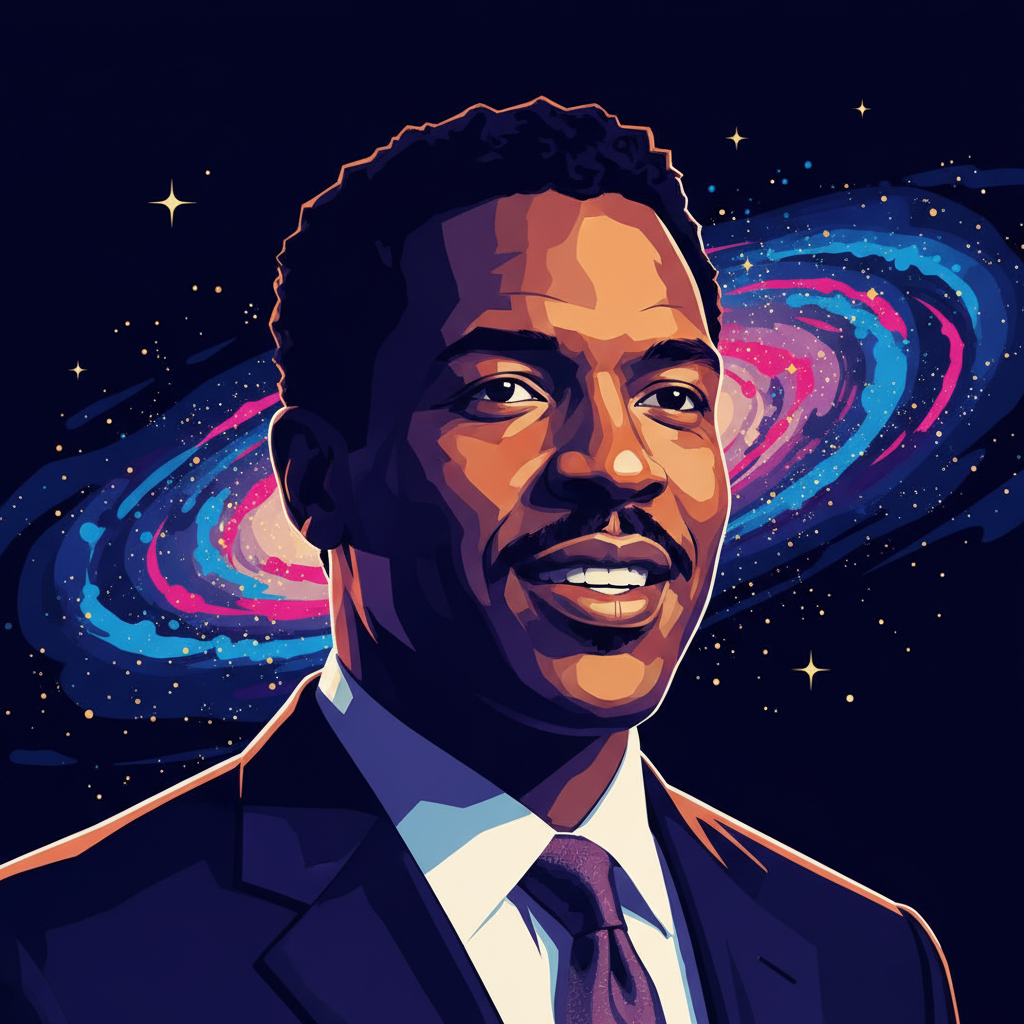
Neil deGrasse Tyson — "I'm not saying there are no aliens. I'm just saying the evidence is insufficient…"
I'm not saying there are no aliens. I'm just saying the evidence is insufficient for me to conclude it.
I'm not saying there are no aliens. I'm just saying the evidence is insufficient for me to conclude it.
Click any product to generate a realistic preview. Up to 3 at a time.
* Initial load can take up to 90 seconds — revising the preview in another color is nearly instant.
"I'm not afraid of death. I'm afraid of dying without having lived a full life."
"Curiosity and the urge to solve problems are the great forces of human nature."
"My goal is to empower people to use the methods and tools of science to analyze information and come to their own conclusions."
"I would be a lot more comfortable if I could be assured that the people who say 'I'm a Christian' actually lived by the tenets of Christianity."
"I'm a big believer in the fact that if you're not making mistakes, you're not trying hard enough."
American astrophysicist, Hayden Planetarium director, and Cosmos: A Spacetime Odyssey host who carries the Carl Sagan public-science mantle. Closely associated with Bill Nye (fellow science communicator) and Brian Greene (theoretical physicist and string-theory popularizer). For an intellectual contrast, see Ken Ham, founder of Answers in Genesis and the Creation Museum — Ham's career has been organized around defending biblical 6-day creationism — exactly the science-education position Tyson's mainstream-science communication is structured to refute.
Found in 1 providers: grok
1 source checked
The quote draws a clear line between possibility and proof. Tyson isn't denying aliens exist — he's refusing to claim something as fact without sufficient evidence. This embodies scientific thinking: conclusions must follow data, not wishful thinking or popular belief. It's the difference between 'I don't know' and 'I believe.' Intellectual honesty sometimes means sitting with uncertainty rather than rushing to a comfortable answer.
Tyson, director of the Hayden Planetarium and host of StarTalk and Cosmos, built his career on making science accessible without sacrificing rigor. A protégé of Carl Sagan, he inherited Sagan's principle that extraordinary claims require extraordinary evidence. Tyson frequently addresses UFO/UAP questions publicly, and this quote captures his signature move: refusing to dismiss wonder while demanding proof. His credibility depends on never confusing possibility with conclusion.
Tyson speaks during a remarkable convergence: Congress held unprecedented UAP hearings, the Pentagon released classified footage of unidentified aerial phenomena, and NASA formed its first official UAP study panel. Meanwhile, the James Webb Space Telescope began detecting atmospheric signatures of distant planets. Public fascination with aliens peaked while institutional science cautiously engaged. In this environment, maintaining evidentiary standards while refusing outright dismissal reflects exactly the tension science must navigate.
AI-generated insights based on extensive research and information for context. Factual errors? Email [email protected].
Your cart is empty