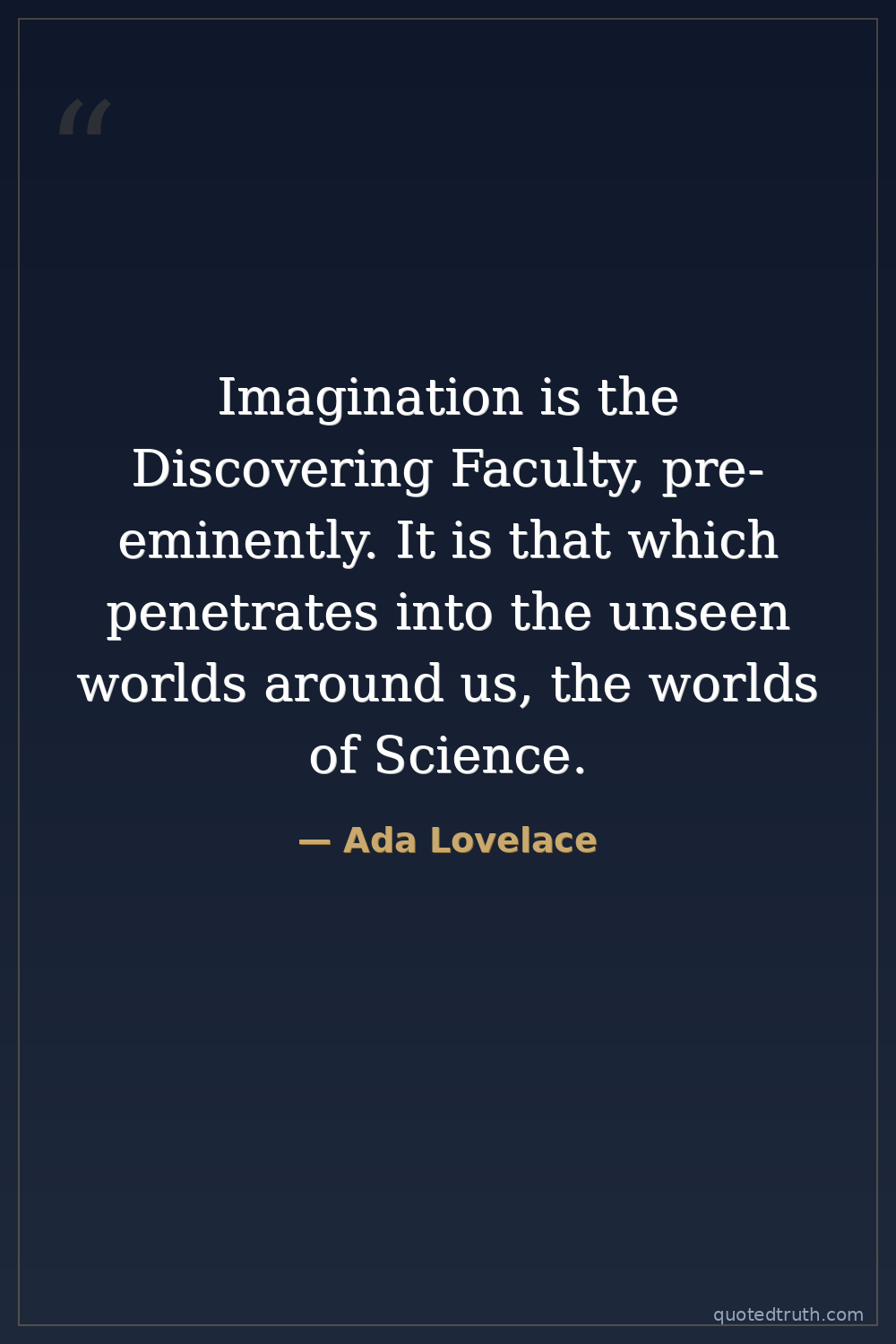
Ada Lovelace — "Imagination is the Discovering Faculty, pre-eminently. It is that which penetrat…"
Imagination is the Discovering Faculty, pre-eminently. It is that which penetrates into the unseen worlds around us, the worlds of Science.
Imagination is the Discovering Faculty, pre-eminently. It is that which penetrates into the unseen worlds around us, the worlds of Science.
Click any product to generate a realistic preview. Up to 3 at a time.
* Initial load can take up to 90 seconds — revising the preview in another color is nearly instant.
"I am a very singular person."
"I am a great believer in the power of an enthusiastic imagination."
"I consider myself a high priestess of science."
"I am convinced that the brain is capable of far more than we imagine."
"I am never so知其不可为而为之 happy as when I am really engaged in some good hard thinking."
Found in 1 providers: grok
1 source checked
Imagination is not mere fantasy but the core cognitive tool that enables discovery. It allows the mind to move beyond what is directly observable into hidden realms of possibility — the structures, laws, and patterns underlying reality. Without imagination, science becomes rote observation; with it, science becomes the act of revealing truths that exist but have never yet been seen or proven.
Lovelace embodied this conviction. Working with Charles Babbage's Analytical Engine in the 1840s, she imagined uses for the machine that its own inventor had not conceived — including that it could compose music or manipulate symbols beyond numbers. Her famous notes on the Engine reveal a mind that leapt from mechanical gears to abstract possibility, grounding her as the first to envision general-purpose computing.
The 1840s were the dawn of industrial mechanization, when many assumed machines were purely physical tools for physical labor. Romanticism was receding but its reverence for imagination persisted in intellectual circles. Scientific societies largely excluded women, yet natural philosophy was exploding with discovery. In that climate, asserting that imagination — not brute empiricism alone — drives science was both philosophically bold and quietly subversive.
AI-generated insights based on extensive research and information for context. Factual errors? Email [email protected].
Your cart is empty