Erwin Schrodinger — "In fact, I should say that the world is a picture drawn by ourselves, and that w…"
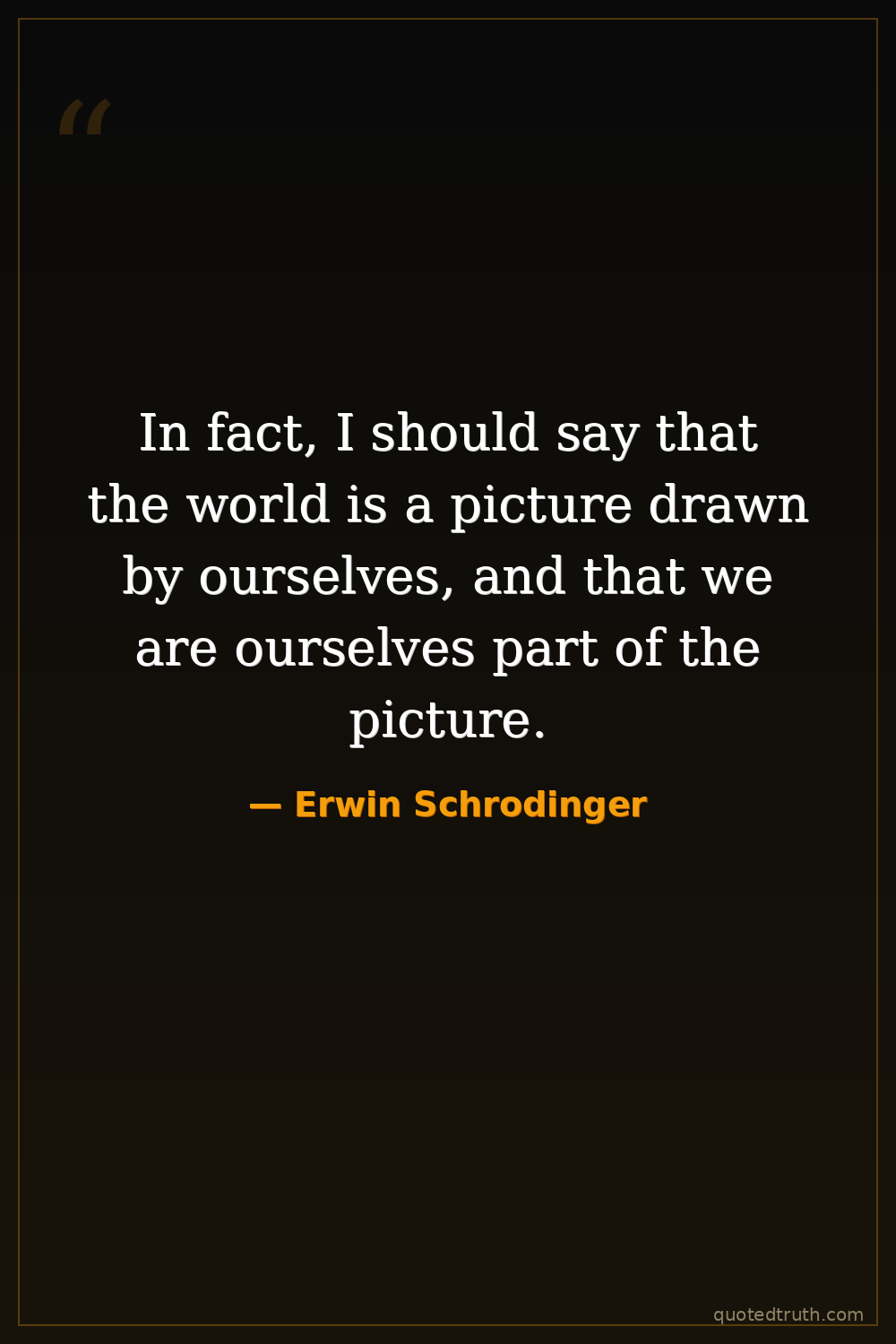
In fact, I should say that the world is a picture drawn by ourselves, and that we are ourselves part of the picture.
In fact, I should say that the world is a picture drawn by ourselves, and that we are ourselves part of the picture.
Click any product to generate a realistic preview. Up to 3 at a time.
* Initial load can take up to 90 seconds — revising the preview in another color is nearly instant.
"The world is a mystery, and we are here to unravel it."
"The world is not made of atoms, it is made of stories."
"Quantum physics thus reveals a basic oneness of the universe."
"The total number of minds in the universe is one. In fact, consciousness is a singularity."
"A theoretical science, like any other human activity, is entirely a matter of taste."
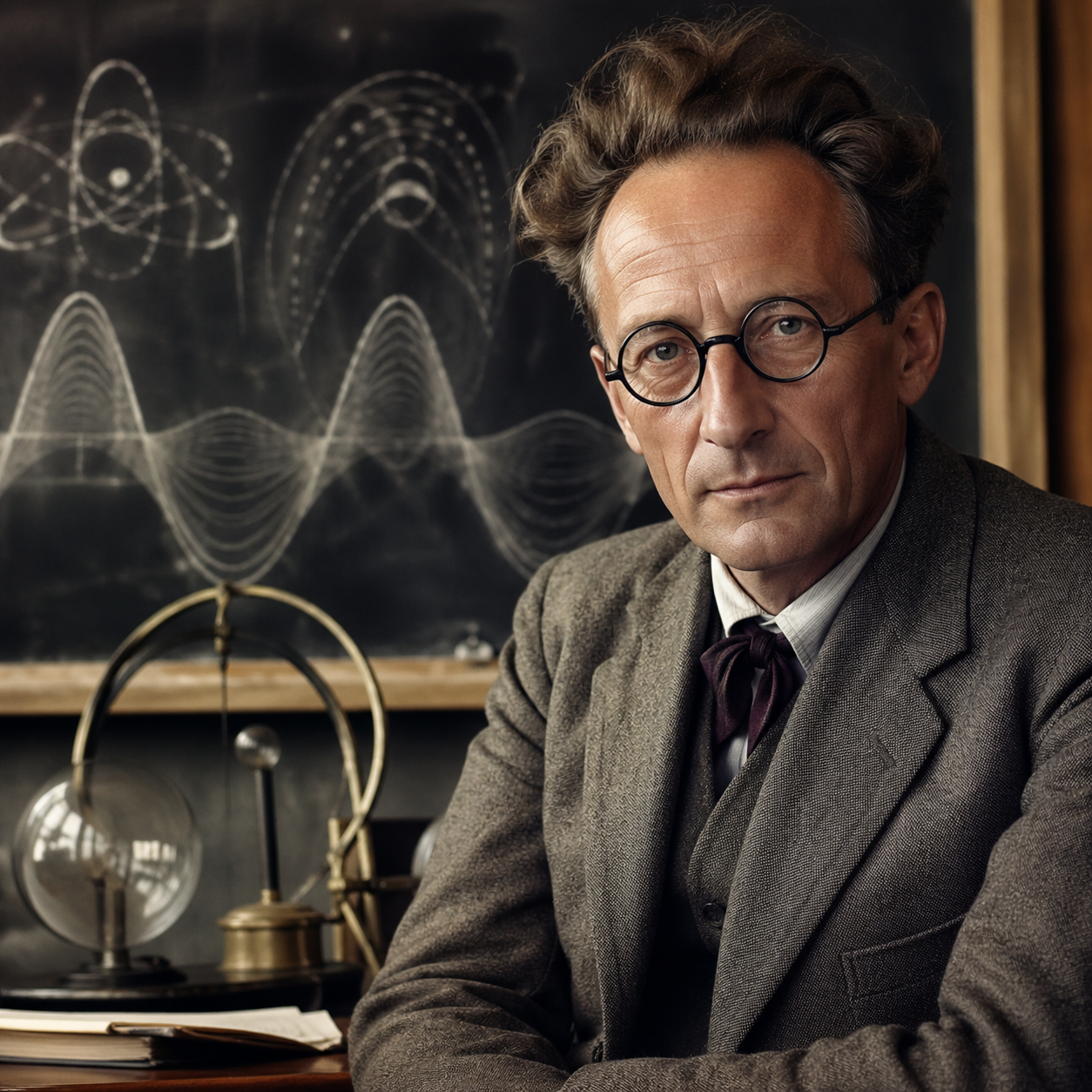
Austrian physicist who shared the 1933 Nobel for the wave equation that bears his name and the famous cat thought-experiment. Closely associated with Werner Heisenberg (matrix-mechanics rival who reached the same physics by different math) and Albert Einstein (his pen-pal on quantum interpretation). For an intellectual contrast, see Niels Bohr, Danish physicist and architect of the Copenhagen interpretation — Schrödinger's cat thought-experiment was specifically designed to ridicule Bohr's 'observer-dependent reality' reading of quantum mechanics — Schrödinger thought the Copenhagen interpretation was absurd; the cat was meant as reductio ad absurdum.
Found in 1 providers: grok
1 source checked
Reality isn't something we passively observe — we actively construct it through perception, thought, and measurement. We don't stand outside the world looking in; we are embedded in the very picture we create. The observer and the observed are fundamentally inseparable. Our consciousness doesn't merely record an independent external world; it participates in shaping what that world actually is.
Schrödinger's 1926 wave equation described particles as probability waves that collapse upon measurement, making the observer integral to physical reality. His famous cat paradox forced physicists to confront how observation determines quantum states. He explored consciousness and reality extensively in 'Mind and Matter.' This quote mirrors his lifelong conviction: the physicist cannot be cleanly separated from the physics being studied.
The 1920s–1950s saw quantum mechanics overturn classical physics, sparking fierce debate about the observer's role. The Copenhagen interpretation placed measurement — and implicitly consciousness — at the heart of physical reality. Einstein resisted, insisting the world existed independently of observation. Schrödinger lived through this revolution, and his paradoxes forced physicists to seriously confront whether reality is fundamentally observer-dependent rather than objectively fixed.
AI-generated insights based on extensive research and information for context. Factual errors? Email [email protected].
Your cart is empty