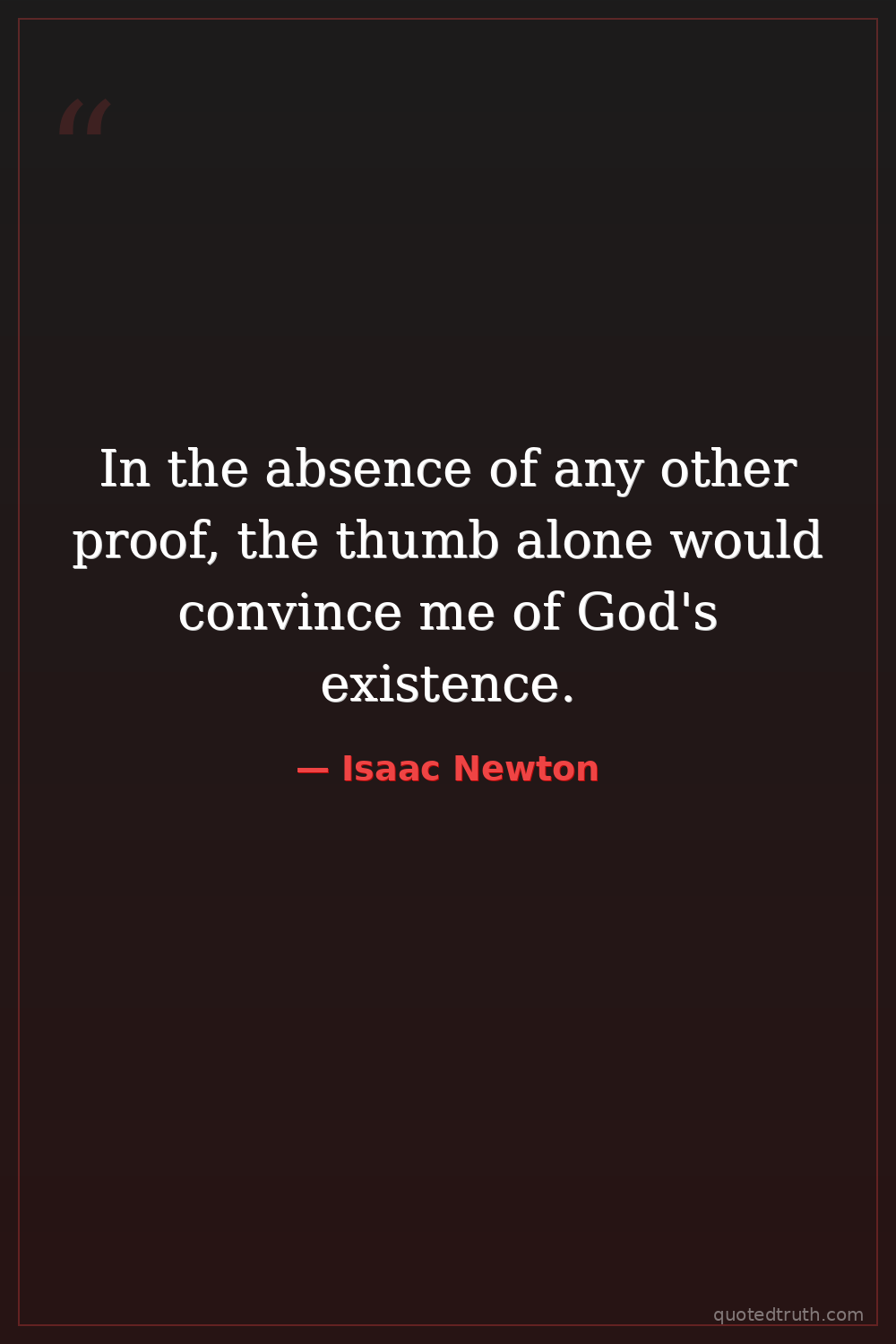
Isaac Newton — "In the absence of any other proof, the thumb alone would convince me of God's ex…"
In the absence of any other proof, the thumb alone would convince me of God's existence.
In the absence of any other proof, the thumb alone would convince me of God's existence.
Click any product to generate a realistic preview. Up to 3 at a time.
* Initial load can take up to 90 seconds — revising the preview in another color is nearly instant.
"It seems probable to me, that God in the beginning formed matter in solid, massy, hard, impenetrable, moveable particles..."
"God created everything by number, weight and measure."
"The great ocean of truth lay all undiscovered before me."
"For the conservation of motion, it is necessary that the body should be moved in a vacuum."
"The parts of all homogeneal hard bodies which fully touch one another, stick together with a very strong attraction."
Found in 1 providers: deepseek
1 source checked
The quote argues that even a single piece of evidence from nature — here, the human thumb — is sufficient proof of divine creation. The thumb's extraordinary complexity, precision, and versatility implies intentional design rather than random chance. Nature needs no elaborate theological argument; its intricate engineering speaks for itself. One small, closely examined thing reveals craftsmanship so improbably perfect it demands a creator behind it.
Newton wrote more theological manuscripts than scientific ones, spending decades analyzing biblical prophecy and viewing nature as God's second scripture. His Principia explicitly framed gravity as evidence of divine order. He rejected a purely mechanistic universe, insisting God actively sustains creation. An ardent if heterodox Christian who studied alchemy partly as spiritual inquiry, Newton saw science not as opposing faith but as its most rigorous confirmation.
Newton lived during the Scientific Revolution, when natural philosophers feared mechanistic explanations of the cosmos implied godlessness. Natural theology — proving God through observable nature — became a powerful intellectual response. Boyle, Ray, and later Paley built entire frameworks around design arguments. The Royal Society's founders, mostly devout Anglicans, believed scientific inquiry glorified the Creator. Atheism remained socially dangerous and legally prosecutable throughout Newton's lifetime.
AI-generated insights based on extensive research and information for context. Factual errors? Email [email protected].
Your cart is empty