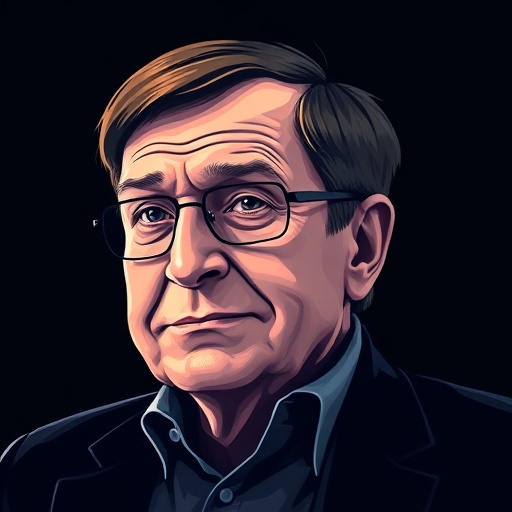
Stephen Hawking — "Intelligence is the ability to adapt to change."
Intelligence is the ability to adapt to change.
Intelligence is the ability to adapt to change.
Click any product to generate a realistic preview. Up to 3 at a time.
* Initial load can take up to 90 seconds — revising the preview in another color is nearly instant.
"I think [contacting an alien civilization] would be a disaster. The extraterrestrials would probably be far in advance of us. The history of advanced races meeting more primitive people on this planet…"
"The greatest enemy of knowledge is not ignorance, it is the illusion of knowledge."
"I believe that the simplest explanation is that there is no God who created the universe and directed our fate. This leads me to a profound realization: there is probably no heaven and afterlife eithe…"
"The laws of nature are the same everywhere in the universe."
"The greatest achievement of mankind is to understand the universe."
British theoretical physicist whose Hawking radiation work and A Brief History of Time (1988) brought black-hole physics to a mass audience while he lived with ALS for 55 years. Closely associated with Roger Penrose (his collaborator on singularity theorems) and Carl Sagan (fellow popularizer who wrote Brief History's foreword). For an intellectual contrast, see William Lane Craig, American philosopher of religion — Craig's Kalam cosmological argument depends on the Big Bang requiring a divine first cause; Hawking's no-boundary proposal was specifically designed to remove the moment that would require one — the cleanest cosmology-vs-natural-theology contrast in modern thought.
Found in 2 providers: grok,deepseek
2 sources checked
Intelligence isn't raw knowledge or a high test score — it's flexibility. Truly smart people adjust their thinking, strategies, and behavior when circumstances change. In a world that never stops shifting, the most capable minds aren't those with the most facts memorized, but those who can pivot, absorb new information, and remain effective under novel conditions. Adaptability, not static brilliance, is the core of real intelligence.
Hawking was diagnosed with ALS at 21 and told he had two years to live. Instead of surrendering, he adapted continuously — learning to communicate through a speech synthesizer, directing research entirely through thought and dictation, producing landmark work on black holes while fully paralyzed. His life was lived proof of this quote: intellectual power survived total physical transformation because he never stopped reconfiguring how he functioned.
Hawking's career spanned 1960–2018, an era of relentless change: the Cold War space race reshaped physics funding, computing transformed how science was done, and the internet rewired human knowledge. Late-20th-century physics itself demanded adaptation — quantum mechanics and general relativity refused to merge, forcing constant revision of assumptions. His era rewarded those who evolved with new tools and frameworks, making adaptability not just personally relevant but professionally essential.
AI-generated insights based on extensive research and information for context. Factual errors? Email [email protected].
Your cart is empty