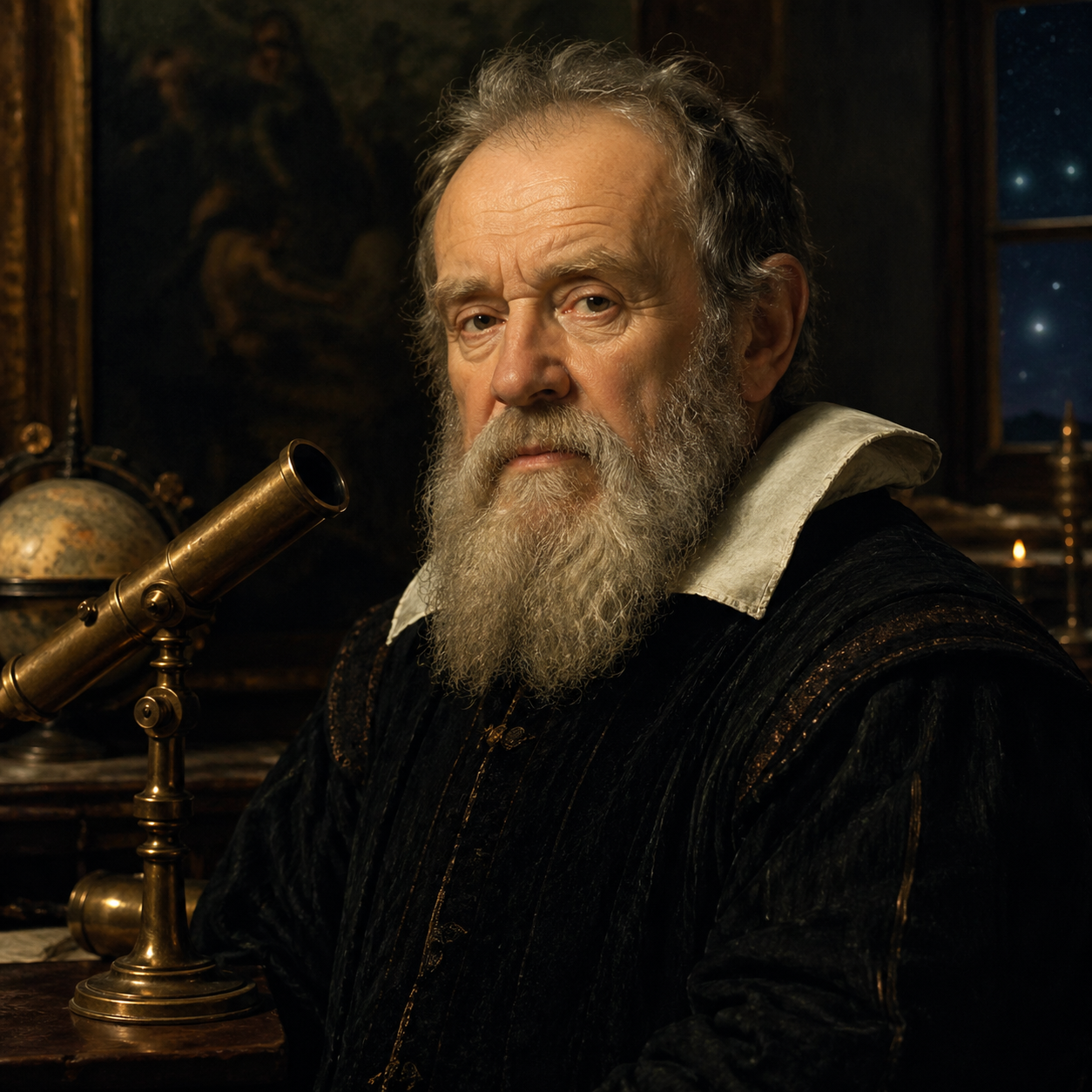
Galileo Galilei — "It is a beautiful thing to know that the heavens are not immutable."
It is a beautiful thing to know that the heavens are not immutable.
It is a beautiful thing to know that the heavens are not immutable.
Click any product to generate a realistic preview. Up to 3 at a time.
* Initial load can take up to 90 seconds — revising the preview in another color is nearly instant.
"I do not believe that the same God who has given us senses, reason and intellect would have us abandon their use."
"To command the sun and moon, God must have given them motion."
"It is surely harmful to souls to make it a heresy to believe what has been proved."
"The Bible shows the way to go to heaven, not the way the heavens go."
"The greater the number of people who believe a proposition, the more likely it is to be false."
Found in 1 providers: grok
1 source checked
Change and impermanence in the cosmos is not a flaw but a wonder. The universe is dynamic, evolving, and subject to transformation — and recognizing this is intellectually liberating. Rather than mourning instability, we should marvel at it. A living, changing sky tells us the universe operates by discoverable laws, not divine decree frozen in place forever.
Galileo's telescopic observations directly challenged the Aristotelian doctrine of celestial perfection — he discovered sunspots, lunar mountains, and Jupiter's moons, proving the heavens were neither perfect nor unchanging. This statement captures his career-defining conviction: empirical evidence trumps inherited dogma. His willingness to say so publicly brought him into fatal conflict with the Catholic Inquisition.
In the early modern period, Aristotelian cosmology — endorsed by the Church — held that celestial spheres were eternal, perfect, and immutable. Any change above the Moon's orbit was theologically and philosophically threatening. Galileo's era was witnessing the Scientific Revolution crack open that worldview, with Copernicus, Tycho Brahe, and Kepler each chipping away at geocentric permanence before Galileo delivered empirical proof.
AI-generated insights based on extensive research and information for context. Factual errors? Email [email protected].
Your cart is empty