Edward Jenner — "It is a fortunate circumstance, that the Cow Pox is not infectious; for if it we…"
It is a fortunate circumstance, that the Cow Pox is not infectious; for if it were, it would be a source of great alarm.
It is a fortunate circumstance, that the Cow Pox is not infectious; for if it were, it would be a source of great alarm.
Click any product to generate a realistic preview. Up to 3 at a time.
* Initial load can take up to 90 seconds — revising the preview in another color is nearly instant.
"The opposition I have met with has only served to confirm me in my opinion."
"The deviation of man from the state in which he was originally placed by nature seems to have proved to him a prolific source of diseases."
"I have often thought that if mankind were more generally enlightened, they would be more virtuous."
"I have always endeavoured to act upon the principle, that what is right to be done, should be done with all our might."
"Altho' I should be happy to shield it myself from the speckled Monster, yet I would advise you not long to risk my coming to Town. I will just add that I consider the Vaccine Lancet in the hand of [Dr…"
Found in 1 providers: grok
1 source checked
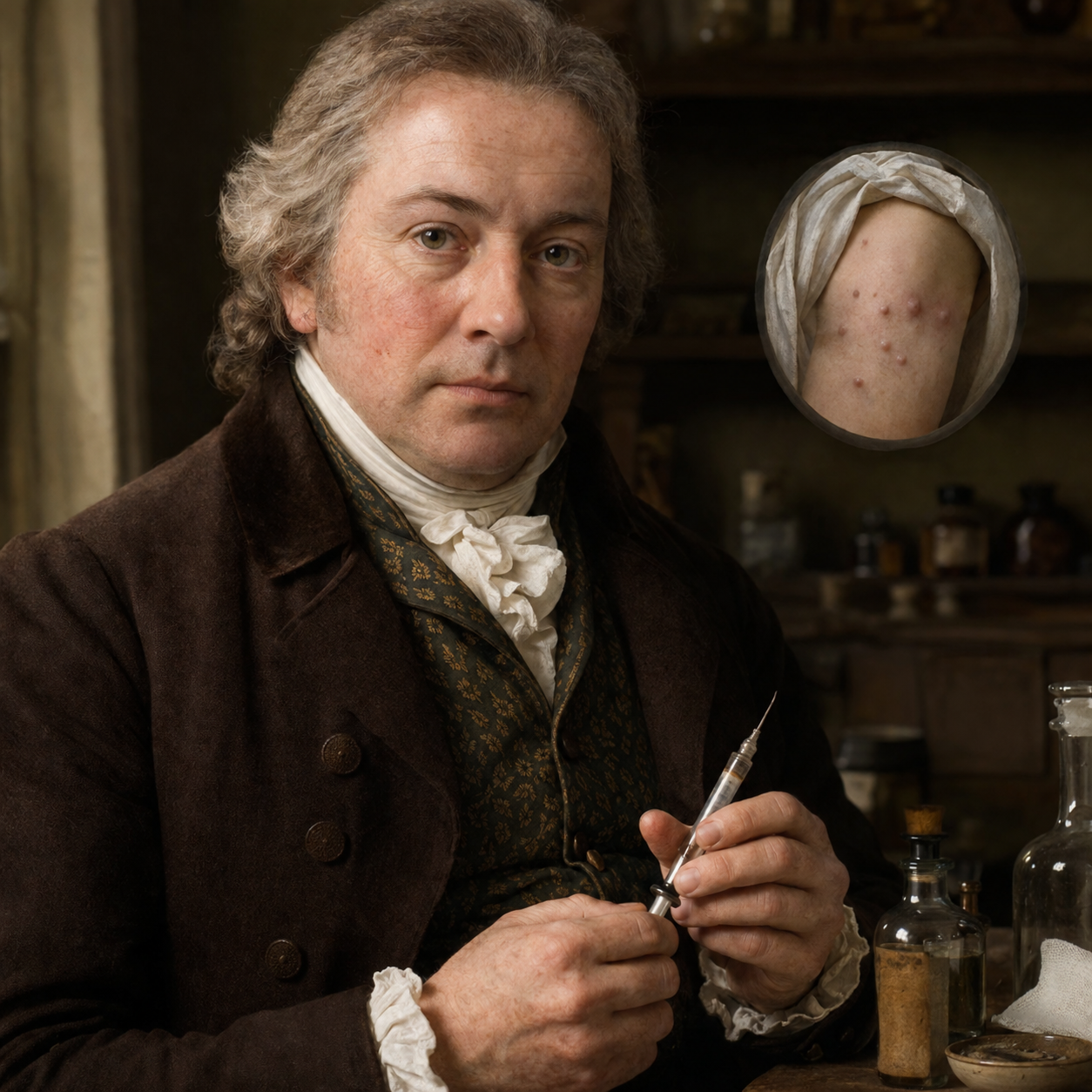
Jenner is expressing relief that cowpox — the substance he used to create his smallpox vaccine — does not spread person-to-person. If it were contagious, vaccinating one person could inadvertently infect others, turning a protective tool into a new epidemic. The quote reassures the public that his vaccine is safe to use broadly: it confers immunity without creating a chain of transmission that would cause widespread alarm and undermine trust in the procedure.
Jenner spent years observing Gloucestershire dairy workers who caught cowpox and seemed immune to smallpox — the bedrock of his vaccine theory. He was acutely conscious that public fear could kill his work before it saved lives. His 1796 experiment on eight-year-old James Phipps depended entirely on demonstrating safety. Non-transmissibility was one of his strongest arguments against critics who feared vaccination would introduce a new plague rather than end smallpox.
In the late 18th century, smallpox killed 400,000 Europeans annually and blinded or scarred millions more. The era's only preventive — variolation using live smallpox material — was itself contagious and deadly in roughly 1–2% of cases. Public terror of disease transmission was visceral. Jenner's 1796 vaccination faced furious opposition from physicians, clergy, and satirists. Proving cowpox could not spread person-to-person was essential: it distinguished vaccination from variolation and made mass immunization morally and practically defensible.
AI-generated insights based on extensive research and information for context. Factual errors? Email [email protected].
Your cart is empty