Alexander Fleming — "It is a happy accident that the mold grew on my plate, but it was not an acciden…"
It is a happy accident that the mold grew on my plate, but it was not an accident that I recognized it.
It is a happy accident that the mold grew on my plate, but it was not an accident that I recognized it.
Click any product to generate a realistic preview. Up to 3 at a time.
* Initial load can take up to 90 seconds — revising the preview in another color is nearly instant.
"I have been asked by many people how I came to discover penicillin. The answer is that I did not discover it. I just happened to notice it."
"I hope that my work will inspire others to pursue scientific discovery."
"A good many people think that I deserve some credit for the discovery of penicillin. They are wrong. It was discovered by nature."
"I did not invent penicillin. Nature did that. I only discovered it by accident."
"I had no idea that I had stumbled on to a subject that would prove to be of such immense importance."
Found in 1 providers: grok
1 source checked
Fleming distinguishes between luck and skill in scientific discovery. Chance placed the mold on his petri dish, but only a trained, observant mind could see what it meant. Lucky breaks happen to many people, yet most miss them entirely. Recognition requires preparation, expertise, and the willingness to pause on something unexpected rather than discard it. Discovery belongs to those ready to understand what accident reveals.
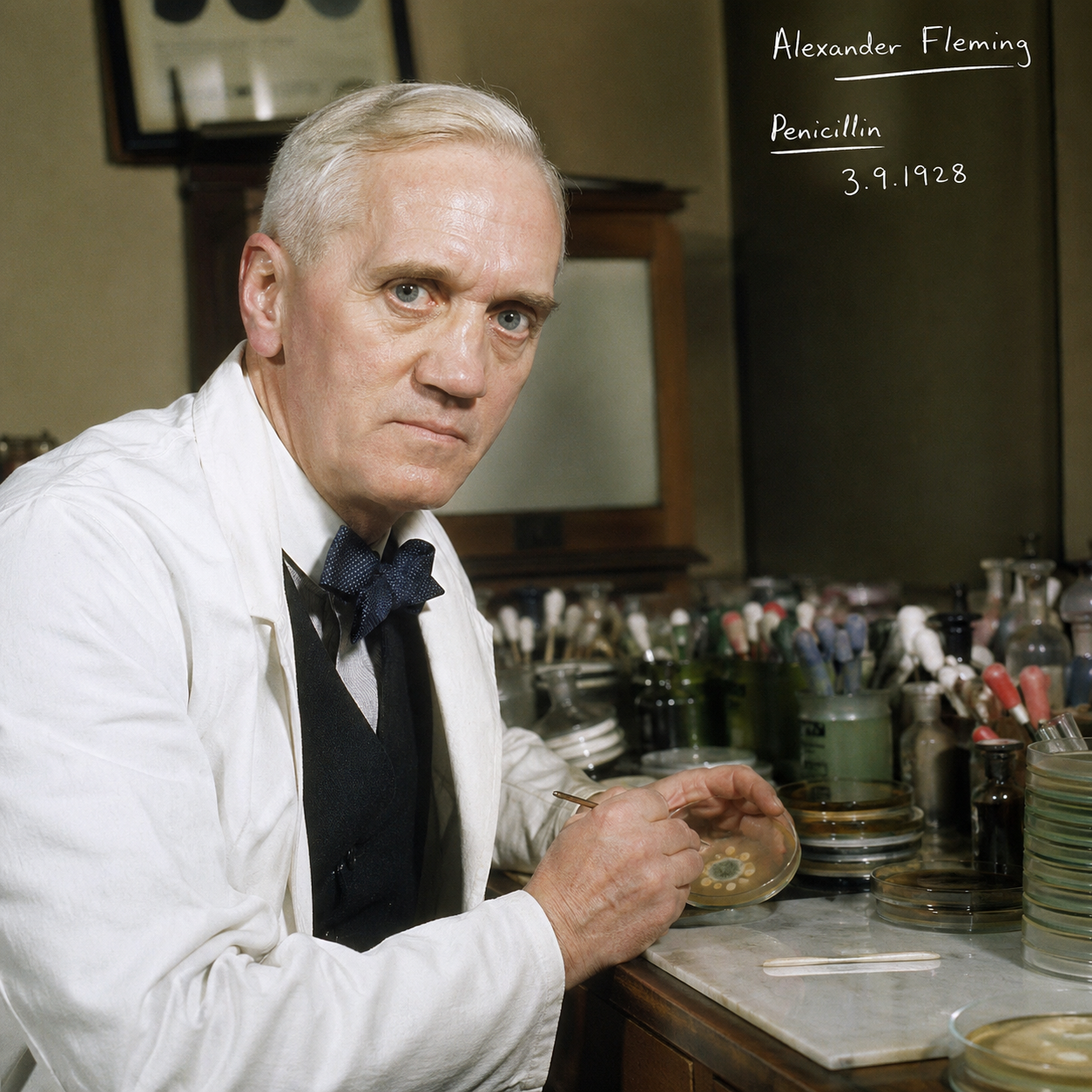
Fleming worked as a bacteriologist at St. Mary's Hospital in London, where in 1928 he noticed mold contaminating a Staphylococcus culture had killed surrounding bacteria. A less curious researcher would have tossed the spoiled plate. His World War I experience treating infected wounds had primed him to seek antibacterial agents, making him uniquely prepared to grasp Penicillium notatum's significance, work that earned him the 1945 Nobel Prize.
The interwar period faced staggering mortality from bacterial infections—pneumonia, sepsis, and wound infections killed routinely, with no effective treatment. Fleming's WWI service exposed him to soldiers dying from infected injuries that antiseptics could not save. The 1918 flu pandemic deepened urgency around microbial threats. His 1928 observation, later developed by Florey and Chain in the 1940s, launched the antibiotic era and transformed twentieth-century medicine, surgery, and life expectancy worldwide.
AI-generated insights based on extensive research and information for context. Factual errors? Email [email protected].
Your cart is empty