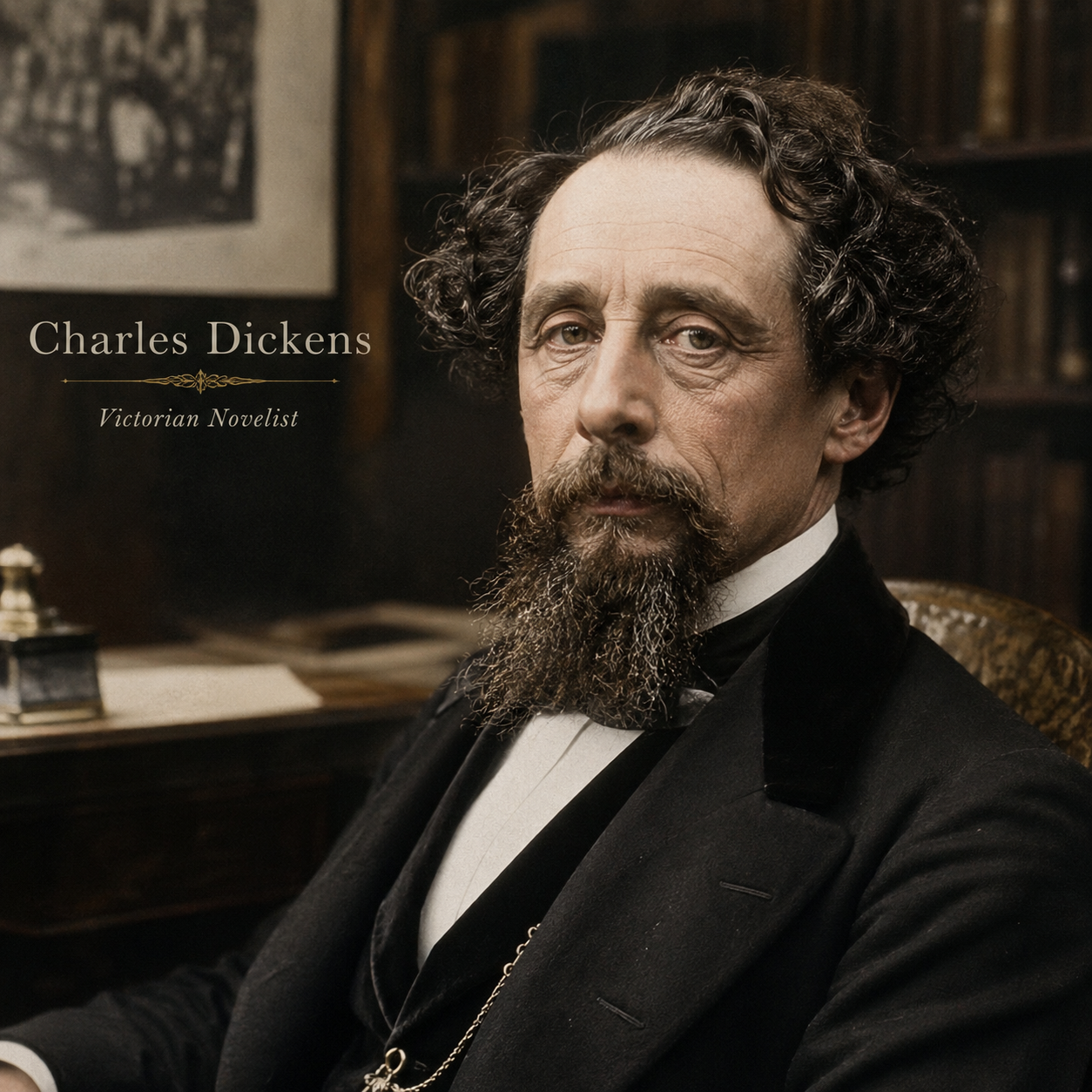
Charles Dickens — "It is a most extraordinary thing that I have never been able to get a moment's p…"
It is a most extraordinary thing that I have never been able to get a moment's peace in my life, without having to pay for it.
It is a most extraordinary thing that I have never been able to get a moment's peace in my life, without having to pay for it.
Click any product to generate a realistic preview. Up to 3 at a time.
* Initial load can take up to 90 seconds — revising the preview in another color is nearly instant.
"I am not a believer in the perfectibility of human nature."
"Have a heart that never hardens, and a temper that never tires, and a touch that never hurts."
"It is a most extraordinary, and at the same time a most natural, thing, that a man should be able to look back upon his life and see it as a whole."
"It is a very remarkable thing, that the very people who are most anxious to get into society are the very people who are least fitted for it."
"It was one of those March days when the sun shines hot and the wind blows cold: when it is summer in the light, and winter in the shade."
English novelist whose Oliver Twist (1838), A Christmas Carol (1843), and Bleak House (1852) made Victorian poverty inescapable for the British middle class. Closely associated with William Makepeace Thackeray (Vanity Fair rival and contemporary serial novelist) and George Eliot (later Victorian giant who built on Dickens's social-realism foundation). For an intellectual contrast, see Jeremy Bentham, founder of utilitarianism (1748-1832) — Mr. Gradgrind in Hard Times (1854) is a direct caricature of Bentham-style social calculation — 'Facts, sir, nothing but Facts!' is the most-cited literary attack on utilitarianism's reduction of human life to measurable units. Dickens's serialized social-novel form is itself a rebuke of utilitarian abstraction.
Your cart is empty