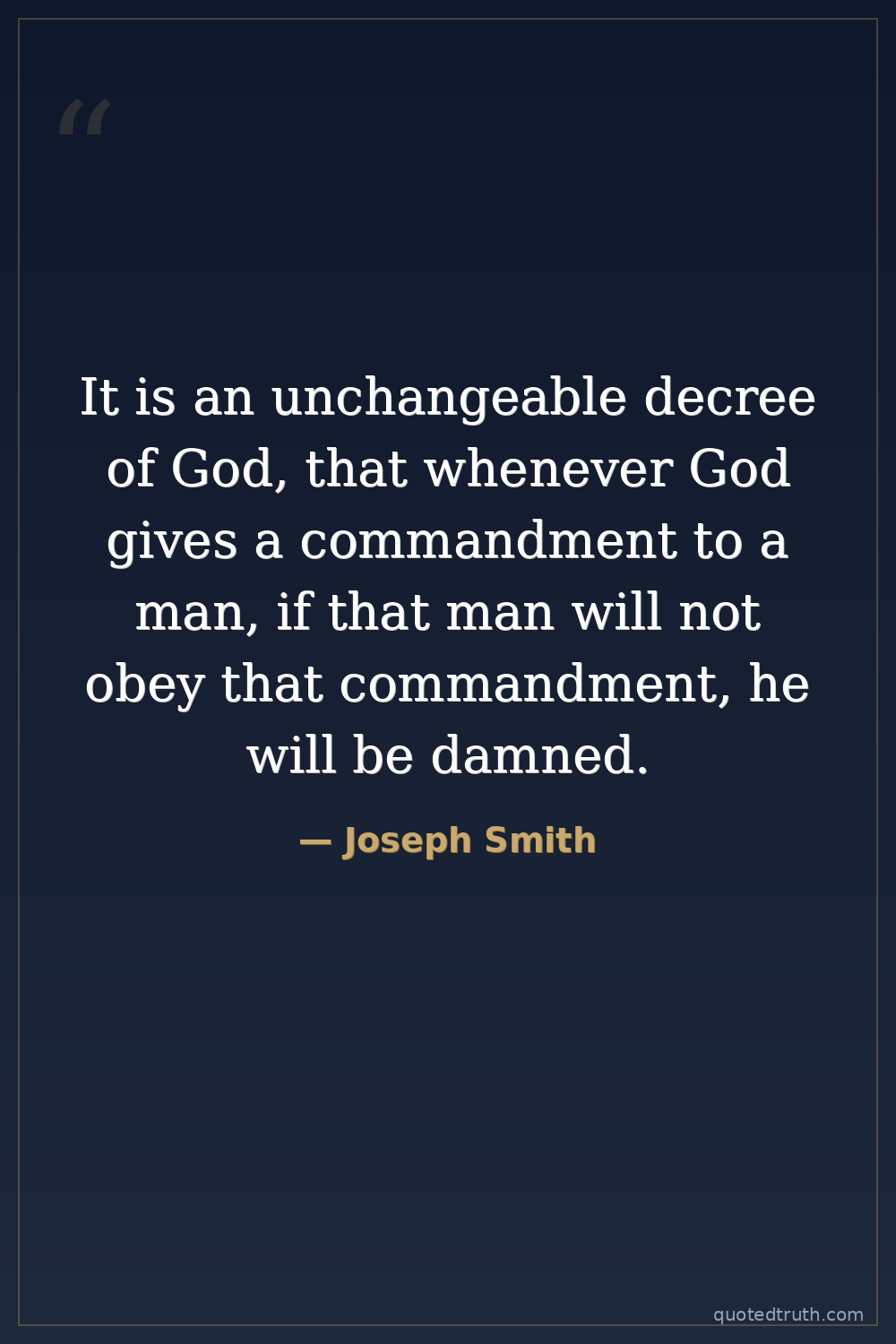
Joseph Smith — "It is an unchangeable decree of God, that whenever God gives a commandment to a …"
It is an unchangeable decree of God, that whenever God gives a commandment to a man, if that man will not obey that commandment, he will be damned.
It is an unchangeable decree of God, that whenever God gives a commandment to a man, if that man will not obey that commandment, he will be damned.
Click any product to generate a realistic preview. Up to 3 at a time.
* Initial load can take up to 90 seconds — revising the preview in another color is nearly instant.
"I told them I was a Prophet of God, and had a right to obtain revelations, and that I should not be trammelled by men."
"If I am to be a martyr, I am willing to be one."
"I am a man of temperance, and I will be temperate in all things."
"I will not be bought, nor sold, nor flattered, nor threatened."
"I am a friend to the poor, and I have always been so."
Found in 1 providers: gemini
1 source checked
Divine commandments carry absolute, non-negotiable consequences. Disobedience to God's direct commands results in damnation — not as arbitrary punishment but as an immutable moral law woven into the universe's structure. Spiritual law is fixed and objective, comparable to physical law. Obedience isn't optional or gradable; it is the sole condition for salvation. The word 'unchangeable' is key — no appeal, no exception, no mercy clause overrides the decree.
Joseph Smith (1805–1844) built his entire prophetic identity on claiming direct revelation from God, including restoration of lost commandments and priesthood authority. This quote reflects his foundational teaching that God speaks to living prophets and that those revelations carry binding weight. His theology demanded obedience to commandments he himself delivered, making this statement simultaneously doctrinal and a reinforcement of his own prophetic authority over the early LDS community.
The Second Great Awakening swept early 19th-century America, producing competing revivalist movements, new denominations, and fierce theological debate about salvation, grace, and works. Smith emerged in this chaotic religious landscape of western New York's 'Burned-over District,' where multiple sects claimed truth. His absolute framing of divine commandment as cosmic law offered certainty and clarity against Protestant disagreements over predestination and free will during Jacksonian America's era of democratic individualism.
AI-generated insights based on extensive research and information for context. Factual errors? Email [email protected].
Your cart is empty