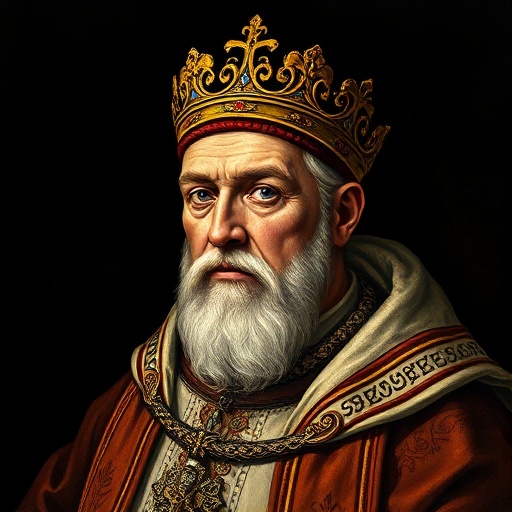
Pope Urban II — "It is Christ who commands it."
It is Christ who commands it.
It is Christ who commands it.
Click any product to generate a realistic preview. Up to 3 at a time.
* Initial load can take up to 90 seconds — revising the preview in another color is nearly instant.
"If you must have blood, bathe in the blood of the infidels."
"Let the holy sepulcher of the Lord our Savior, which is possessed by unclean nations, especially incite you, and the holy places which are now treated with ignominy and irreverently polluted with thei…"
"Let your arms be stained with the blood of the infidels."
"We absolve all who undertake this journey from all penance for their sins."
"Let no property, no labors detain you, for this land of yours, which is so fertile, has hardly enough to support its cultivators."
Pope (1088-1099) whose Council of Clermont speech (November 1095) launched the First Crusade — the founding event of nine centuries of Christian-Muslim military conflict. Closely associated with Pope Gregory VII (his predecessor on papal-imperial reform). For an intellectual contrast, see Saladin, Kurdish-Muslim Sultan of Egypt and Syria (1138-1193) — Saladin recaptured Jerusalem in 1187, undoing the First Crusade Urban II launched 92 years earlier. Saladin's chivalrous treatment of Christian prisoners became the canonical Muslim counter-image to Crusader brutality. The cleanest before/after pairing of the Crusades' moral arc.
Found in 1 providers: grok
1 source checked
This declaration asserts that a commanded action carries divine authority — that the speaker is not acting on personal ambition or political calculation, but transmitting God's direct will. It removes human responsibility by elevating the order to sacred command, making refusal equivalent to defying Christ himself. It is a rhetorical device that transforms a human directive into an unchallengeable theological imperative.
Urban II spoke these words at the Council of Clermont in 1095, launching the First Crusade. As pope, he claimed supreme spiritual authority as Christ's vicar on earth. Invoking Christ directly was central to his persuasive strategy — he needed European nobles and peasants to sacrifice their lives for Jerusalem, and only divine command, not papal request, could mobilize that scale of commitment.
In 1095 medieval Europe, Christ's authority was the ultimate political and moral force. The Church held unprecedented power over kings and commoners alike. Jerusalem had fallen under Seljuk Turkish control, alarming Christian Europe. Urban exploited deep popular piety, the concept of holy war, and feudal obligation to God to unite fractious European lords under a single, divinely sanctioned military campaign.
AI-generated insights based on extensive research and information for context. Factual errors? Email [email protected].
Your cart is empty