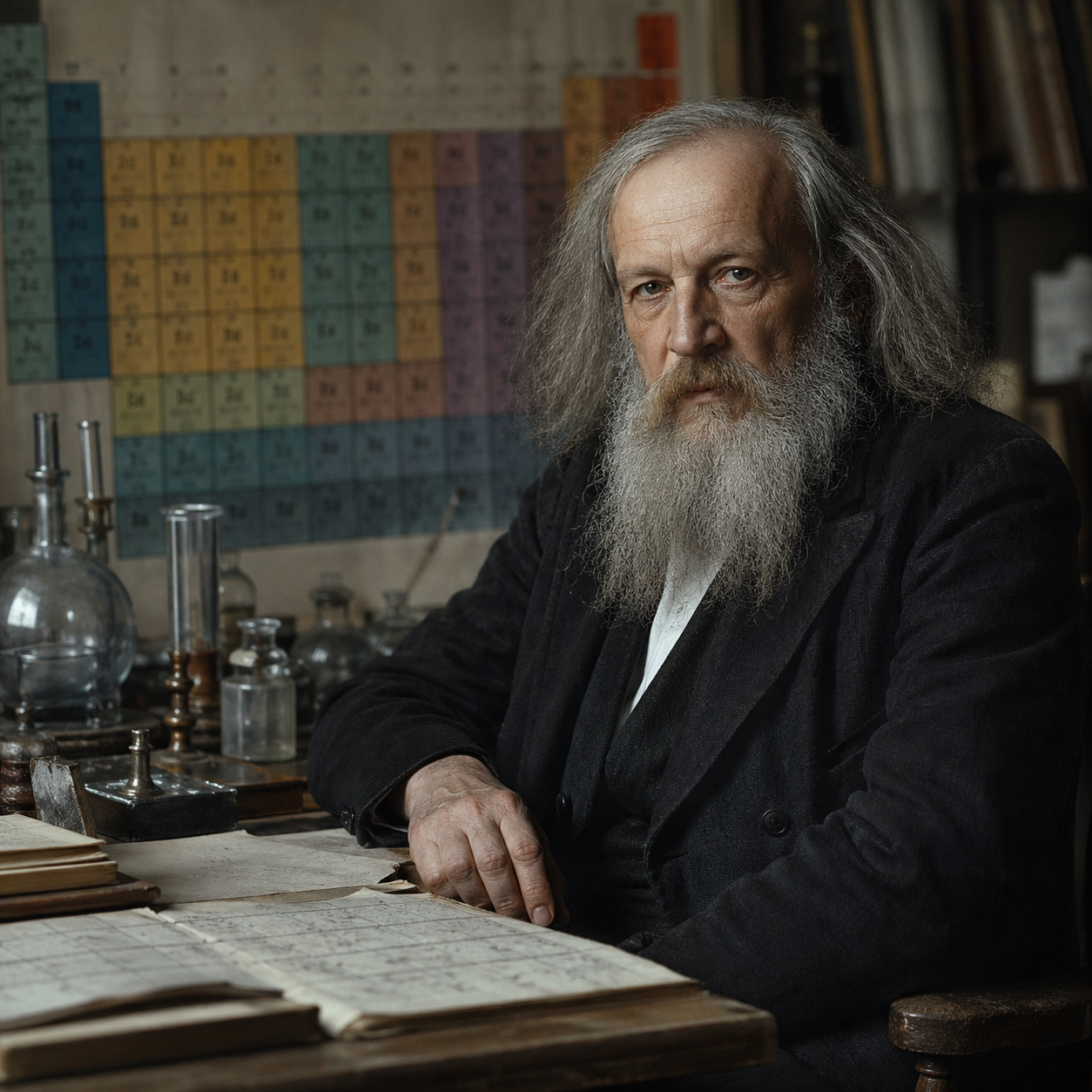
Dmitri Mendeleev — "It is easier to make a scientific discovery than to explain it to the common man…"
It is easier to make a scientific discovery than to explain it to the common man.
It is easier to make a scientific discovery than to explain it to the common man.
Click any product to generate a realistic preview. Up to 3 at a time.
* Initial load can take up to 90 seconds — revising the preview in another color is nearly instant.
"Without knowledge, without work, there is no hope for humanity."
"The edifice of science not only requires material, but also a plan. Without the material, the plan alone is but a castle in the air—a mere possibility; whilst the material without a plan is but useles…"
"It is the function of science to discover the existence of a general reign of order in nature and to find the causes governing this order. And this refers in equal measure to the relations of man - so…"
"he reproached the modern scientific thought because it “got entangled in ions and electrons”."
"Science begins where measurement begins."
Found in 1 providers: grok
1 source checked
Finding something new in nature can actually be the simpler part of science. Translating that finding into language an ordinary person grasps, without losing accuracy or oversimplifying, is a much harder task. Discovery rewards patient experimentation and insight, but communication demands empathy, clarity, and the ability to bridge expert knowledge with everyday understanding. Many breakthroughs stay locked inside specialist circles because no one manages that second, harder step.
Mendeleev wrestled with this firsthand. After arranging the elements into his periodic table in 1869, he spent decades defending and explaining the system, predicting unknown elements like gallium and germanium to convince skeptics. He also wrote textbooks, lectured widely, and advised the Russian government on agriculture, oil, and tariffs, repeatedly translating dense chemistry for students, bureaucrats, and farmers who lacked his training but needed his conclusions to act.
Late nineteenth-century Russia was rapidly industrializing while most citizens remained illiterate peasants. Science was exploding across Europe with thermodynamics, evolution, and atomic theory, yet universities served a tiny elite. Public lectures, popular journals, and world's fairs were emerging as bridges to mass audiences. Mendeleev lived this tension, working in St. Petersburg laboratories while the Tsarist state pressed scientists to modernize an empire whose common citizens had little formal schooling and deep suspicion of new ideas.
AI-generated insights based on extensive research and information for context. Factual errors? Email [email protected].
Your cart is empty