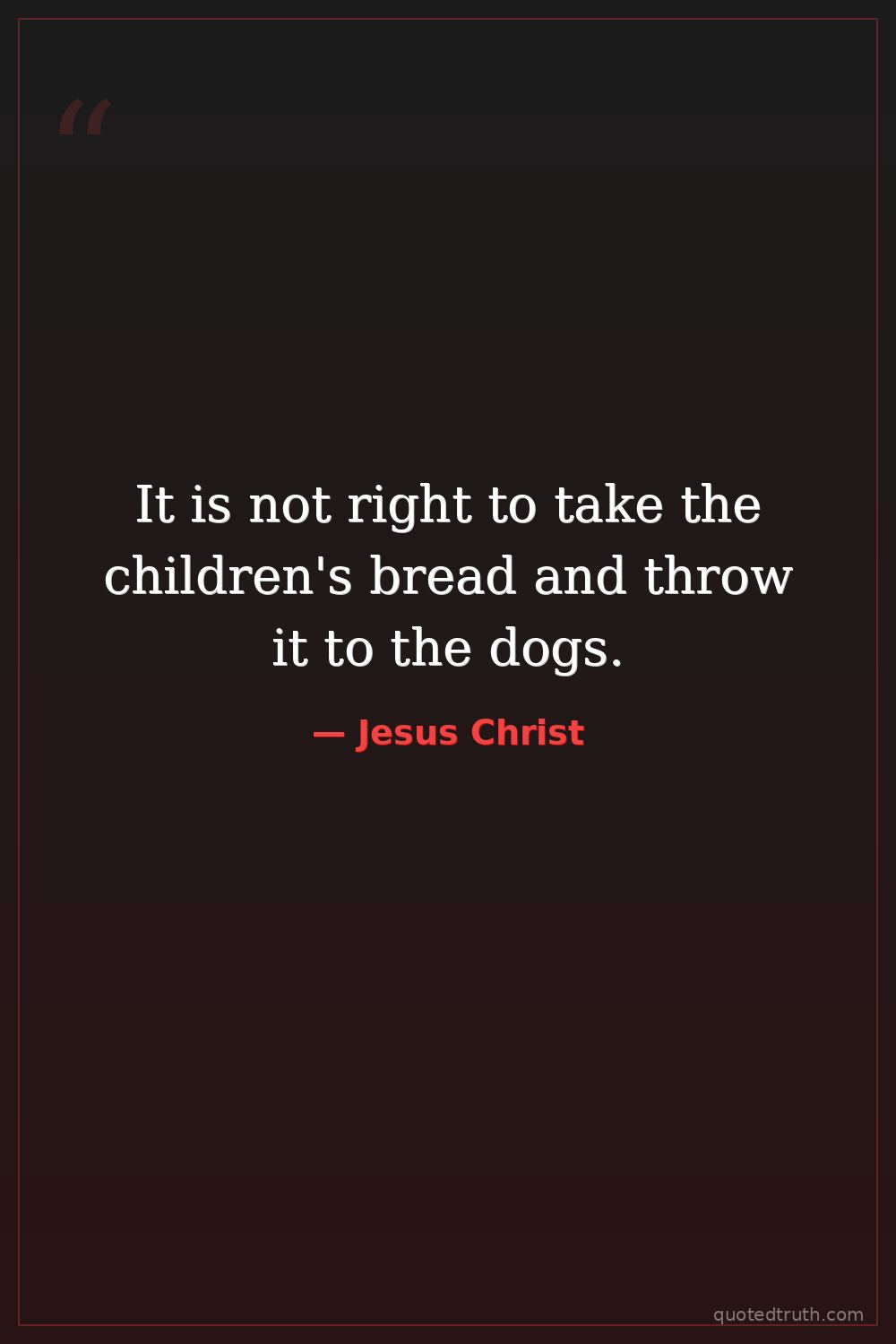
Jesus Christ — "It is not right to take the children's bread and throw it to the dogs."
It is not right to take the children's bread and throw it to the dogs.
It is not right to take the children's bread and throw it to the dogs.
Click any product to generate a realistic preview. Up to 3 at a time.
* Initial load can take up to 90 seconds — revising the preview in another color is nearly instant.
"You serpents, you brood of vipers, how are you to escape the condemnation of hell?"
"It is easier for a camel to go through the eye of a needle than for someone who is rich to enter the kingdom of God."
"There is a place of 'weeping and gnashing of teeth'."
"For where your treasure is, there your heart will be also."
"And these will go away into eternal punishment, but the righteous into eternal life."
Matthew 15:26, said to a Canaanite woman requesting healing for her daughter.
Date: c. 30-33 CE
GeneralFound in 1 providers: gemini
1 source checked
Resources and care meant for a specific group should not be diverted to outsiders before that group's needs are met. Spoken to a non-Jewish woman asking for healing, the line signals that priority belongs to the household first. Modern readers can hear it as a hard boundary: limited bandwidth goes to your own people before strangers, though the story ends with Jesus granting her request anyway.
Jesus framed his early mission as directed to Israel, and this exchange with the Syrophoenician woman tests that framing. His willingness to relent after her sharp reply ('even the dogs eat the crumbs') fits his pattern of rewarding bold faith and expanding mercy beyond ethnic lines, foreshadowing the Gentile mission that defined Christianity after his death.
First-century Judea lived under Roman occupation with sharp boundaries between Jews and surrounding Gentile peoples like the Phoenicians. 'Dogs' was common Jewish shorthand for Gentiles, and table scraps imagery reflected real household hierarchy. Religious teachers were expected to keep ritual and ethnic lines clean, so a rabbi healing a pagan woman's daughter crossed a recognized social barrier of the time.
AI-generated insights based on extensive research and information for context. Factual errors? Email [email protected].
Your cart is empty