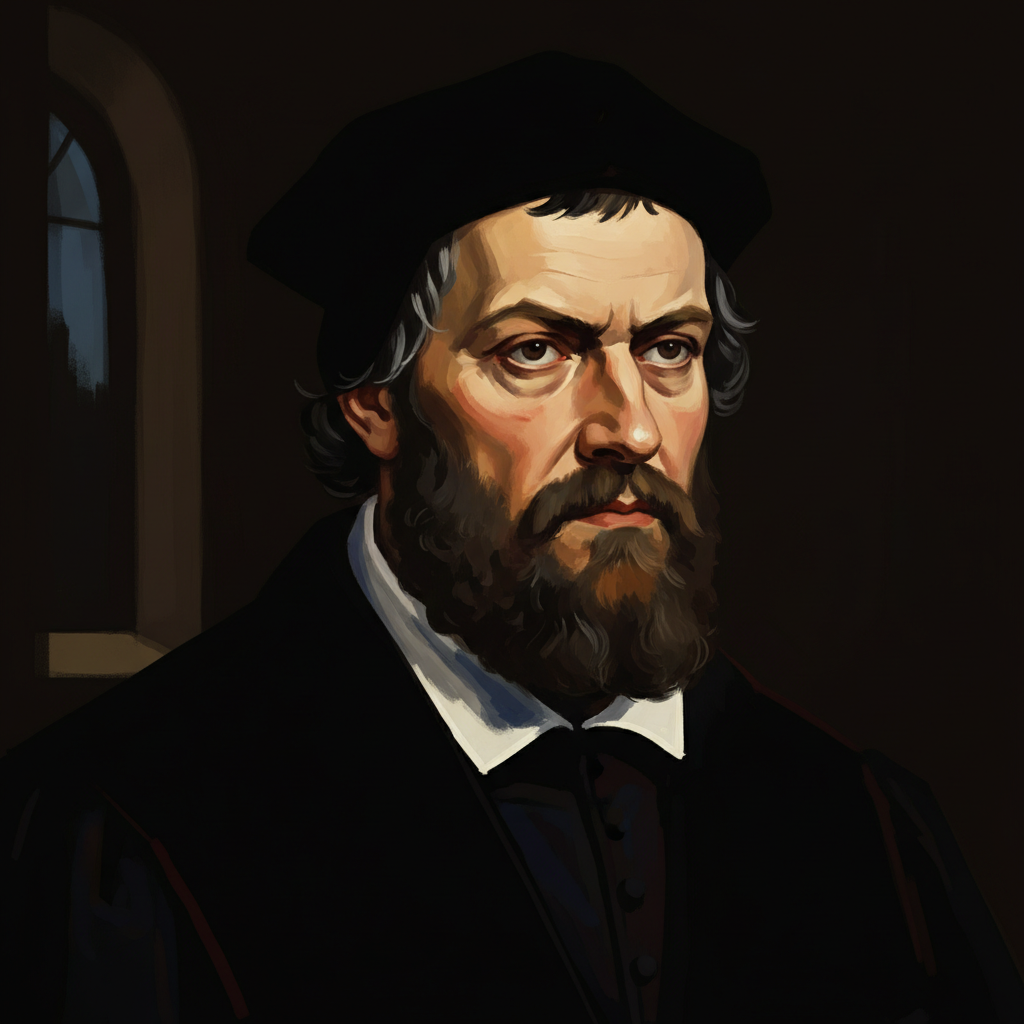
Martin Luther — "It is not the business of the government to preach the gospel."
It is not the business of the government to preach the gospel.
It is not the business of the government to preach the gospel.
Click any product to generate a realistic preview. Up to 3 at a time.
* Initial load can take up to 90 seconds — revising the preview in another color is nearly instant.
"A man who has no wife is only half a man."
"Sleep is a most excellent thing, for it makes us forget all the miseries of life."
"You are not only responsible for what you say, but also for what you do not say."
"If I could understand how a good Christian could be a usurer, I would eat him."
"I am afraid that the schools will prove the very gates of hell, unless they diligently labor in explaining the Holy Scriptures and engraving them in the heart of the youth."
German theologian whose 95 Theses (1517) launched the Protestant Reformation and broke the Catholic Church's monopoly on Western Christianity. Closely associated with Philipp Melanchthon (Lutheran systematizer) and John Calvin (later Reformer who built on Luther's break). For an intellectual contrast, see Pope Leo X, Renaissance pope (1513-1521) — Leo X's indulgence sales triggered Luther's break and Leo excommunicated him in 1521 — Luther's entire Reformation is structured as a direct answer to the indulgence-funded Vatican Leo represented.
Found in 1 providers: grok
1 source checked
Government and religious preaching should stay separate. Civil authorities handle law, order, and public welfare, while spreading religious teaching belongs to the church and its ministers. Rulers have no mandate to dictate spiritual matters or force citizens into faith through state power. Salvation is a matter of conscience that cannot be legislated or enforced by political decree. The state's tools—law, taxation, punishment—are wrong instruments for shaping belief.
Luther developed his 'two kingdoms' doctrine distinguishing spiritual authority from temporal rule, a cornerstone of his theology. Though he relied on German princes for protection after his 1521 excommunication, he insisted faith could not be coerced. An ordained Augustinian friar and theology professor at Wittenberg, Luther spent his life defending that salvation comes through personal faith in scripture, not institutional power—whether papal or princely—preaching the gospel himself rather than delegating it to rulers.
In early modern Europe, church and state were deeply fused—rulers enforced religious conformity, and the Holy Roman Emperor defended papal authority. Luther's 1517 Ninety-Five Theses shattered that unity, triggering the Reformation and bloody religious wars. Princes were choosing sides, seizing monasteries, and dictating their subjects' faith under the later principle cuius regio, eius religio. Luther's insistence on separating governmental duty from gospel preaching was radical, challenging a thousand years of Christendom's assumption that political and spiritual power belonged together.
AI-generated insights based on extensive research and information for context. Factual errors? Email [email protected].
Your cart is empty