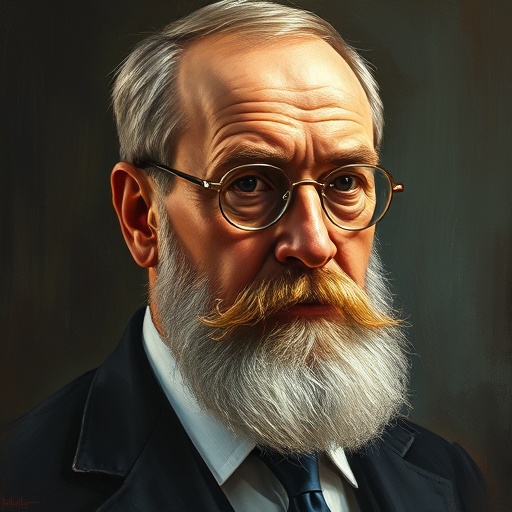
Robert Koch — "It is not the individual that is the target of disease, but the species."
It is not the individual that is the target of disease, but the species.
It is not the individual that is the target of disease, but the species.
Click any product to generate a realistic preview. Up to 3 at a time.
* Initial load can take up to 90 seconds — revising the preview in another color is nearly instant.
"It is a great privilege to be able to contribute to the advancement of science."
"My experiments on anthrax were some of the most challenging of my career."
"The fight against disease is a never-ending battle, but we must never give up."
"The search for remedies against infectious diseases requires tireless effort."
"My work on tuberculosis was the most significant of my life."
Found in 1 providers: grok
1 source checked
Diseases don't target individuals by choice — they spread through populations and threaten entire communities. The real unit of disease is the species, not the person. This reframes illness as a public health problem rather than just a personal medical one. Fighting disease requires understanding transmission, reservoirs, and how pathogens exploit human populations at scale — an inherently epidemiological view that shifts medicine from bedside care to collective prevention.
Koch identified the specific bacteria behind tuberculosis (1882), cholera, and anthrax, proving pathogens spread between people rather than arising spontaneously. His fieldwork during cholera outbreaks in Egypt and India forced him to think in populations, not patients. His germ theory made epidemic control scientifically possible precisely because one microbe could travel person to person across continents — validating his belief that disease operates at the species level.
Koch worked in the late 19th century when tuberculosis killed roughly one in seven Europeans — called 'the white plague.' Repeated cholera pandemics swept continents. Rapid industrialization packed workers into dense, unsanitary urban conditions, turning infectious disease into mass casualty events. Germ theory was actively defeating miasma theory, and governments were building the first modern public health systems — sanitation boards, quarantines, vaccination campaigns — recognizing disease as a civilizational threat, not personal misfortune.
AI-generated insights based on extensive research and information for context. Factual errors? Email [email protected].
Your cart is empty