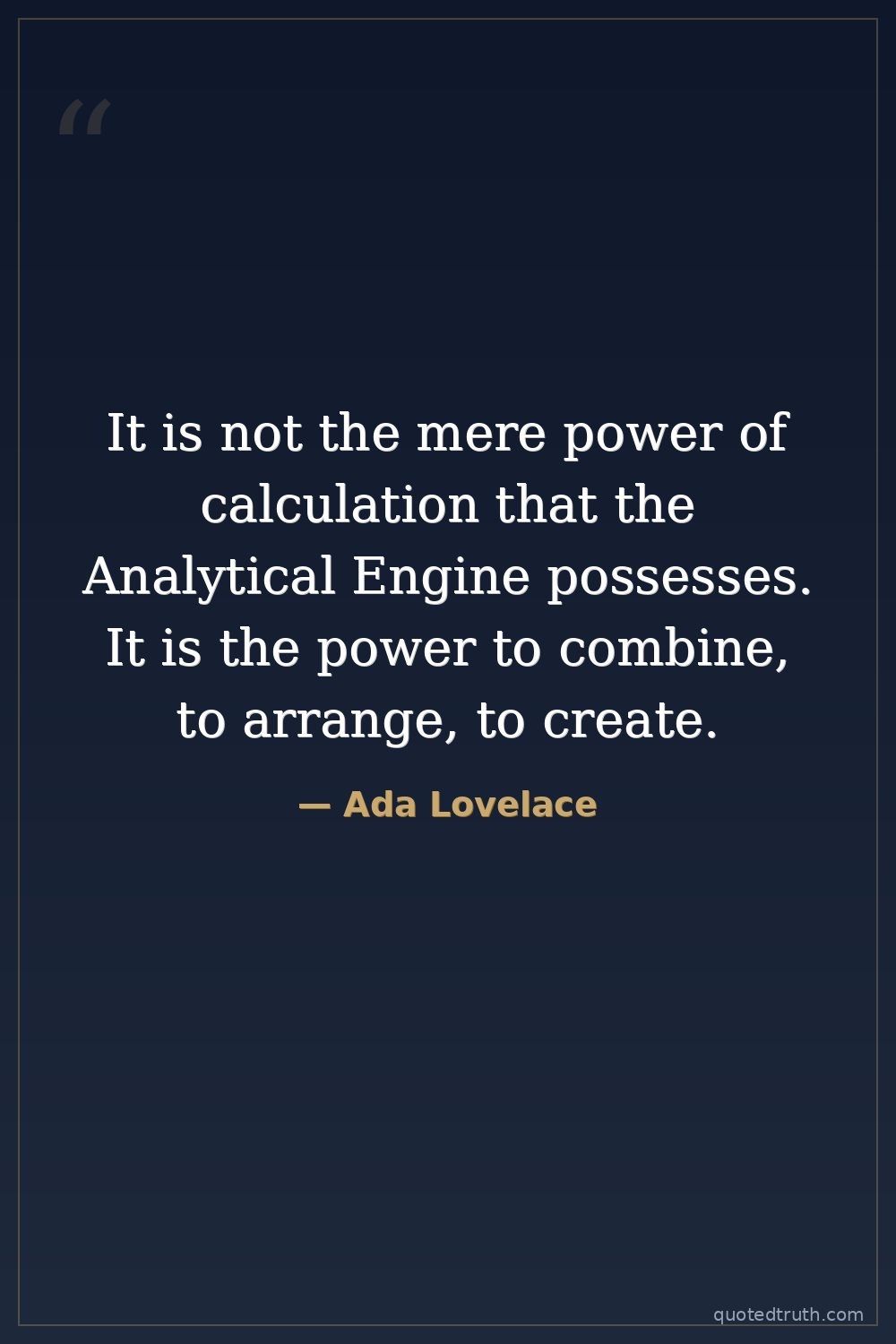
Ada Lovelace — "It is not the mere power of calculation that the Analytical Engine possesses. It…"
It is not the mere power of calculation that the Analytical Engine possesses. It is the power to combine, to arrange, to create.
It is not the mere power of calculation that the Analytical Engine possesses. It is the power to combine, to arrange, to create.
Click any product to generate a realistic preview. Up to 3 at a time.
* Initial load can take up to 90 seconds — revising the preview in another color is nearly instant.
"I am a mathematician and a metaphysician."
"Imagination is the Discovering Faculty, pre-eminently. It is that which penetrates into the unseen worlds around us, the worlds of Science."
"The future belongs to those who can master the art of computation."
"The Analytical Engine is destined to play a crucial role in the advancement of human knowledge."
"I have a peculiar turn of mind, which I believe is useful for scientific pursuits."
Notes to 'Sketch of the Analytical Engine Invented by Charles Babbage Esq.'
Date: 1843
Art & CreativityFound in 1 providers: grok
1 source checked
True computing power isn't just arithmetic speed—it's the ability to take pieces of information and combine them into something new. This quote distinguishes a simple calculator from a genuinely creative machine. The Analytical Engine, Lovelace argues, can arrange symbols, construct patterns, and produce outputs never explicitly programmed. In today's terms: this is the gap between a pocket calculator and a general-purpose computer capable of generating music, language, or strategy.
Lovelace published her Notes on the Analytical Engine in 1843, including the first published algorithm. Unlike Babbage, who focused on arithmetic capability, she envisioned the machine composing music and manipulating symbols beyond numbers. Trained under Mary Somerville and tutored by Augustus De Morgan, she believed creative imagination and scientific rigor were inseparable. This quote encapsulates her singular vision: that machines could be tools of creation, not merely calculation.
Lovelace worked in the 1840s at the height of Britain's Industrial Revolution. Machines were understood as labor-saving mechanical devices—looms, steam engines, printing presses. Most contemporaries, including mathematicians, viewed Babbage's engine as a faster arithmetic table. The concept of a general-purpose symbolic processor was unimaginable. Her insight that the engine could operate on any symbol, not just numbers, anticipated Alan Turing's 1936 formalization of universal computation by nearly a century.
AI-generated insights based on extensive research and information for context. Factual errors? Email [email protected].
Your cart is empty