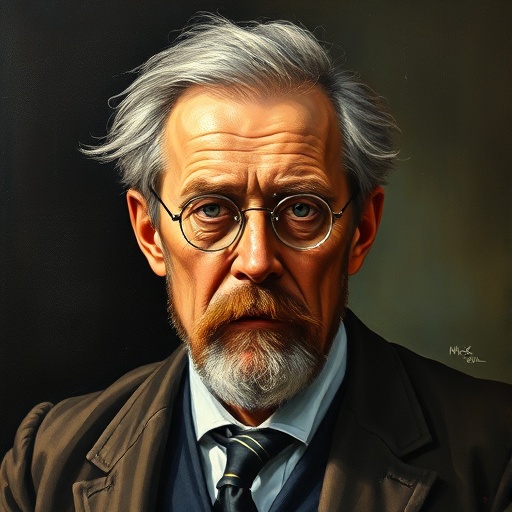
Max Planck — "It is not the truth that matters, but the search for it."
It is not the truth that matters, but the search for it.
It is not the truth that matters, but the search for it.
Click any product to generate a realistic preview. Up to 3 at a time.
* Initial load can take up to 90 seconds — revising the preview in another color is nearly instant.
"Science and religion are not antagonistic; they are complementary."
"The quantum theory is a theory of the greatest simplicity and beauty."
"The creative scientist has to be a man of faith. He must have faith in his results, and in the laws of nature."
"Experiment is the only means of knowledge at our disposal. Everything else is poetry, imagination."
"The scientist's greatest reward is the joy of discovery."
Found in 1 providers: grok
1 source checked
This saying argues that the value lies in the act of seeking understanding, not in possessing a final answer. Arriving at a fixed conclusion can close off curiosity, while questioning, testing, and revising keeps the mind alive. What matters is the disciplined pursuit itself, the willingness to investigate, doubt, and refine, because any claimed truth is provisional and the honest work of inquiry is what actually advances knowledge and human understanding.
Planck founded quantum theory in 1900 by questioning classical physics' failure to explain blackbody radiation, a result he reached only through years of dogged calculation. He famously noted that new truths triumph as older scientists die off, showing his respect for relentless inquiry over settled doctrine. A devout Lutheran yet rigorous physicist, he saw science as an endless approach toward reality, never a finished possession, mirroring this very sentiment.
Planck worked from the 1890s through the 1940s, an era when classical Newtonian certainty collapsed under relativity and quantum mechanics. Scientists witnessed atoms split, spacetime bend, and determinism falter. Germany endured two world wars, Nazi rule, and the loss of Planck's son to Hitler's regime. In this turbulence, fixed truths, political and scientific, proved fragile, making the humble, ongoing search itself the only reliable foundation for knowledge and moral clarity.
AI-generated insights based on extensive research and information for context. Factual errors? Email [email protected].
Your cart is empty