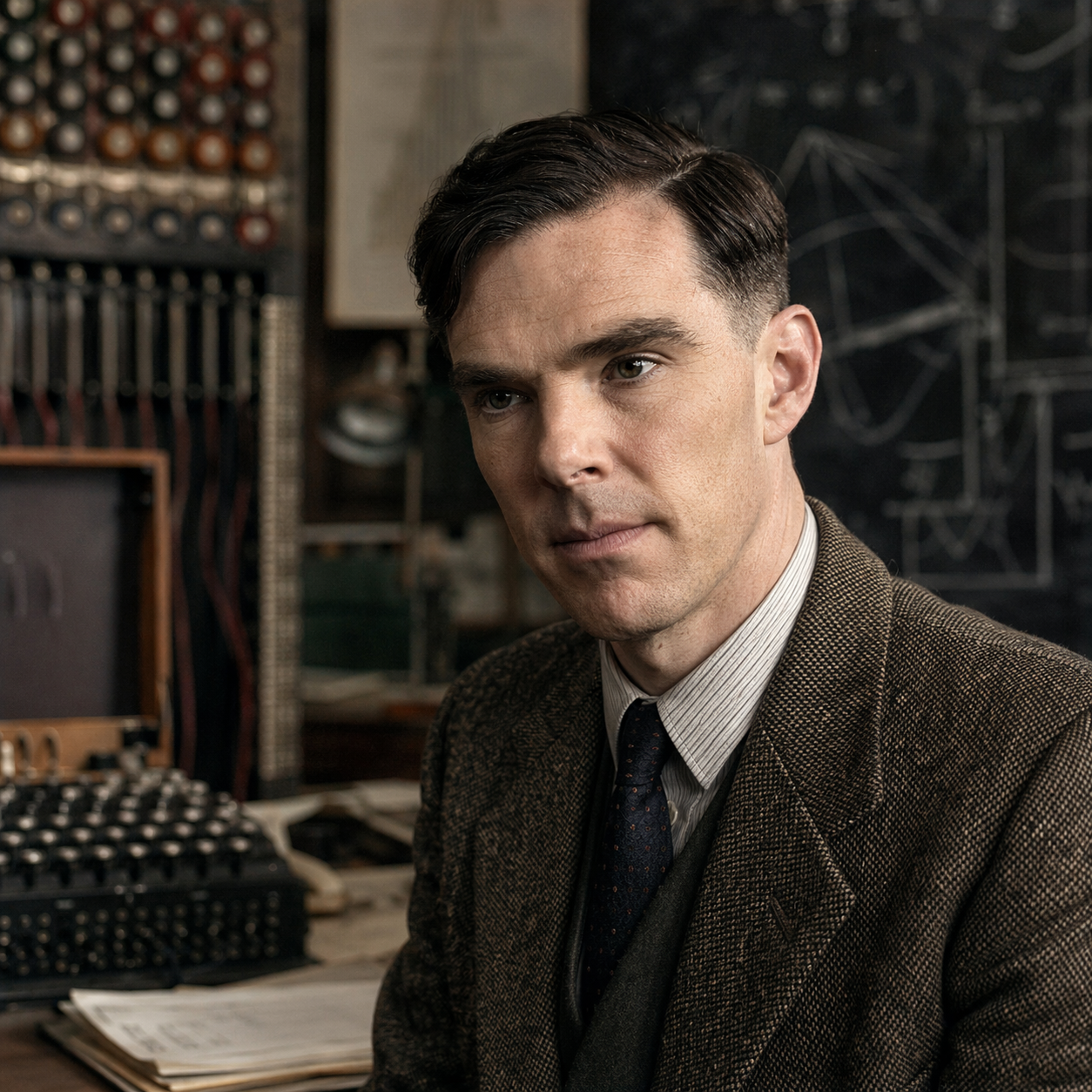
Alan Turing — "It is possible to invent a single machine which can be used to compute any compu…"
It is possible to invent a single machine which can be used to compute any computable sequence.
It is possible to invent a single machine which can be used to compute any computable sequence.
Click any product to generate a realistic preview. Up to 3 at a time.
* Initial load can take up to 90 seconds — revising the preview in another color is nearly instant.
"The human brain is an electrical machine."
"We like to believe that Man is in some subtle way superior to the rest of creation. It is best if he can be shown to be necessarily superior, for then there is no danger of him losing his commanding p…"
"The development of artificial intelligence will have a profound impact on society."
"The original question, 'Can machines think?' I believe to be too meaningless to deserve discussion. Nevertheless I believe that at the end of the century the use of words and general educated opinion …"
"A human being is a machine for converting food into thoughts."
From his paper 'On Computable Numbers, with an Application to the Entscheidungsproblem'.
Date: 1936
PhilosophicalFound in 1 providers: gemini
1 source checked
Any calculation that can be defined by a finite set of rules can be performed by one universal machine — you don't need a separate device for each task. This single insight underpins every general-purpose computer ever built: one machine, infinite problems, all solvable through the right instructions.
Turing published this in his landmark 1936 paper introducing the theoretical 'Turing machine.' A mathematician who broke the Enigma cipher at Bletchley Park, he spent his life proving that intelligence and computation are formalizable. This quote captures his core conviction: thinking itself might be mechanized, a belief that defined his entire career.
In the 1930s, 'computers' were human clerks doing arithmetic by hand. No electronic computers existed. Turing wrote this during a foundational crisis in mathematics triggered by Gödel and Hilbert. His theoretical machine resolved key questions about what is provably computable, arriving just before WWII would demand exactly the mechanical codebreaking he had already imagined.
AI-generated insights based on extensive research and information for context. Factual errors? Email [email protected].
Your cart is empty