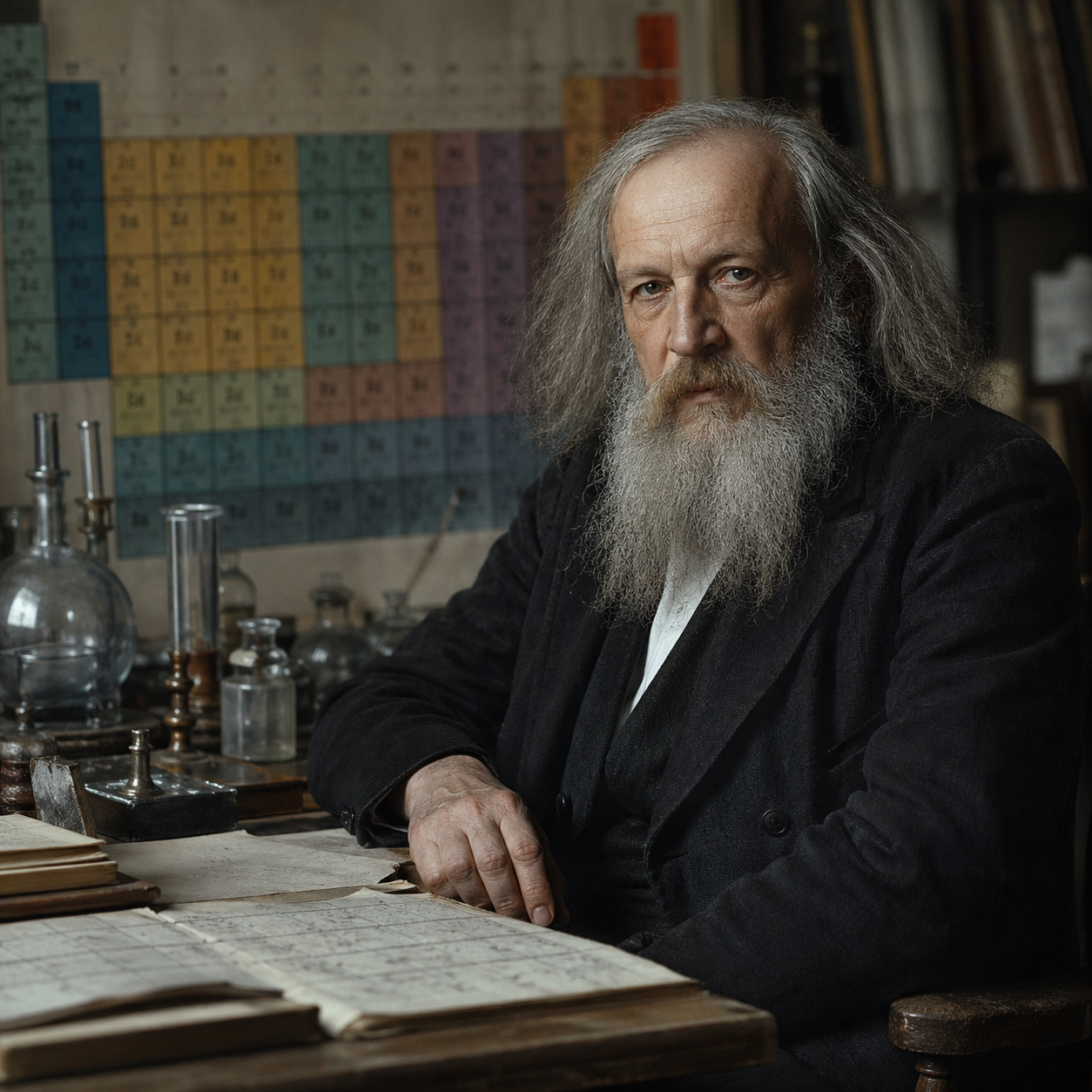
Dmitri Mendeleev — "It is the duty of the chemist to teach the world how to use the elements wisely."
It is the duty of the chemist to teach the world how to use the elements wisely.
It is the duty of the chemist to teach the world how to use the elements wisely.
Click any product to generate a realistic preview. Up to 3 at a time.
* Initial load can take up to 90 seconds — revising the preview in another color is nearly instant.
"I have been called a charlatan, a madman, and a dreamer, but I have always pursued the truth."
"The greatest joy of the scientist is in discovering some new truth, some new regularity, some new law."
"Without order, our science is nothing but a miserable collection of facts."
"A well-made theory is like a good overcoat; Eloquent words are like a beautiful tie."
"I saw in a dream a table where all the elements fell into place as required. Awakening, I immediately wrote it down on a piece of paper."
Found in 1 providers: grok
1 source checked
Chemists carry a responsibility beyond discovery. Understanding what elements are and how they behave is only half the job; the other half is guiding society to apply that knowledge thoughtfully, safely, and for lasting benefit. The statement frames chemistry as a public service, where practitioners must educate industry, government, and citizens so that powerful materials improve lives rather than cause harm through misuse, waste, or ignorance.
Mendeleev built the periodic table in 1869, revealing hidden order among the elements and predicting undiscovered ones like gallium and germanium. He also advised the Russian government on petroleum, agriculture, tariffs, and metrology, treating chemistry as a national tool. This quote mirrors his conviction that a chemist owes society more than laboratory work; he personally toured oil fields, wrote on industry, and pushed practical education to spread elemental knowledge widely.
Mendeleev lived through Russia's industrial awakening in the late 1800s, when coal, steel, petroleum, and synthetic dyes were reshaping economies. Elements once curiosities became engines of factories, weapons, and fertilizers. Governments raced to exploit natural resources with little public understanding of chemistry. His call for wise use landed during this rush, urging scientists to guide responsible development rather than let extraction and manufacturing outpace the knowledge needed to manage them.
AI-generated insights based on extensive research and information for context. Factual errors? Email [email protected].
Your cart is empty