Dmitri Mendeleev — "It is the function of the scientist to do 3 things: to observe, to generalize, a…"
It is the function of the scientist to do 3 things: to observe, to generalize, and to predict.
It is the function of the scientist to do 3 things: to observe, to generalize, and to predict.
Click any product to generate a realistic preview. Up to 3 at a time.
* Initial load can take up to 90 seconds — revising the preview in another color is nearly instant.
"Work, look for peace and calm in work: you will find it nowhere else."
"There is nothing in this world that I fear to say."
"Hypotheses help and guide scientific work — the search for truth — as the tiller's plough helps the cultivation of useful plants."
"There is no death, but only change."
"The chemical elements are the children of the sun."
Defining the role of a scientist
Date: Undated, from his teaching or philosophical writings
WisdomFound in 1 providers: grok
1 source checked
Science is not just collecting facts or memorizing knowledge. A scientist must do three connected jobs: carefully watch what actually happens in nature, find broader patterns or rules that explain those observations, and then use those rules to forecast what will happen in situations not yet tested. Prediction is the real proof, because it shows the pattern is genuine and not just a coincidence pulled from past data.
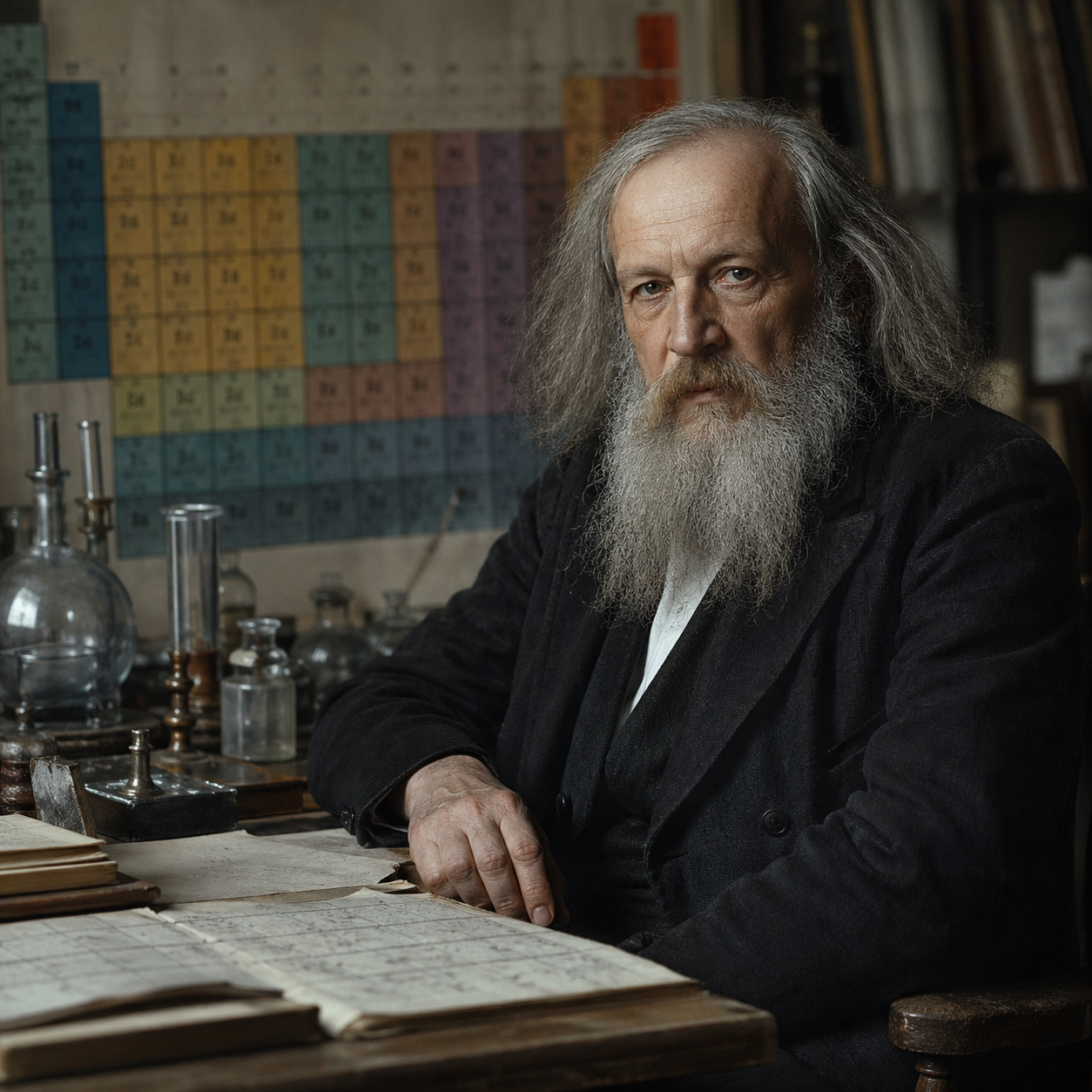
Mendeleev practiced exactly this method when building the periodic table in 1869. He observed the properties of 63 known elements, generalized that properties repeat by atomic weight, then boldly predicted undiscovered elements like gallium, scandium, and germanium, even forecasting their densities and melting points. When those elements were later found matching his numbers, his framework was vindicated. The quote is essentially his own working philosophy distilled into one sentence.
Mendeleev worked in late 19th-century Russia during a chemistry boom where dozens of new elements were being isolated yearly but no unifying theory existed. Atoms were still hypothetical, and rivals like Meyer were racing toward similar classifications. Tsarist Russia was modernizing its universities, and Mendeleev pushed empirical, predictive science against mystical and purely descriptive traditions, helping establish chemistry as a rigorous predictive discipline alongside physics.
AI-generated insights based on extensive research and information for context. Factual errors? Email [email protected].
Your cart is empty