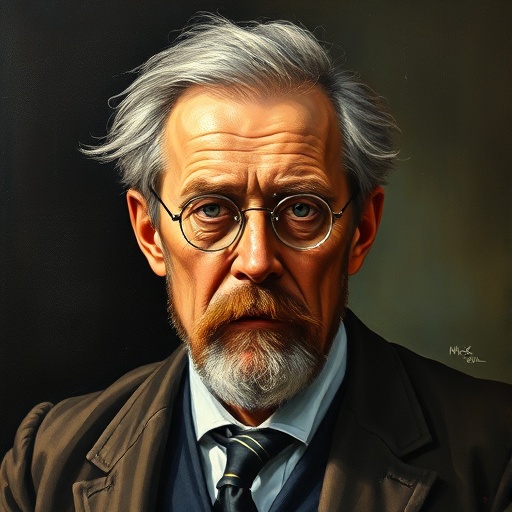
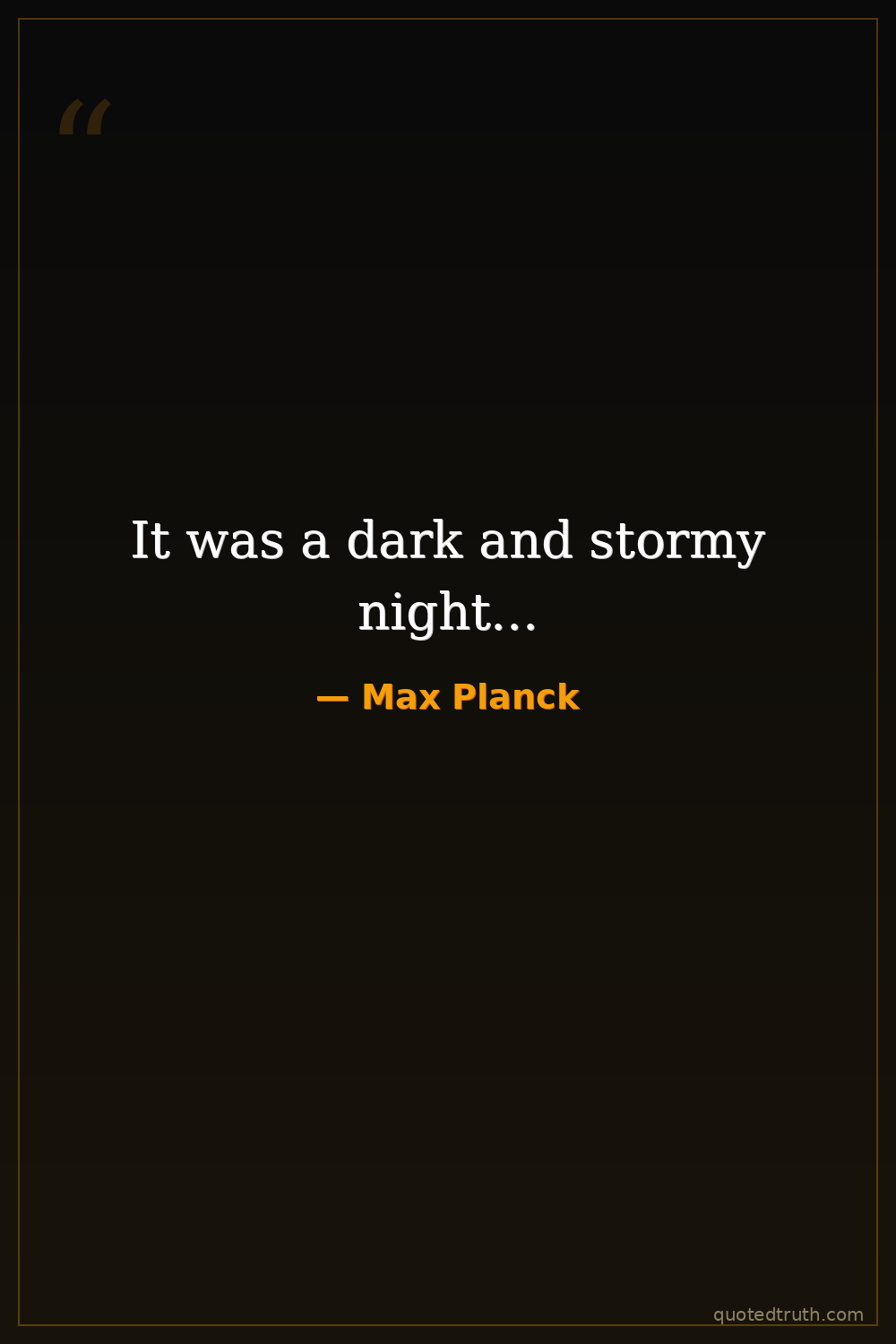
Max Planck — "It was a dark and stormy night..."
It was a dark and stormy night...
It was a dark and stormy night...
Click any product to generate a realistic preview. Up to 3 at a time.
* Initial load can take up to 90 seconds — revising the preview in another color is nearly instant.
"The quantum hypothesis will never make the slightest sense to anyone who cannot accept the existence of a real, objective world independent of our observations."
"All matter originates and exists only by virtue of a force… We must assume behind this force the existence of a conscious and intelligent Mind. This Mind is the matrix of all matter."
"The old pioneers of science, such as Galileo, Kepler, Newton, were deeply religious men."
"When we consider the development of science, we cannot help noticing that it is in many places the work of individuals who, in opposition to the general current of their time, have succeeded in imposi…"
"The aim of science is to understand the world, not to explain it away."
This is a famous opening line from a novel by Edward Bulwer-Lytton, not a quote by Max Planck.
Date: N/A
ShockingFound in 1 providers: grok
1 source checked
The line paints a scene of gloom and turbulence, using weather as a stand-in for uncertainty, fear, or dramatic upheaval. It signals that something consequential is about to unfold against a backdrop of darkness and disorder. In modern terms, it captures that moment when conditions feel chaotic and visibility is low, yet the story, decision, or discovery ahead will matter precisely because it emerges from such unsettled circumstances.
Planck spent decades probing the obscure foundations of physics, where classical certainties dissolved into quantum strangeness. A cautious, deeply religious thinker, he pressed forward despite personal tragedy, including the loss of sons to war and execution under the Nazi regime. The imagery of darkness preceding revelation mirrors his own path: grappling with blackbody radiation until, almost reluctantly, he introduced the quantum, a concept that unsettled the orderly physics he himself revered.
Planck worked from the late 1800s through the mid-twentieth century, an era of scientific revolution and political catastrophe. Classical physics was cracking, relativity and quantum mechanics were overturning Newtonian order, and two world wars engulfed Germany. Weimar instability gave way to Nazi rule, universities were purged, and colleagues fled or perished. Amid literal bombings and moral darkness, science itself was reshaped, making turbulent nights an apt metaphor for the age Planck endured and helped transform.
AI-generated insights based on extensive research and information for context. Factual errors? Email [email protected].
Your cart is empty