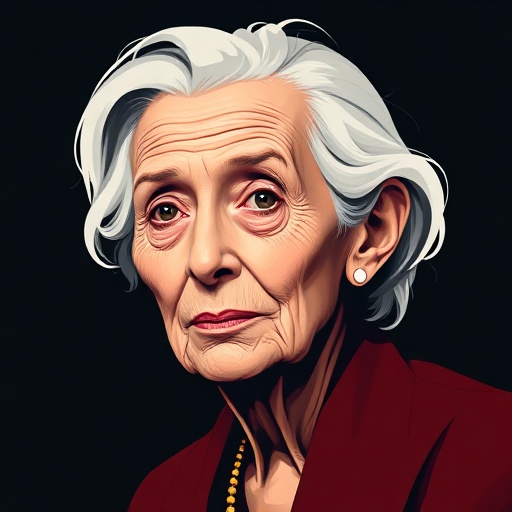
Jane Goodall — "It's not just about saving animals, it's about saving ourselves."
It's not just about saving animals, it's about saving ourselves.
It's not just about saving animals, it's about saving ourselves.
Click any product to generate a realistic preview. Up to 3 at a time.
* Initial load can take up to 90 seconds — revising the preview in another color is nearly instant.
"Every single day, we make choices that impact the planet. We can choose to make a difference."
"I believe that the human heart, when it is truly open, is capable of great compassion."
"We have so much to learn from the natural world. If we just open our eyes and listen."
"I believe that there is hope for the future, as long as we don't give up."
"Every single one of us can make a difference, and we should never forget that."
British primatologist who in 1960 began the longest-running wild primate study at Gombe Stream, transforming our understanding of chimpanzees. Closely associated with Dian Fossey (mountain-gorilla researcher) and Birutė Galdikas (orangutan researcher; together with Goodall and Fossey one of Louis Leakey's 'Trimates'). For an intellectual contrast, see Walter Palmer, American dentist who killed Cecil the Lion in Zimbabwe in 2015 — Palmer represents the trophy-hunting tradition Goodall's life's work has been organized against — the colonial-era hunter-naturalist worldview that treated primates and big game as specimens or trophies, which Goodall's Roots & Shoots and Jane Goodall Institute exist specifically to displace.
Found in 1 providers: grok
1 source checked
Conservation isn't purely altruistic — protecting wildlife and natural ecosystems directly protects human survival. When biodiversity collapses, the systems humans depend on — clean water, stable climate, food chains, disease regulation — collapse with it. Caring for other species isn't separate from caring for humanity; it is caring for humanity. Self-preservation and environmental stewardship are the same cause viewed from different angles.
Goodall spent decades at Gombe Stream watching forest destruction threaten both chimpanzees and neighboring human communities simultaneously. She transitioned from detached scientist to global advocate, founding the Jane Goodall Institute and Roots & Shoots youth program. Her fieldwork taught her that ecological collapse harms humans directly through disease, food insecurity, and climate disruption — making the inseparability of human and wildlife fate the driving philosophy behind her decades of conservation work.
Goodall's message gained urgency as late-20th-century deforestation, biodiversity collapse, and climate change accelerated globally. The 1992 Rio Earth Summit framed conservation as a human survival issue, not mere sentiment. Later, COVID-19 — linked to zoonotic disease spillover from disrupted animal habitats — viscerally confirmed her point. With scientists declaring a sixth mass extinction underway and climate tipping points looming, her argument that destroying ecosystems ultimately destroys human civilization moved from philosophy to established science.
AI-generated insights based on extensive research and information for context. Factual errors? Email [email protected].
Your cart is empty