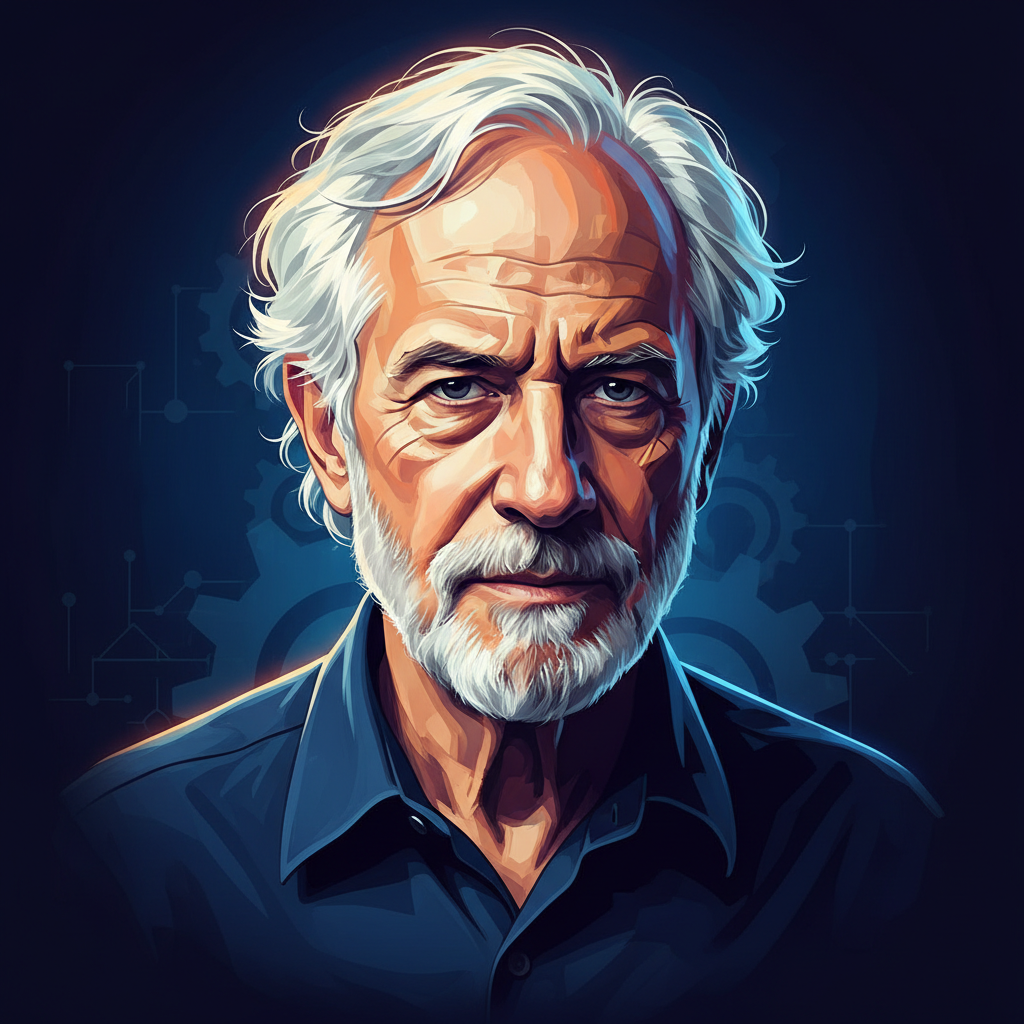
Noam Chomsky — "It's very hard to predict the future, but one thing is clear: the future is goin…"
It's very hard to predict the future, but one thing is clear: the future is going to be very different from the past.
It's very hard to predict the future, but one thing is clear: the future is going to be very different from the past.
Click any product to generate a realistic preview. Up to 3 at a time.
* Initial load can take up to 90 seconds — revising the preview in another color is nearly instant.
"The very fact that you're allowed to talk about it shows you what a free country this is. It's not."
"The public is not supposed to understand these things. It's supposed to believe what it's told."
"The United States has devoted enormous resources to overthrowing democratic governments."
"The only way to deal with an unfree world is to become so absolutely free that your very existence is an act of rebellion."
"The general population doesn't know what's happening, and it doesn't even know that it doesn't know."
American linguist whose generative-grammar revolution (Syntactic Structures, 1957) reshaped linguistics, and whose Manufacturing Consent (1988, with Edward Herman) reshaped media criticism. Closely associated with Edward S. Herman (media-criticism co-author) and Howard Zinn (left historian peer and friend). For an intellectual contrast, see B.F. Skinner, Harvard behaviorist psychologist (1904-1990) — Chomsky's 1959 review of Skinner's Verbal Behavior is the most-cited demolition in 20th-century psychology — the moment behaviorism's dominance ended and the cognitive-science era began. Skinner's stimulus-response account of language and Chomsky's innate-faculty account are the cleanest 'environment vs nature' linguistic poles.
The standard scholarly entry points to Noam Chomsky's work: Robert F. Barsky (Vanderbilt, Chomsky biographer) — Noam Chomsky: A Life of Dissent (1997); James McGilvray (McGill, philosophy of language) — The Cambridge Companion to Chomsky (ed., 2005). These are the works graduate seminars cite when teaching Noam Chomsky.
Your cart is empty