Pope Urban II — "Jerusalem is the navel of the world; the land is fruitful above all others, like…"
Jerusalem is the navel of the world; the land is fruitful above all others, like another paradise of delights.
Jerusalem is the navel of the world; the land is fruitful above all others, like another paradise of delights.
Click any product to generate a realistic preview. Up to 3 at a time.
* Initial load can take up to 90 seconds — revising the preview in another color is nearly instant.
"The kingdom of the Greeks is now dismembered by them and deprived of territory so vast in extent that it can not be traversed in a march of two months. On whom therefore is the labor of avenging these…"
"Let the cross be your guide and your banner."
"And we do not command or advise that the old or feeble, or those unfit for bearing arms, undertake this journey; nor ought women to set out at all, without their husbands or brothers or legal guardian…"
"But if you are hindered by love of children, parents and wives, remember what the Lord says in the Gospel, 'He that loveth father or mother more than me, is not worthy of me.'"
"Those who have made a vow to go to Jerusalem, let them fulfill it as soon as possible."
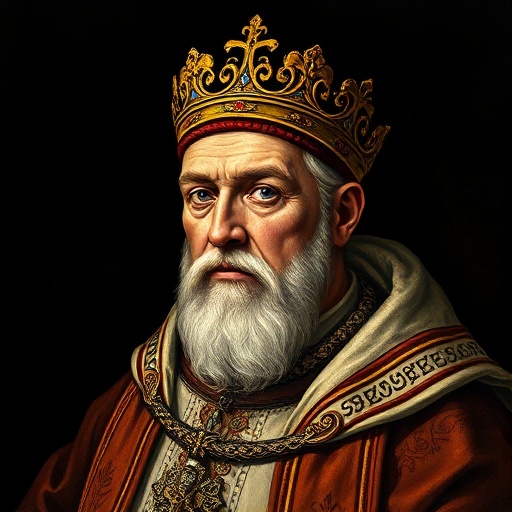
Pope (1088-1099) whose Council of Clermont speech (November 1095) launched the First Crusade — the founding event of nine centuries of Christian-Muslim military conflict. Closely associated with Pope Gregory VII (his predecessor on papal-imperial reform). For an intellectual contrast, see Saladin, Kurdish-Muslim Sultan of Egypt and Syria (1138-1193) — Saladin recaptured Jerusalem in 1187, undoing the First Crusade Urban II launched 92 years earlier. Saladin's chivalrous treatment of Christian prisoners became the canonical Muslim counter-image to Crusader brutality. The cleanest before/after pairing of the Crusades' moral arc.
Found in 2 providers: gemini,grok
2 sources checked
Jerusalem is the spiritual and geographic center of all creation — the fixed point around which human history revolves. The land itself is described as supremely fertile, a paradise surpassing all others. The quote argues this place is uniquely sacred and uniquely blessed, making its possession a matter of cosmic importance — not merely political or military, but a duty owed by all Christians to God and civilization itself.
Urban II delivered these words at the Council of Clermont in 1095, directly launching the First Crusade. As a Cluniac reformer turned pope, he saw Christendom as a unified spiritual kingdom requiring active defense. Reclaiming Jerusalem was his defining theological act. His speech fused religious duty with earthly reward, promising spiritual indulgences to fighters. This quote captures his core conviction that sacred geography demanded sacred warfare and collective Christian sacrifice.
In 1095, Seljuk Turks controlled Jerusalem, blocking Christian pilgrimage routes and threatening Byzantine Constantinople. Medieval Christians genuinely believed Jerusalem sat at Earth's geographic and spiritual center — the omphalos mundi — a concept mapped on Mappa Mundi charts. The Church of the Holy Sepulchre stood there, marking Christ's burial site. Urban's speech at Clermont ignited the First Crusade, mobilizing tens of thousands across Europe who believed reclaiming this paradise was divinely commanded.
AI-generated insights based on extensive research and information for context. Factual errors? Email [email protected].
Your cart is empty