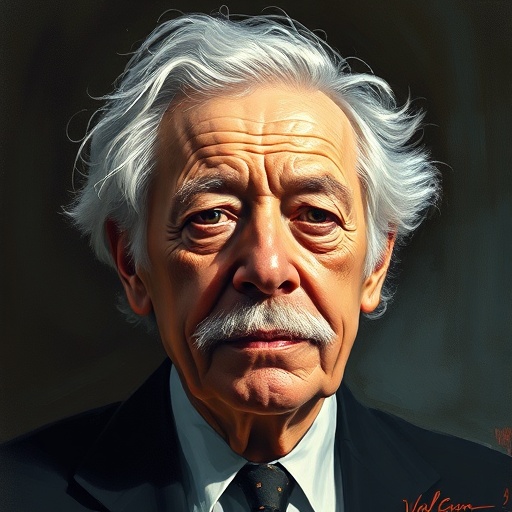
Linus Pauling — "Just one living cell in the human body is, more complex than New York City."
Just one living cell in the human body is, more complex than New York City.
Just one living cell in the human body is, more complex than New York City.
Click any product to generate a realistic preview. Up to 3 at a time.
* Initial load can take up to 90 seconds — revising the preview in another color is nearly instant.
"The most important quality for a scientist is imagination."
"I have been interested in vitamins for a long time, and I have taken large doses of vitamin C for many years."
"The only way to discover the limits of the possible is to go beyond them into the impossible."
"There is no such thing as a 'safe' dose of radiation."
"I am a firm believer in the power of the human mind to solve problems."
Found in 1 providers: gemini
1 source checked
A single living cell manages thousands of simultaneous chemical reactions, synthesizes proteins, produces energy, removes waste, and communicates with neighboring cells—all within a microscopic space. This quote argues that nature's engineering at the cellular level dwarfs humanity's greatest achievements. New York City, with all its infrastructure and interdependent systems, becomes a modest analogy for the invisible complexity operating inside every cell in your body.
Pauling won Nobel Prizes in Chemistry (1954) and Peace (1962)—the only person awarded two unshared Nobels. His groundbreaking work on chemical bonds and molecular structure gave him unmatched insight into biochemical complexity. Later in life, his orthomolecular medicine research deepened his focus on cellular chemistry. This quote reflects his core conviction: that understanding life required grasping the staggering molecular machinery operating inside individual cells.
Pauling worked during molecular biology's birth: Watson and Crick decoded DNA's structure in 1953, the same year Pauling proposed a competing model, and electron microscopy was first revealing cell ultrastructure. Cold War science funding was accelerating biochemistry research. Scientists were only beginning to map organelles, enzymes, and signaling networks inside cells, making the comparison to a city both conceptually fresh and scientifically grounded for the first time.
AI-generated insights based on extensive research and information for context. Factual errors? Email [email protected].
Your cart is empty