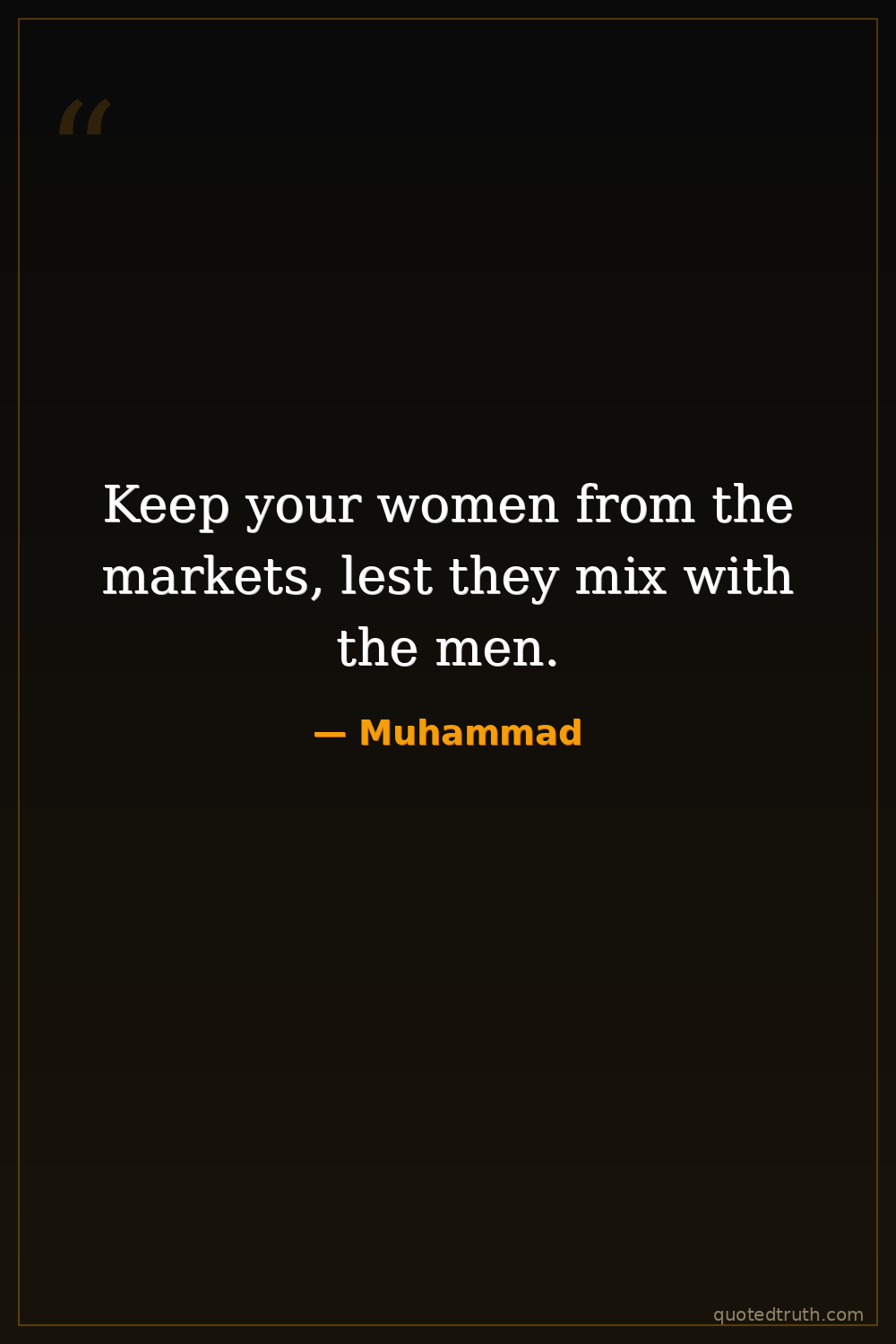
Muhammad — "Keep your women from the markets, lest they mix with the men."
Keep your women from the markets, lest they mix with the men.
Keep your women from the markets, lest they mix with the men.
Click any product to generate a realistic preview. Up to 3 at a time.
* Initial load can take up to 90 seconds — revising the preview in another color is nearly instant.
"The Hour will not be established until you fight with the Jews, and the stone behind which a Jew will be hiding will say. 'O Muslim! There is a Jew hiding behind me, so kill him.'"
"The best of you are those who are best to their families."
"No one who has an atom's weight of pride in his heart will enter Paradise."
"Indeed, I have been sent with concise words and comprehensive meanings."
"The one who repents from sin is like one who has not sinned at all."
Found in 1 providers: grok
1 source checked
This statement urges restricting women from public marketplaces to prevent unsupervised interaction between men and women. It reflects a concern about gender mingling in commercial public spaces, treating separation of the sexes as a matter of social propriety and moral safeguarding. In practical terms, it advises keeping women away from crowded trading venues where they would inevitably encounter unrelated men, framing such avoidance as protective rather than restrictive of women's participation in economic life.
Muhammad founded Islam in 7th-century Arabia and established social codes governing family, worship, and public conduct for the early Muslim community in Medina. As both religious prophet and civic leader, he issued guidance on modesty, gender interaction, and public behavior. This saying aligns with his broader teachings on hijab, guardianship, and gendered etiquette, though its authenticity and interpretation remain debated among scholars. It reflects his role shaping norms that structured daily life for believers.
Seventh-century Arabian markets were crowded, rowdy hubs where traders, travelers, and tribes mixed, and unescorted women faced real risks of harassment, abduction, or reputational harm in a tribal honor culture. Medina's early Muslim community was building new social norms distinct from pre-Islamic Arabian practice, and segregation guidelines emerged alongside rules on inheritance, marriage, and modesty. Public spaces lacked modern protections, so restricting women's market access was framed as shielding them within a volatile, patriarchal tribal society.
AI-generated insights based on extensive research and information for context. Factual errors? Email [email protected].
Your cart is empty