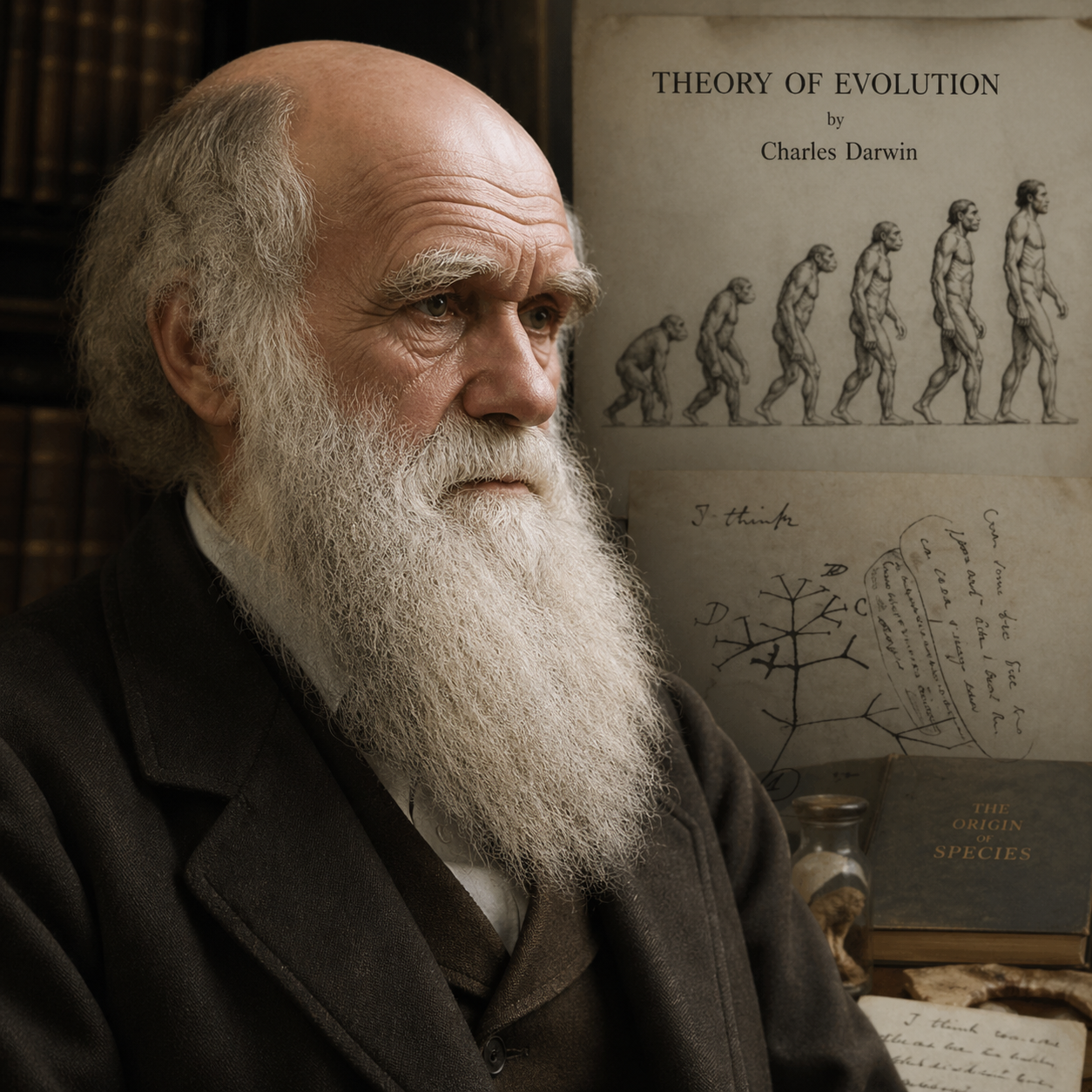
Charles Darwin — "Man tends to increase at a greater rate than his means of subsistence."
Man tends to increase at a greater rate than his means of subsistence.
Man tends to increase at a greater rate than his means of subsistence.
Click any product to generate a realistic preview. Up to 3 at a time.
* Initial load can take up to 90 seconds — revising the preview in another color is nearly instant.
"Man selects only for his own good: Nature only for that of the being which she tends."
"Man, with all his noble qualities, with sympathy which feels for the most debased, with benevolence which extends not only to other men but to the humblest living creature, with his god-like intellect…"
"He who understands baboon would do more towards metaphysics than Locke."
"No one can feel more strongly than I do the extreme difficulty of accounting for the origin of species."
"Blushing is the most peculiar and most human of all expressions."
British naturalist whose On the Origin of Species (1859) established evolution by natural selection — the unifying theory of modern biology. Closely associated with Thomas Henry Huxley (his 'bulldog' public defender) and Alfred Russel Wallace (independent co-discoverer of natural selection). For an intellectual contrast, see William Paley, Anglican theologian and Natural Theology author (1743-1805) — Origin of Species is structurally a 400-page reply to Paley — Darwin admired Paley's watchmaker-argument as an undergraduate at Cambridge and then spent 20 years building the empirical machinery to displace him. The cleanest 'design argument vs natural selection' founding rebuttal in science.
The standard scholarly entry points to Charles Darwin's work: Janet Browne (Harvard, history of science) — Charles Darwin: Voyaging (1995) and The Power of Place (2002); Adrian Desmond (UCL, biographer) — Darwin: The Life of a Tormented Evolutionist (1991, with James Moore). These are the works graduate seminars cite when teaching Charles Darwin.
Found in 1 providers: deepseek
1 source checked
Human populations grow faster than food and resources can sustain them. This creates inevitable scarcity — not everyone can survive or reproduce. The gap between how many mouths exist and how much food can be produced forces constant competition. Abundance is temporary; shortage is the default condition. Those who cannot secure enough resources lose the struggle. Scarcity, not plenty, defines the baseline of human and animal existence.
Darwin read Thomas Malthus's population essay in 1838 and called it his eureka moment. Population pressure gave him the precise mechanism he needed for natural selection: if more organisms are born than resources support, those with advantageous traits survive to reproduce while others perish. This Malthusian insight became the engine of 'On the Origin of Species' (1859). Darwin explicitly credited Malthus in his autobiography as the idea that unlocked his entire theory.
The 1800s brought explosive industrialization and population growth across Europe — London's population quadrupled between 1800 and 1900. Ireland's Great Famine (1845–52) killed one million and displaced another million, making population-versus-food tension viscerally real. Urban poverty, colonial resource competition, and visible mass starvation made Malthusian limits observable daily. Darwin's contemporaries watched human misery unfold at industrial scale, lending this population-pressure idea the weight of lived catastrophe, not abstract economics.
AI-generated insights based on extensive research and information for context. Factual errors? Email [email protected].
Your cart is empty