Benjamin Franklin — "Many a false step was made by standing still."
Many a false step was made by standing still.
Many a false step was made by standing still.
Click any product to generate a realistic preview. Up to 3 at a time.
* Initial load can take up to 90 seconds — revising the preview in another color is nearly instant.
"If you would be lov'd, love."
"He that has a wife and children, has given hostages to fortune."
"He that can have patience can have what he will."
"He that by the Plough would thrive, Himself must either hold or drive."
"If you're going through hell, keep going."
Polymath Founding Father, diplomat, and Poor Richard's Almanack author who helped draft the Declaration of Independence and the Constitution. Closely associated with John Adams (fellow Founder, Massachusetts statesman) and Thomas Jefferson (fellow Declaration drafter). For an intellectual contrast, see Thomas Hutchinson, last royal governor of colonial Massachusetts — Franklin leaked Hutchinson's loyalist correspondence to Boston in 1772 to inflame revolutionary sentiment — Hutchinson represented the colonial-aristocrat crown-loyalty that Franklin's revolution was organized to dismantle.
Found in 1 providers: grok
1 source checked
Inaction is its own kind of mistake. When you hesitate or refuse to move forward, you don't avoid errors — you create them. Standing still feels safe, but it produces failures of its own: missed opportunities, stagnation, and decisions made by default rather than by choice. Risk is unavoidable; the only question is whether you choose your risks deliberately or let paralysis choose them for you.
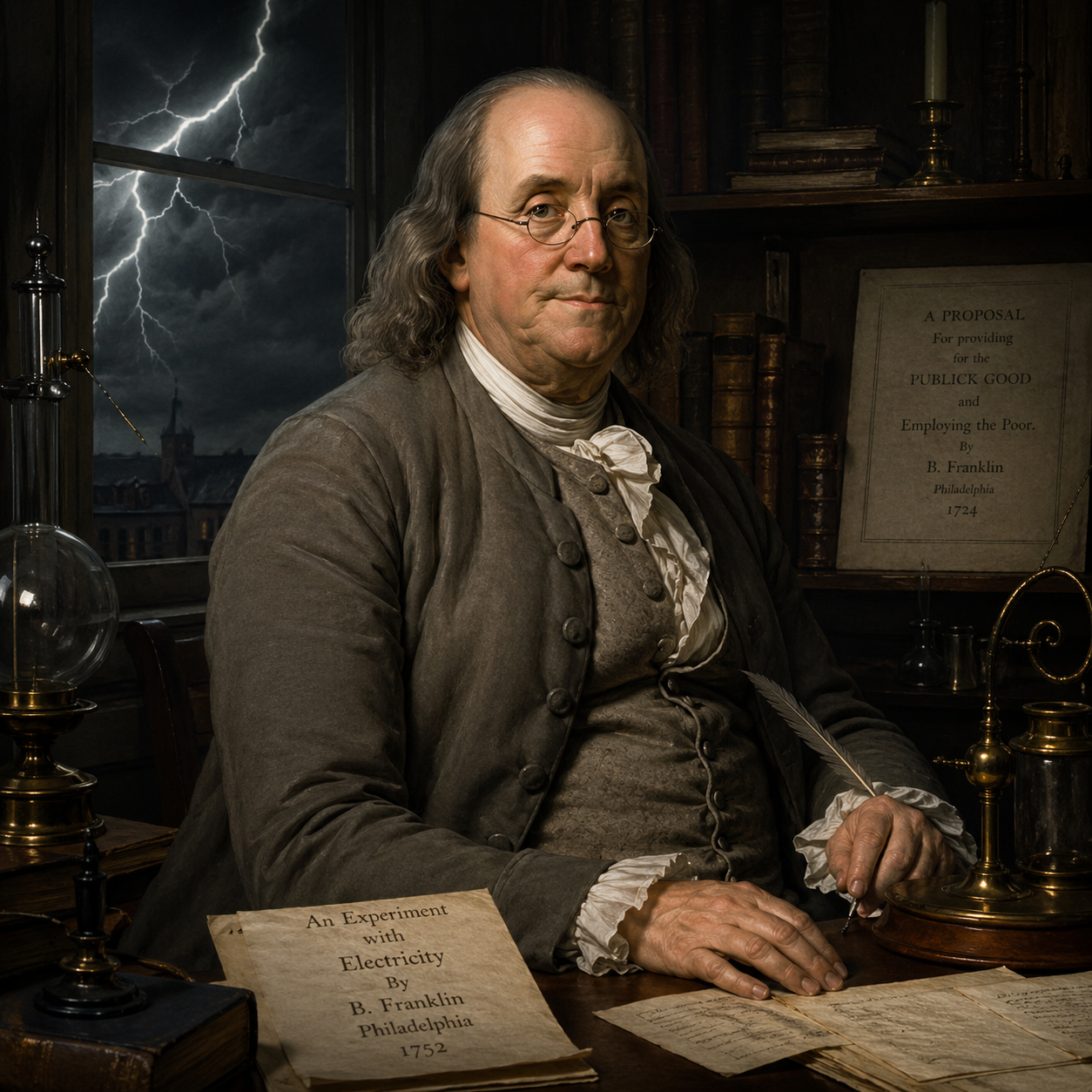
Franklin embodied this principle throughout his life. He left Boston at 17 with almost nothing, crossed the Atlantic multiple times as an elderly diplomat, and ran hands-on electrical experiments rather than theorizing from an armchair. His Poor Richard's Almanack consistently celebrated industry and initiative. As a founding father, he backed independence when caution dominated. He never waited for perfect circumstances — he moved, adapted, and treated inaction as the real danger.
In colonial America, fortunes rose and fell on decisive action. Merchants who hesitated lost trade routes to bolder rivals; settlers who delayed lost land. The era's prevailing ethic already praised industriousness, but Franklin's circles — printers, scientists, statesmen — faced mounting urgency: Britain's grip was tightening, and the colonies needed actors, not observers. The entire founding generation was forced to choose between dangerous movement and the false comfort of standing still.
AI-generated insights based on extensive research and information for context. Factual errors? Email [email protected].
Your cart is empty