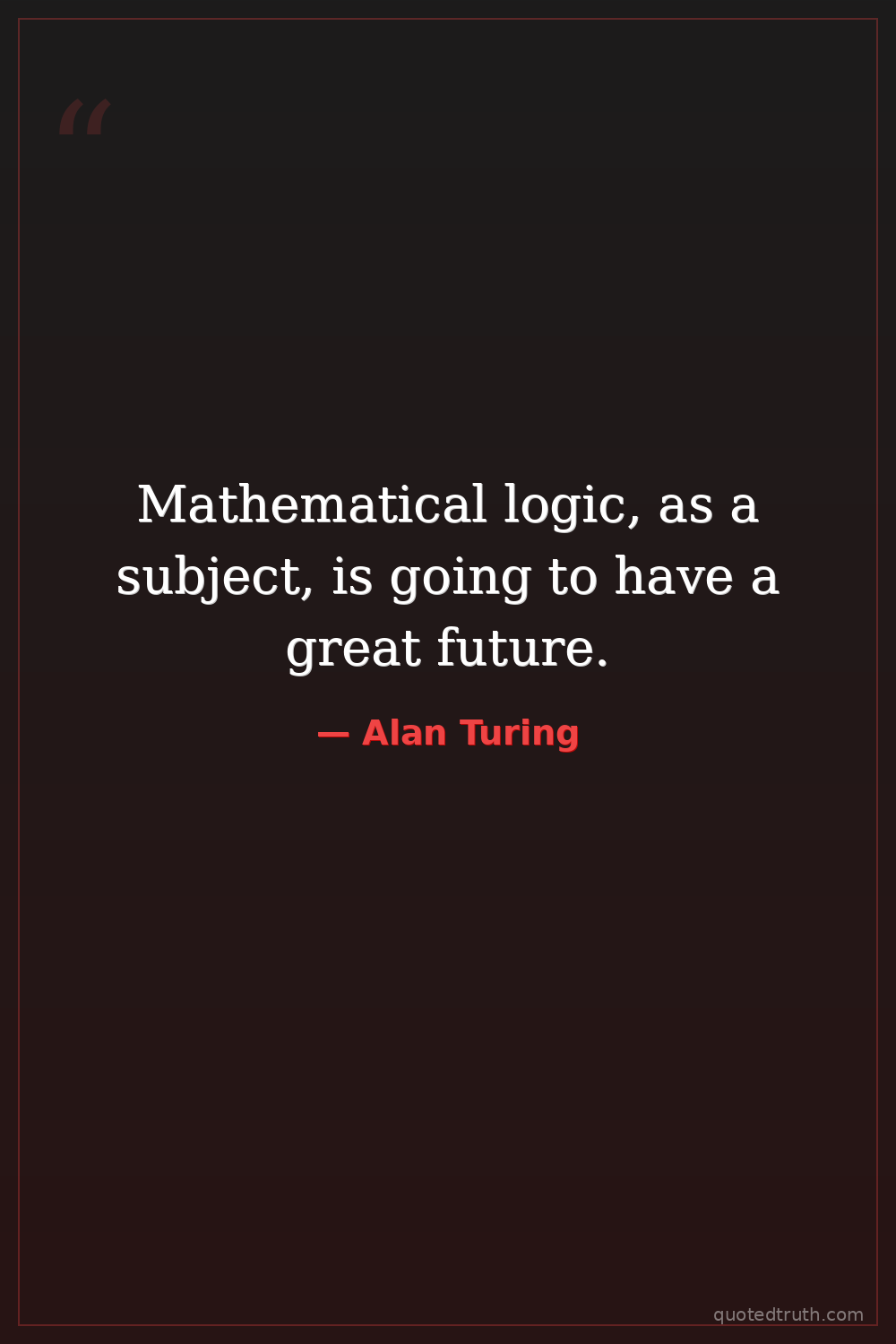
Alan Turing — "Mathematical logic, as a subject, is going to have a great future."
Mathematical logic, as a subject, is going to have a great future.
Mathematical logic, as a subject, is going to have a great future.
Click any product to generate a realistic preview. Up to 3 at a time.
* Initial load can take up to 90 seconds — revising the preview in another color is nearly instant.
"The extent to which we regard something as a machine is a matter of degree."
"I expect to lie in the sun, talk French and modern Greek, and make love, though the sex and nationality... has yet to be decided: in fact it is quite possible that this item will be altogether omitted…"
"The idea of a 'thinking machine' is not something that should be taken lightly."
"We like to believe that Man is in some subtle way superior to the rest of creation. It is best if he can be shown to be necessarily superior, for then there is no danger of him losing his commanding p…"
"The view that machines cannot give rise to surprises is due, I believe, to a fallacy to which philosophers and mathematicians are particularly subject."
Found in 1 providers: grok
1 source checked
Mathematics would develop powerful formal systems for reasoning, proof, and computation that would transform science and technology. The underlying structure of logical thinking could be mechanized, analyzed, and extended far beyond human intuition alone, opening entirely new fields of inquiry that blend abstract reasoning with practical problem-solving in ways previously unimaginable.
Turing built his career on mathematical logic, from his 1936 paper introducing Turing machines to his work on computability and decidability. He proved certain mathematical questions are undecidable, simultaneously founding theoretical computer science. His Enigma codebreaking applied formal logical reasoning to real-world cryptanalysis, validating his belief that abstract mathematics had profound practical power.
In the 1930s-1950s, Gödel's incompleteness theorems had just shaken foundations of mathematics, while Hilbert's formalist program was collapsing. Church, Turing, and Kleene were independently formalizing computability. The dawn of electronic computers made mechanized logic suddenly tangible. Cold War cryptography and early AI research confirmed that mathematical logic would indeed reshape science, warfare, and human knowledge.
AI-generated insights based on extensive research and information for context. Factual errors? Email [email protected].
Your cart is empty