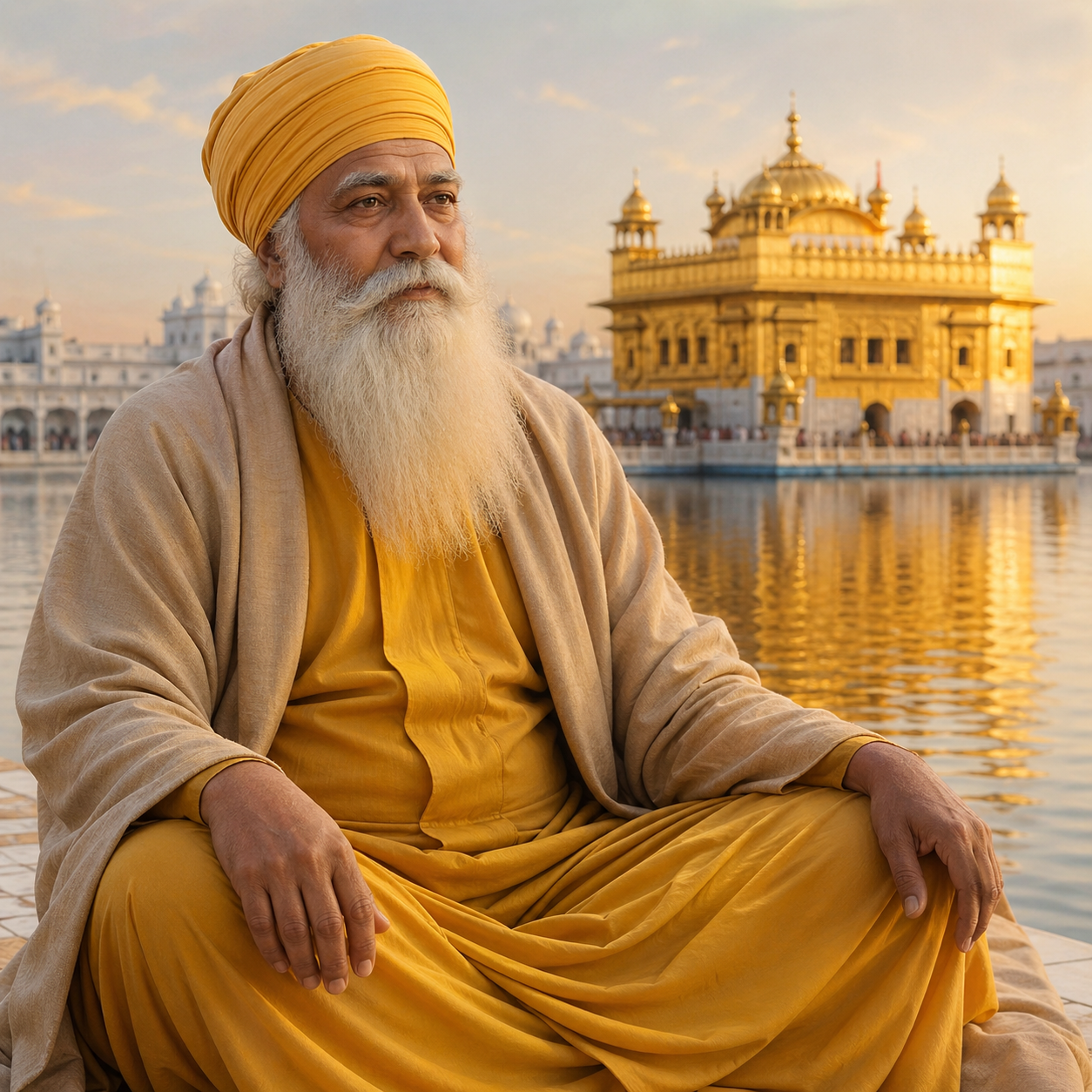
Guru Nanak — "May your days be blessed and your phone battery never die mid-conversation."
May your days be blessed and your phone battery never die mid-conversation.
May your days be blessed and your phone battery never die mid-conversation.
Click any product to generate a realistic preview. Up to 3 at a time.
* Initial load can take up to 90 seconds — revising the preview in another color is nearly instant.
"The world is a drama, staged in a dream. And sometimes, the plot is really confusing."
"Alone let him constantly meditate in solitude on that which is salutary for his soul, for he who meditates in solitude attains supreme bliss."
"Without genuine understanding, observing (Clergy-concocted) fasting, religious rituals and daily Poojaa lead only to the love of duality."
"I am neither male nor female, nor am I sexless. I am the Peaceful One, whose form is self-effulgent, powerful radiance."
"Do not speak ill of anyone, for God dwells in every heart."
Founder of Sikhism and the first of the Ten Sikh Gurus, whose teachings of one universal God and rejection of caste shaped Punjab. Closely associated with Kabir (mystical poet whose verses appear in the Sikh Guru Granth Sahib). For an intellectual contrast, see Brahmanical orthodoxy, the Hindu caste-and-ritual establishment of his era — Sikhism was founded as a deliberate alternative to both Hindu ritual hierarchy and Islamic exclusivism — Nanak's universalism was a structural rejection of caste and priestly mediation.
Found in 1 providers: grok
1 source checked
A hybrid blessing that fuses timeless goodwill with a very modern dread: the dropped call. It wishes someone abundant days and uninterrupted connection — because in an age of constant digital communication, losing battery mid-conversation feels like losing the thread of something important. The humor grounds an ancient form of blessing in an anxiety everyone instantly recognizes, making warmth feel immediate and personal rather than formal.
Guru Nanak (1469–1539) completed four great Udasis — journeys spanning thousands of miles across South Asia, Central Asia, and the Middle East — specifically to sustain face-to-face dialogue across religious and caste divides. His entire spiritual project depended on keeping conversation alive. The terror of a severed connection mid-exchange would have resonated: for Nanak, broken dialogue meant broken community, and his life's work was stitching those breaks shut through presence and word.
Guru Nanak lived through the collapse of the Lodi Sultanate, Babur's invasion, and deep Hindu-Muslim fracture across the Indian subcontinent. Communication across communities was politically dangerous and logistically brutal — messages traveled by foot or horse, taking weeks. Against this backdrop, his insistence on direct human conversation as the vehicle for spiritual truth was radical. Unbroken dialogue wasn't convenience; it was resistance against the forces pulling people apart.
AI-generated insights based on extensive research and information for context. Factual errors? Email [email protected].
Your cart is empty