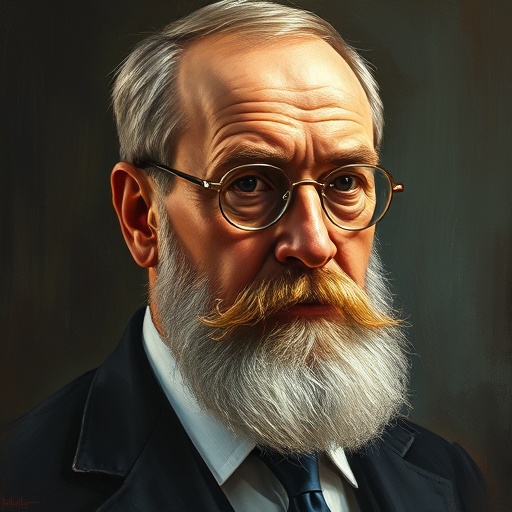
Robert Koch — "My experiments on anthrax were some of the most challenging of my career."
My experiments on anthrax were some of the most challenging of my career.
My experiments on anthrax were some of the most challenging of my career.
Click any product to generate a realistic preview. Up to 3 at a time.
* Initial load can take up to 90 seconds — revising the preview in another color is nearly instant.
"I believe that every disease has a specific cause, and that cause can be identified."
"The future of medicine lies in the prevention of disease, not in its cure."
"The scientific method is the only reliable path to knowledge."
"The development of effective vaccines is a crucial step in controlling infectious diseases."
"As soon as I had found the tubercle bacillus, I found it also in the sputum of phthisical patients."
Found in 1 providers: grok
1 source checked
Meaningful scientific progress comes through difficulty and perseverance. Landmark discoveries aren't easily won — they require confronting technical obstacles, refining methods, and withstanding scrutiny. The speaker reflects on formative, hard-won work with earned pride. The hardest experiments often yield the most important results, and that challenge is inseparable from genuine scientific achievement. Difficulty here isn't a complaint but a mark of significance: only problems worth solving push a researcher to their limits.
Koch's anthrax experiments in the 1870s were genuinely his most technically demanding early work. Operating in a makeshift home laboratory in Wollstein, he tracked the full life cycle of Bacillus anthracis — including spore formation — using techniques he largely invented himself. This work established his credibility and led directly to Koch's Postulates, his logical framework for proving causation in infectious disease. It launched the career that would culminate in isolating the tuberculosis bacillus in 1882 and winning the Nobel Prize.
The 1870s were a battleground between germ theory and miasma theory. Pasteur had shown fermentation was microbial, but proving a specific bacterium caused a specific animal disease was uncharted territory. Anthrax devastated European livestock and occasionally killed humans. Koch's anthrax work arrived when medicine desperately needed a new explanatory framework and rigorous experimental proof. His success helped tip the scientific consensus decisively toward germ theory, reshaping public health, hospital practice, and the entire future of infectious disease research.
AI-generated insights based on extensive research and information for context. Factual errors? Email [email protected].
Your cart is empty