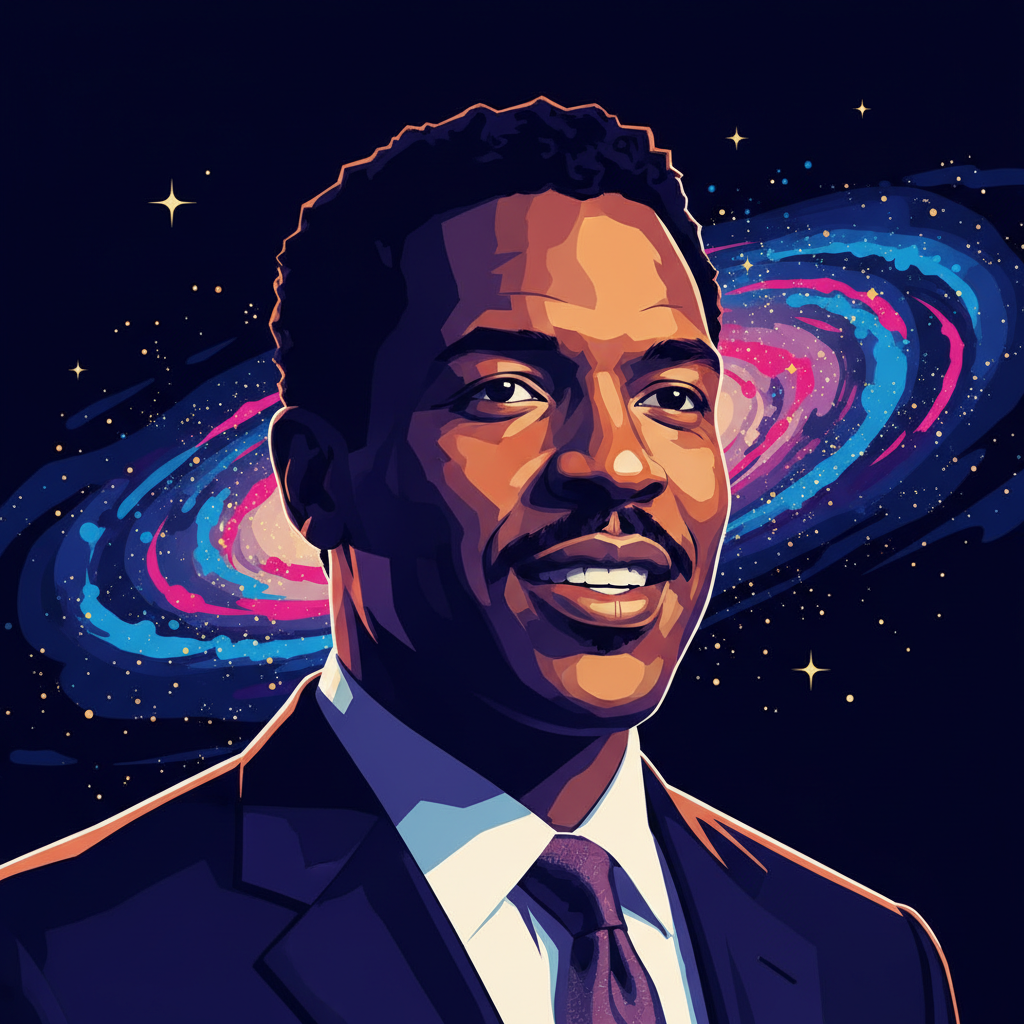
Neil deGrasse Tyson — "My favorite color is the color of the universe, which is a kind of beige-white."
My favorite color is the color of the universe, which is a kind of beige-white.
My favorite color is the color of the universe, which is a kind of beige-white.
Click any product to generate a realistic preview. Up to 3 at a time.
* Initial load can take up to 90 seconds — revising the preview in another color is nearly instant.
"I'm a big believer in the fact that if you're not making mistakes, you're not trying hard enough."
"The universe is a stage, and we are all actors in it."
"The universe is not a hostile place, it's just indifferent."
"I don't want to live in a world where people don't understand science. That's a world of darkness."
"I think the universe is a lot weirder than we give it credit for."
American astrophysicist, Hayden Planetarium director, and Cosmos: A Spacetime Odyssey host who carries the Carl Sagan public-science mantle. Closely associated with Bill Nye (fellow science communicator) and Brian Greene (theoretical physicist and string-theory popularizer). For an intellectual contrast, see Ken Ham, founder of Answers in Genesis and the Creation Museum — Ham's career has been organized around defending biblical 6-day creationism — exactly the science-education position Tyson's mainstream-science communication is structured to refute.
Found in 1 providers: grok
1 source checked
When asked a simple personal question, Tyson answers with an actual scientific measurement: astronomers calculated the average color of all light from 200,000 galaxies and found it to be a warm beige-white, nicknamed Cosmic Latte. By calling this his favorite color, Tyson signals that his sense of self is inseparable from the cosmos. Science isn't just his job — it filters how he experiences even something as personal as aesthetic preference.
Tyson, director of the Hayden Planetarium in New York and host of Cosmos: A Spacetime Odyssey, built his career on making astronomy personally resonant. He believes science belongs to everyone, not just specialists. This quote exemplifies his signature move: hijacking an ordinary question to deliver a genuine discovery. His whole brand rests on showing that the universe isn't remote or impersonal — it's intimate, present, and worth falling in love with.
In 2002, astronomers Karl Glazebrook and Ivan Baldry averaged light from 200,000 galaxies and calculated the universe's mean color as beige-white, immediately nicknamed Cosmic Latte. The finding went viral as a charming, humanizing science story. It landed during the post-Hubble Deep Field era when cosmology exploded into public consciousness, dark energy had just been confirmed, and science communicators like Tyson were actively dismantling the idea that astronomy was cold or inaccessible.
AI-generated insights based on extensive research and information for context. Factual errors? Email [email protected].
Your cart is empty