Stephen Hawking — "My goal is simple. It is a complete understanding of the universe, why it is as …"
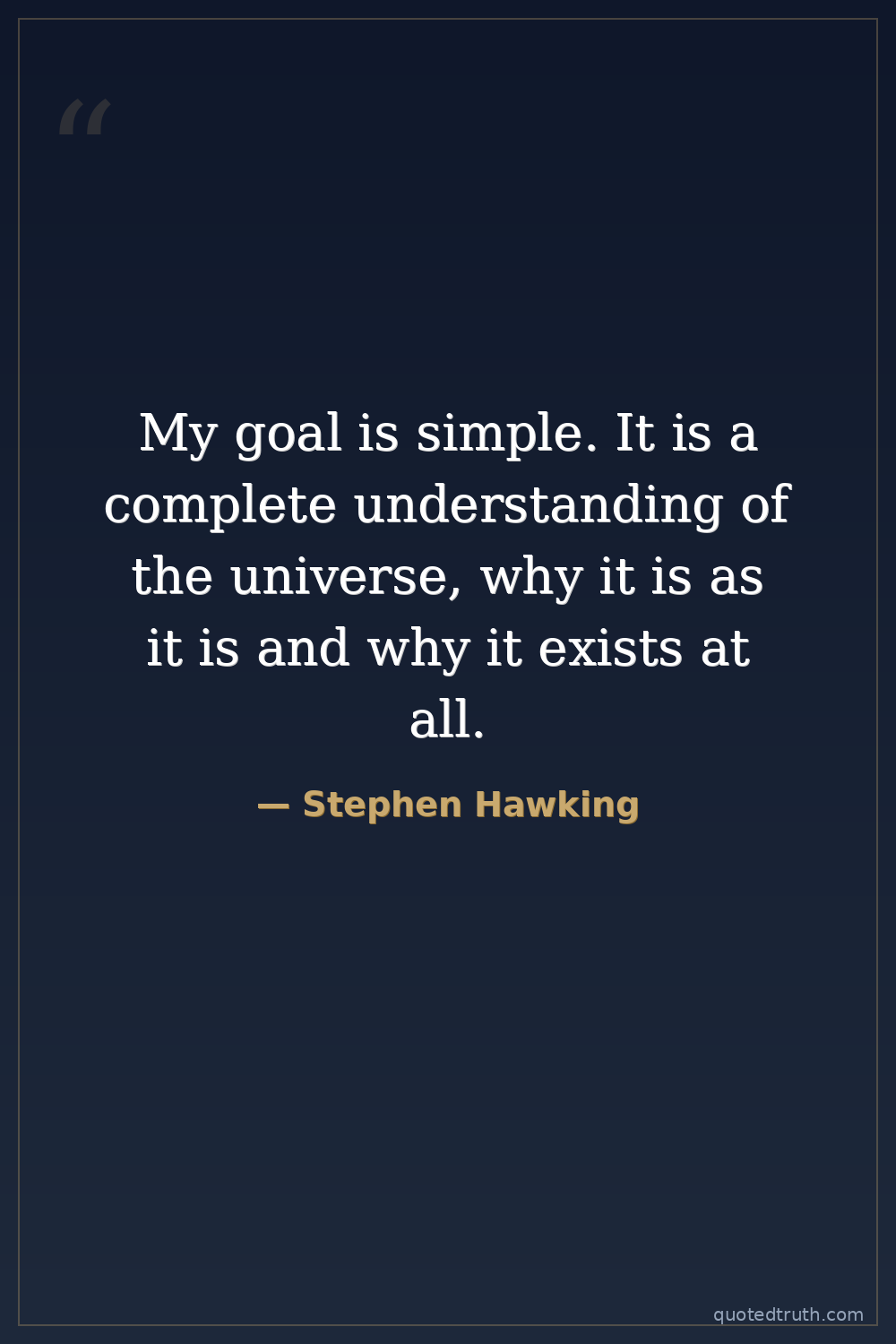
My goal is simple. It is a complete understanding of the universe, why it is as it is and why it exists at all.
My goal is simple. It is a complete understanding of the universe, why it is as it is and why it exists at all.
Click any product to generate a realistic preview. Up to 3 at a time.
* Initial load can take up to 90 seconds — revising the preview in another color is nearly instant.
"We are in danger of destroying ourselves by our greed and stupidity. We cannot remain looking inwards at ourselves on a small and increasingly polluted and overcrowded planet."
"We are all time-travelers, heading into the future at the rate of one second per second."
"The universe is a beautiful mystery, and I'm trying to unravel it."
"I have noticed that even people who claim that everything is predetermined and that we can do nothing to change it, look before they cross the road."
"I believe the simplest explanation is, there is no God. No one created the universe and no one directs our fate. This leads me to a profound realization that there probably is no heaven and no afterli…"
British theoretical physicist whose Hawking radiation work and A Brief History of Time (1988) brought black-hole physics to a mass audience while he lived with ALS for 55 years. Closely associated with Roger Penrose (his collaborator on singularity theorems) and Carl Sagan (fellow popularizer who wrote Brief History's foreword). For an intellectual contrast, see William Lane Craig, American philosopher of religion — Craig's Kalam cosmological argument depends on the Big Bang requiring a divine first cause; Hawking's no-boundary proposal was specifically designed to remove the moment that would require one — the cleanest cosmology-vs-natural-theology contrast in modern thought.
Found in 1 providers: grok
1 source checked
The speaker declares a single, lifelong aim: to understand not just how the universe operates, but why its laws are what they are and why something exists rather than nothing. The irony of calling this "simple" is intentional — it strips away every lesser ambition and names the one question that matters most. It is the clearest possible statement of pure intellectual purpose, undiluted by career or reputation.
Hawking spent over five decades pursuing exactly this, despite being diagnosed with ALS at 21 and given two years to live. His work on singularities with Penrose, Hawking radiation from black holes, and the no-boundary proposal for the universe's origin all attacked the why, not just the how. A Brief History of Time carried the question to millions. His life was the proof that one goal, held absolutely, can define an entire scientific career.
Hawking came of age in an era when physics had two triumphant but irreconcilable frameworks: general relativity governing the large, quantum mechanics governing the small. The space race had made cosmic questions urgent and culturally visible. Physicists in the 1960s–80s were actively hunting a Theory of Everything. Hawking's framing resonated because the tools to attempt a complete answer finally seemed within reach, making the ambition feel like a program, not just a dream.
AI-generated insights based on extensive research and information for context. Factual errors? Email [email protected].
Your cart is empty