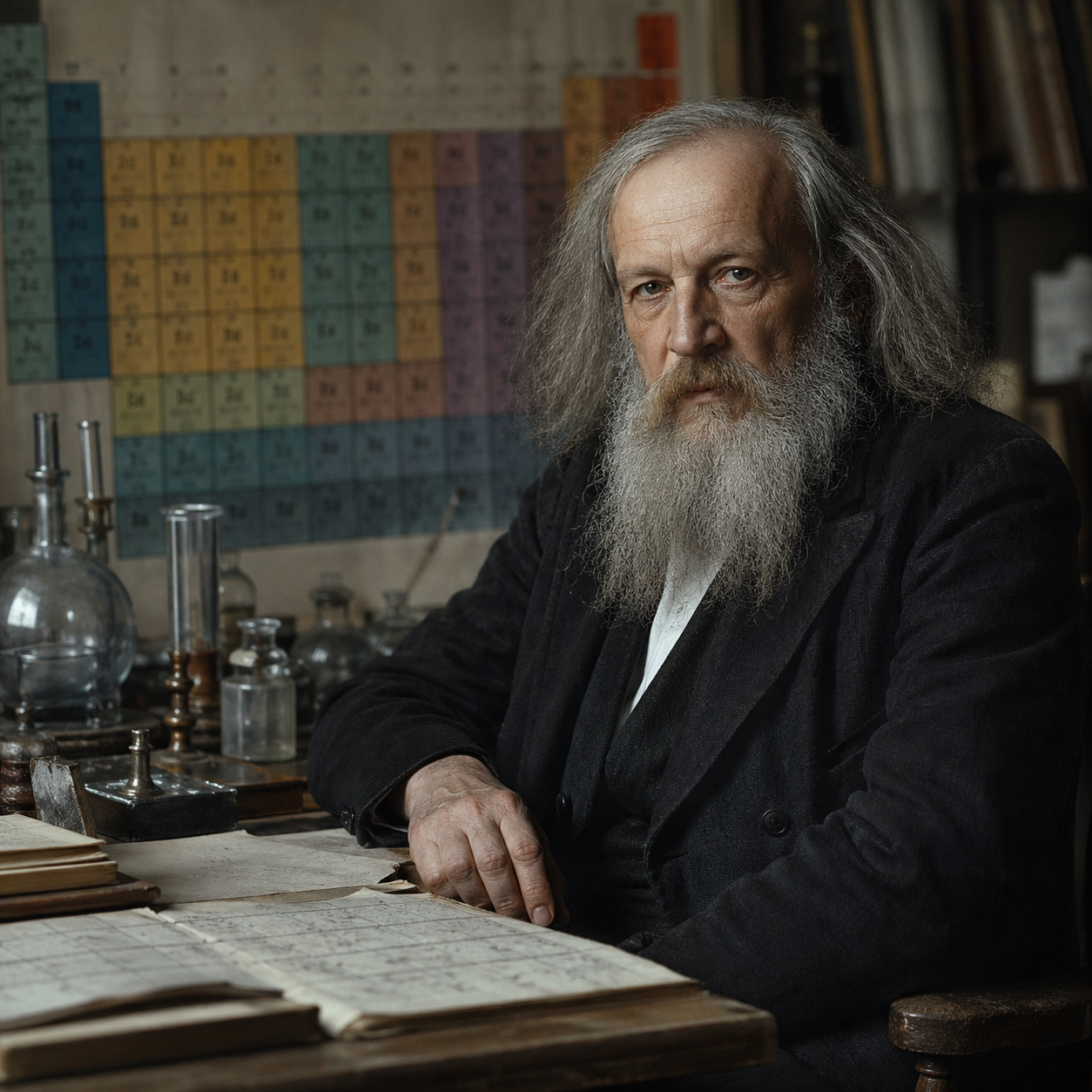
Dmitri Mendeleev — "My main interest is to help my country, Russia, develop its industrial capacity."
My main interest is to help my country, Russia, develop its industrial capacity.
My main interest is to help my country, Russia, develop its industrial capacity.
Click any product to generate a realistic preview. Up to 3 at a time.
* Initial load can take up to 90 seconds — revising the preview in another color is nearly instant.
"When we see the order of the elements, we must admit that there is a higher reason."
"The periodic law will not be overthrown, but only further developed."
"I consider it my duty to warn against this tendency to make a science of alchemy."
"I have always been convinced that the universe is governed by laws that are discoverable through observation and experiment."
"By gradually studying matter, people finally take command of it."
Stating his patriotic motivations for scientific and industrial work
Date: Late 19th century
WisdomFound in 1 providers: grok
1 source checked
The speaker declares that his central motivation is practical service to his homeland by strengthening its manufacturing, resources, and technological base. Beyond personal ambition or pure scholarship, he frames his work as a patriotic duty tied to national economic progress. Success is measured not in discoveries alone but in whether Russia grows stronger, more self-sufficient, and better able to compete with the industrialized powers of the wider world.
Mendeleev is remembered for the periodic table, but he also devoted decades to Russian industry, advising on oil, coal, tariffs, metrology, and agriculture. He toured Baku oilfields, Pennsylvania wells, and the Donets basin, wrote tariff reports, and directed the Chief Bureau of Weights and Measures. His chemistry was always linked to applied national development, so this statement captures his lifelong fusion of scientific rigor with economic patriotism far more than textbook fame suggests.
Late-nineteenth-century Russia was racing to catch up with Britain, Germany, and the United States, still largely agrarian under Alexander II and Alexander III. Railroads, oil in Baku, metallurgy in the Urals, and protective tariffs under Finance Minister Witte defined the era. Serfdom had only recently ended in 1861, and intellectuals debated whether Russia should westernize or follow its own path. Scientists were expected to serve state modernization, making industrial advocacy a natural extension of academic prestige.
AI-generated insights based on extensive research and information for context. Factual errors? Email [email protected].
Your cart is empty