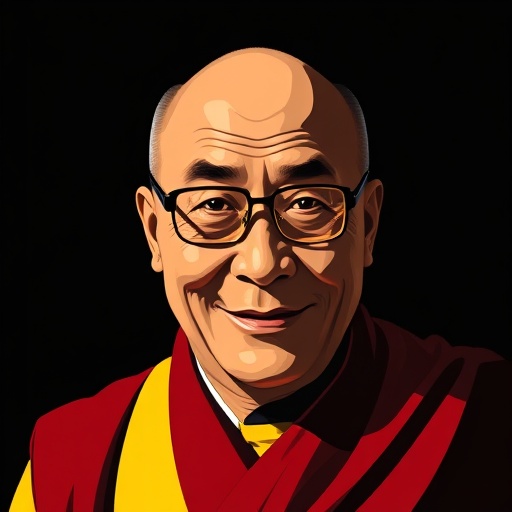
Dalai Lama (14th) — "My religion is very simple. My religion is kindness."
My religion is very simple. My religion is kindness.
My religion is very simple. My religion is kindness.
Click any product to generate a realistic preview. Up to 3 at a time.
* Initial load can take up to 90 seconds — revising the preview in another color is nearly instant.
"I have no special talent. I am only passionately curious."
"I think humor is very important. Sometimes I tell jokes that are not very funny, but people laugh anyway because I am the Dalai Lama."
"The very motion of our life is towards happiness."
"My main concern is the well-being of the six million Tibetans."
"Genuine compassion is not with attachment."
Found in 2 providers: deepseek,grok
2 sources checked
Religion, at its most essential, is not about rituals, scriptures, or institutional belonging — it is about how you treat other people. The Dalai Lama argues that kindness is the single universal practice underlying all spiritual traditions. You need no complex theology or formal faith affiliation to live righteously. Genuine compassion toward others is both the method and the goal of any meaningful spiritual life.
Tenzin Gyatso was recognized as the Dalai Lama at age two and fled Tibet in 1959 after China's military crackdown. Exiled ever since, he consistently refused to preach hatred toward Chinese authorities, instead embodying the Buddhist virtue of karuna — compassion. His Nobel Peace Prize in 1989 honored this stance. For him, kindness is not a slogan but a lived practice sustained through decades of stateless displacement and relentless political persecution.
The late 20th century saw surging religious nationalism, sectarian violence, and conflicts where faith identities fueled mass division — from Northern Ireland to the Balkans to the Middle East. As globalization brought world religions into closer contact, interfaith tension often escalated. The Dalai Lama's declaration of kindness as the universal religious core offered a radical reframe: stripping away doctrinal differences to find ethical common ground accessible across all traditions and cultures.
AI-generated insights based on extensive research and information for context. Factual errors? Email [email protected].
Your cart is empty