Carl Linnaeus — "Nature does not make leaps."
Nature does not make leaps.
Nature does not make leaps.
Click any product to generate a realistic preview. Up to 3 at a time.
* Initial load can take up to 90 seconds — revising the preview in another color is nearly instant.
"If a tree were to be a god, it would be a god of solitude."
"Every country has its own plants, and every plant has its own country."
"Natura non facit saltus. (Nature makes no leaps.)"
"The more hidden the flower, the sweeter the scent."
"The number of species is fixed and unchanging."
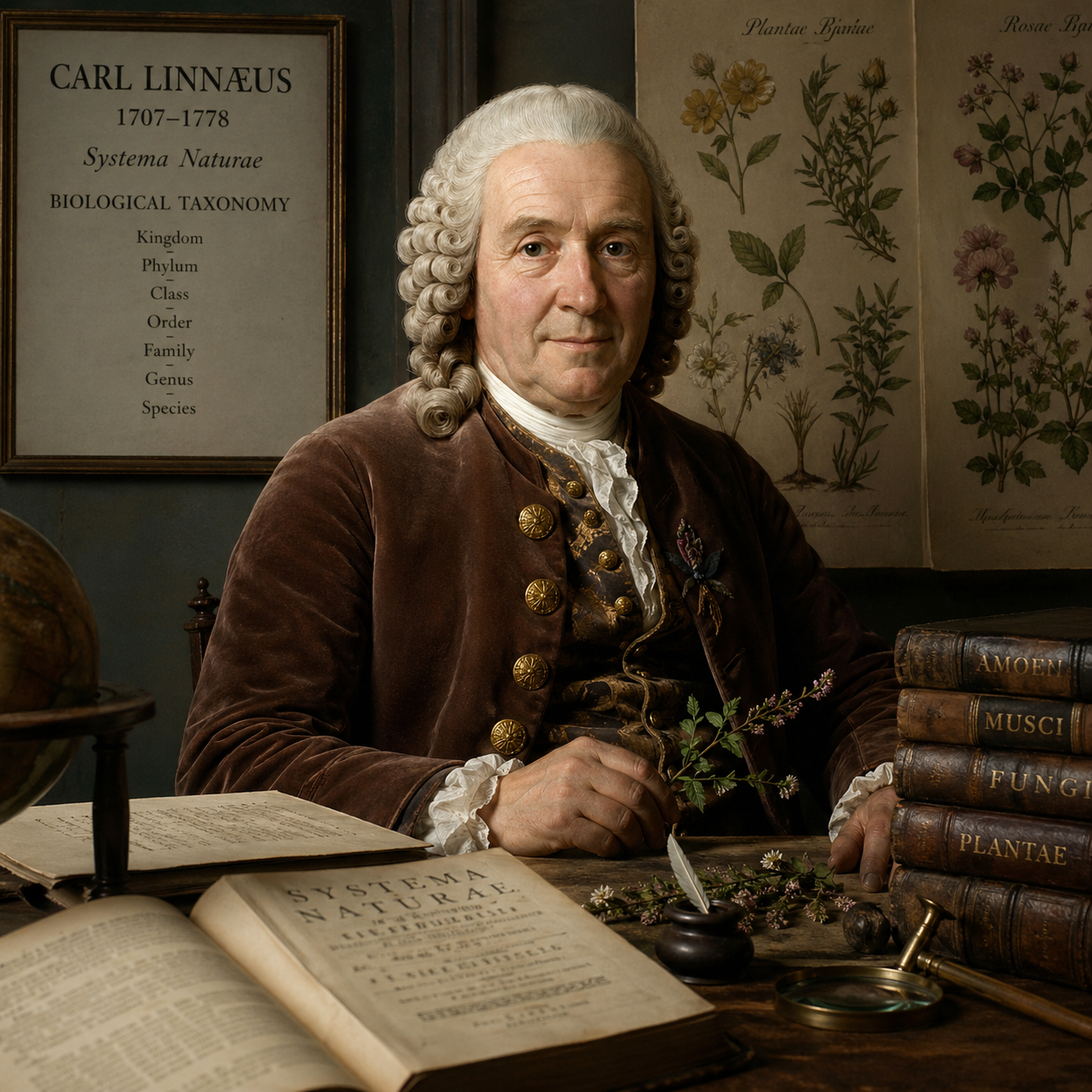
Swedish botanist and the father of modern taxonomy whose Systema Naturae (1735) introduced binomial nomenclature for naming all species. Closely associated with Joseph Banks (British naturalist who carried Linnaean classification on Cook's voyages). For an intellectual contrast, see Comte de Buffon, French naturalist and Histoire Naturelle author (1749-1788) — Buffon explicitly attacked Linnaean fixed-categories taxonomy as artificial and rejected the binomial system; his gradualist, environment-shaped natural history was the explicit alternative. Anticipates the fixed-species-vs-evolution debate Darwin would later resolve.
A fundamental principle of his philosophy, 'Natura non facit saltus', implying a gradual continuum in nature.
Date: c. 1751
Nature & WorldFound in 2 providers: gemini,deepseek
2 sources checked
Change in the natural world happens gradually, through small incremental steps rather than sudden jumps. Species, forms, and processes shade into one another along a continuous scale, so apparent gaps usually reflect missing observations rather than real discontinuities. The saying urges careful, patient observation and warns against expecting abrupt transformations. It implies that understanding nature means tracing fine gradations between things that look separate at first glance.
Linnaeus spent his career sorting plants and animals into nested ranks of kingdom, class, order, genus, and species, and he repeatedly saw organisms that blurred his own boundaries. Holding that nature proceeds by gradations fit a naturalist who built a continuous hierarchy rather than isolated categories. It also matched his belief in an orderly created world whose forms connect through subtle resemblances, guiding his meticulous, comparison-driven method of describing and naming living things.
In the early modern 1700s, European naturalists were cataloguing a flood of new specimens arriving from colonial voyages, and scholars debated whether species were fixed links in a Great Chain of Being or shifted over time. Newton's mechanics had made lawful continuity fashionable, and Leibniz popularized the same maxim about nature's gradualism. Linnaeus wrote inside this climate, where orderly classification, natural theology, and the search for underlying continuity shaped how educated Europeans read the living world.
AI-generated insights based on extensive research and information for context. Factual errors? Email [email protected].
Your cart is empty