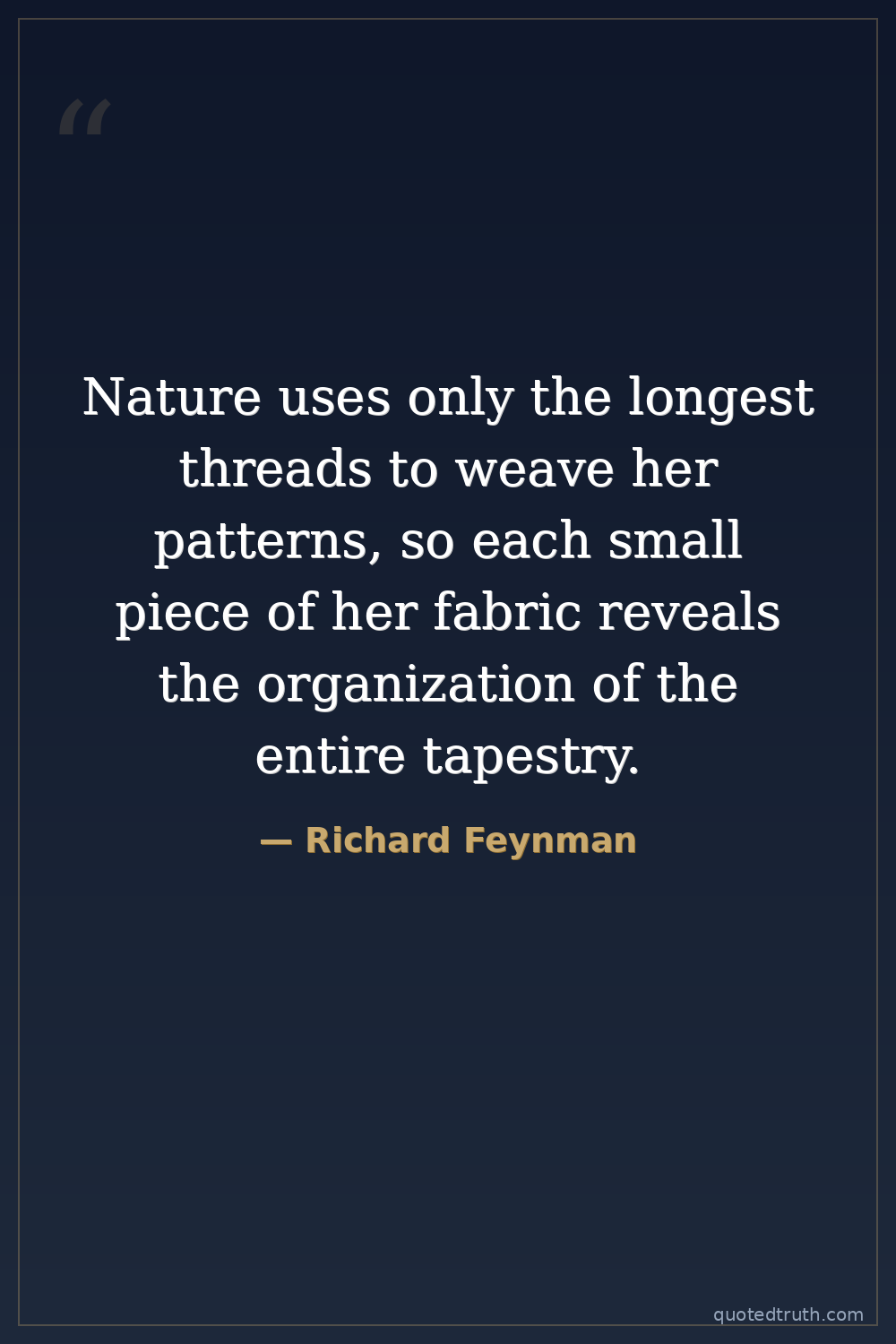
Richard Feynman — "Nature uses only the longest threads to weave her patterns, so each small piece …"
Nature uses only the longest threads to weave her patterns, so each small piece of her fabric reveals the organization of the entire tapestry.
Nature uses only the longest threads to weave her patterns, so each small piece of her fabric reveals the organization of the entire tapestry.
Click any product to generate a realistic preview. Up to 3 at a time.
* Initial load can take up to 90 seconds — revising the preview in another color is nearly instant.
"For a successful technology, reality must take precedence over public relations, for nature cannot be fooled."
"The more you learn, the more you realize how much you don't know."
"The greatest joy is to understand how nature works."
"The principle of science, the definition, almost, is the following: The test of all knowledge is experiment. Experiment is the sole judge of scientific truth."
"I don't know anything about anything."
American theoretical physicist who shared the 1965 Nobel for QED, developed Feynman diagrams, and wrote the Feynman Lectures on Physics. Closely associated with Julian Schwinger (co-Nobelist for QED) and Murray Gell-Mann (Caltech rival and Eightfold-Way physicist). For an intellectual contrast, see Deepak Chopra, physician and quantum-mysticism author — Feynman's Caltech 'cargo cult science' commencement address is the precise template for what he saw as misuse of physics terminology — Chopra-style appropriation of quantum vocabulary for metaphysical claims is the canonical example of what Feynman called 'fooling yourself'.
Found in 1 providers: deepseek
1 source checked
Reality is built from deep, interconnected principles that repeat at every scale. Understanding one small piece of nature fully — whether a particle interaction or a falling leaf — reveals the same fundamental laws governing the whole universe. There are no isolated facts; everything connects back to a few elegant threads that run through all of existence, making genuine understanding of any phenomenon a window into everything.
Feynman spent his career chasing exactly these threads. His work on quantum electrodynamics revealed that electromagnetism, quantum mechanics, and special relativity are woven from the same underlying fabric. His famous path integral formulation showed particles explore all possible histories simultaneously — a perfect example of one small rule generating infinite complexity. His Feynman Lectures aimed to show students that grasping any physics deeply means grasping all of it.
Feynman worked through mid-20th century physics' golden age, when physicists discovered the Standard Model's particle zoo was actually reducible to a handful of fundamental forces and fields. Post-WWII science sought unification — from the atom bomb's physics to quantum field theory. The era believed nature had a compact, discoverable architecture, and Feynman embodied that optimism, insisting complexity always hides simple, universal organizing principles beneath.
AI-generated insights based on extensive research and information for context. Factual errors? Email [email protected].
Your cart is empty