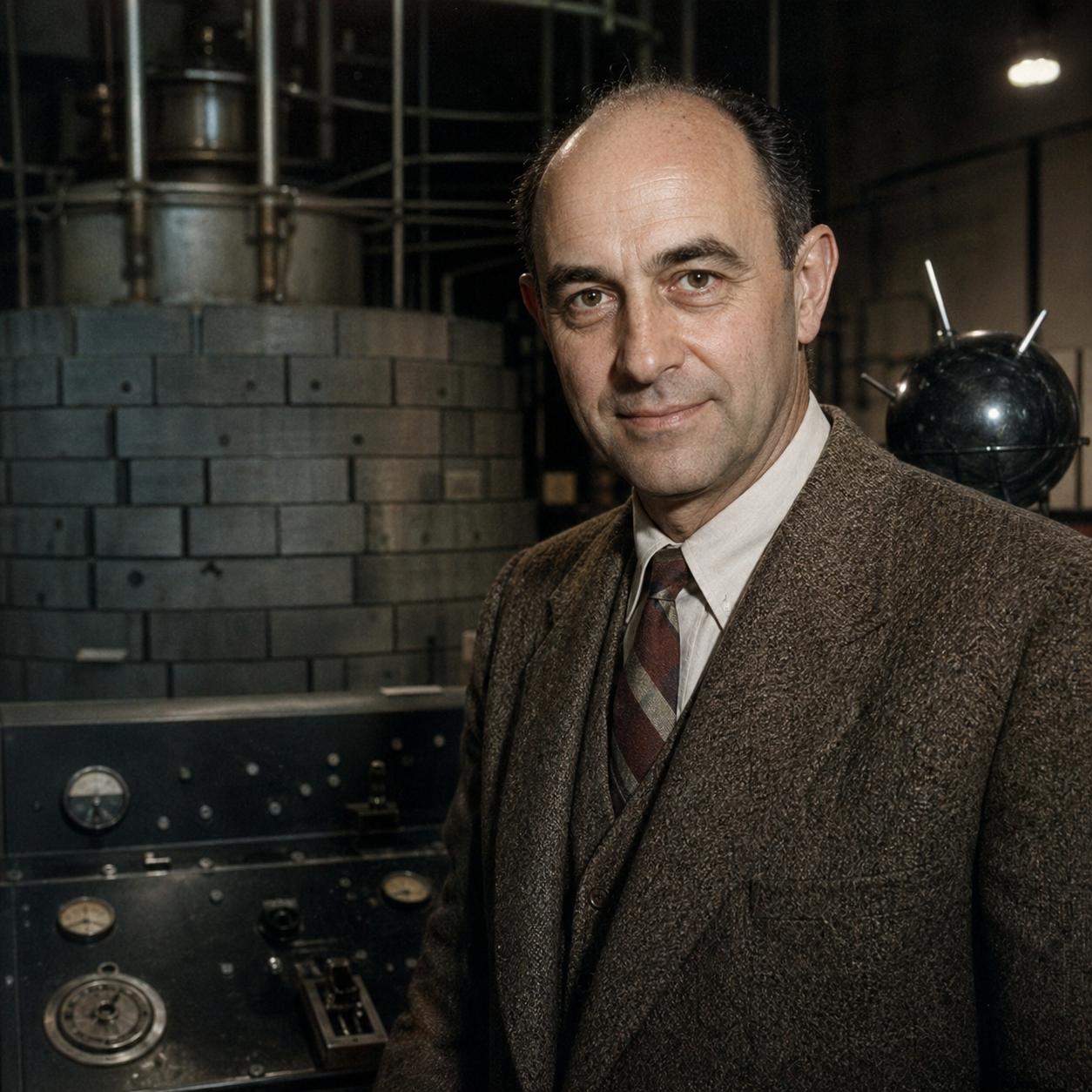
Enrico Fermi — "Never underestimate the joy of being proved wrong."
Never underestimate the joy of being proved wrong.
Never underestimate the joy of being proved wrong.
Click any product to generate a realistic preview. Up to 3 at a time.
* Initial load can take up to 90 seconds — revising the preview in another color is nearly instant.
"Young man, if I could remember the names of these [muons, pions, etc.] particles, I would have been a botanist."
"The atomic age is a new age, and we must learn to live in it."
"It is not good to be the only intelligent man in the world."
"It was a beautiful phenomenon, a terrifying spectacle, and a profound experience."
"I am a simple man, and I like simple explanations."
Found in 1 providers: grok
1 source checked
Being wrong isn't failure — it's discovery. When reality contradicts your prediction, your model of the world just improved. This quote reframes intellectual humility as a source of excitement: correction by evidence means you're closer to truth than before. A thinker who fears being wrong stops asking hard questions. One who welcomes it keeps pushing boundaries. The joy isn't in being wrong — it's in learning something real.
Fermi was legendary for estimation — rapid mental calculations he'd then test against experiment, often delighting when results surprised him. His work on Chicago Pile-1 (1942), the first nuclear reactor, demanded constant hypothesis revision. He built error-checking into thinking itself: his famous Fermi questions start with a guess explicitly designed to be refined. Colleagues recalled he celebrated unexpected data, treating contradiction as the engine of understanding rather than a setback.
Fermi worked during physics' most turbulent era (1920s–1950s). Quantum mechanics had just demolished classical assumptions. Nuclear physics was infant science built almost entirely by being wrong and correcting course. The Manhattan Project operated under extreme uncertainty — teams ran experiments that overturned prior models daily. In this environment, being corrected by evidence wasn't embarrassing; it was the mechanism of breakthrough. Wrong assumptions, rapidly revised, produced both the atomic bomb and postwar nuclear power.
AI-generated insights based on extensive research and information for context. Factual errors? Email [email protected].
Your cart is empty