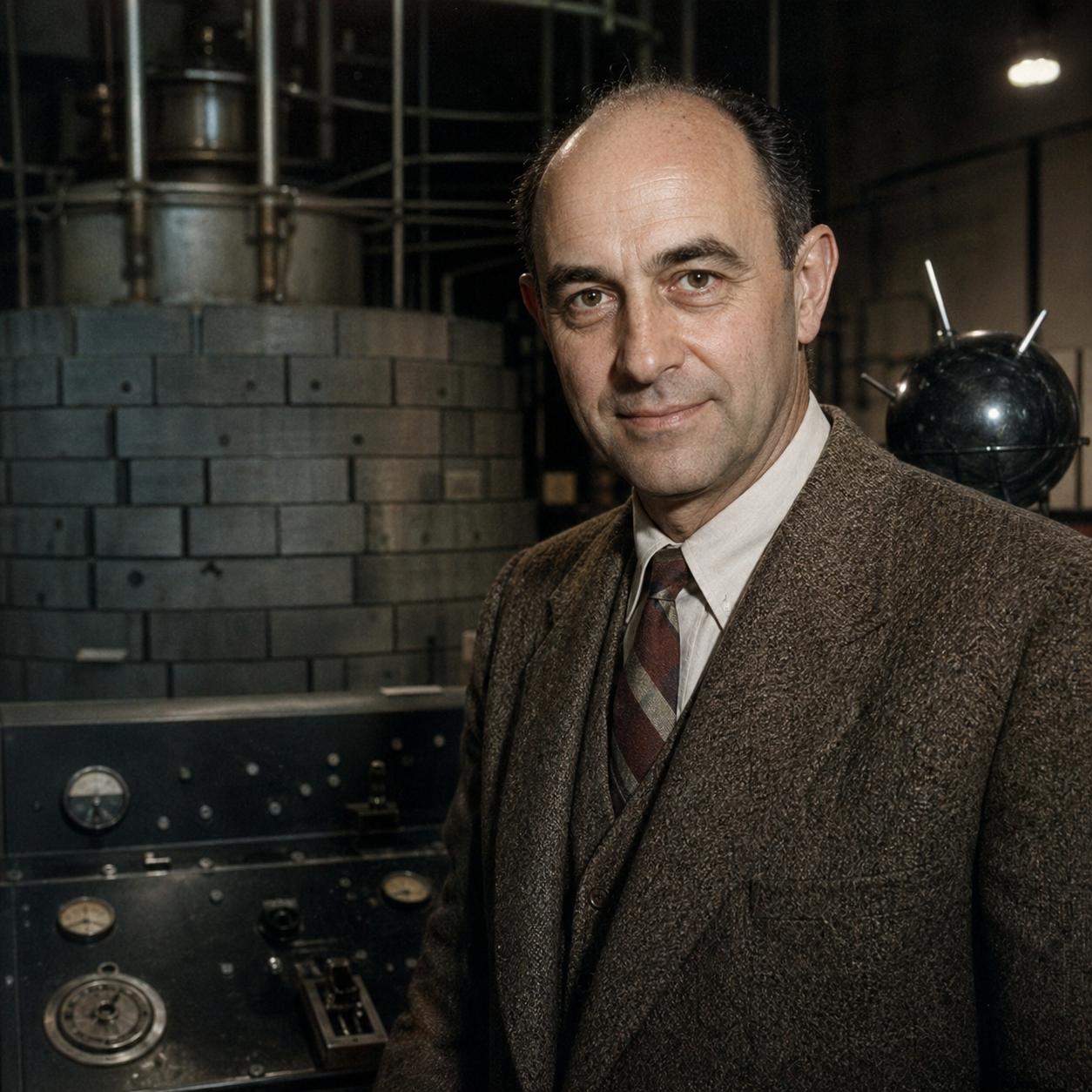
Enrico Fermi — "Never underestimate the power of a good approximation."
Never underestimate the power of a good approximation.
Never underestimate the power of a good approximation.
Click any product to generate a realistic preview. Up to 3 at a time.
* Initial load can take up to 90 seconds — revising the preview in another color is nearly instant.
"When asked what characteristics Nobel prize winning physicists had in common I cannot think of a single one not even intelligence."
"The most important thing in science is to have a good question."
"It is not good to try to stop knowledge from going forward. Ignorance is never better than knowledge."
"It is not enough to know how to build a bomb. One must also know how to control it."
"When we were working on the atomic bomb, we knew that we were doing something that would change the world forever."
Found in 1 providers: grok
1 source checked
Rough estimates and simplified models are genuinely powerful tools for understanding complex problems. Precision isn't always necessary — a well-reasoned approximation can yield accurate insights, guide decisions, and reveal underlying patterns. The skill lies in knowing which details to ignore and which to keep. Approximations aren't intellectual shortcuts born of laziness; they're deliberate, disciplined simplifications that make the intractable tractable and the overwhelming manageable.
Fermi was legendary for 'Fermi estimation' — startlingly accurate back-of-envelope calculations with minimal data. He famously estimated the yield of the first atomic bomb test by dropping scraps of paper and measuring their displacement. His design of Chicago Pile-1, the first nuclear reactor, relied on careful approximations about neutron cross-sections before precise measurements existed. He built intuition-first physics into his teaching at the University of Chicago.
Fermi worked during mid-20th century physics' most explosive era — quantum mechanics and nuclear science were rewriting reality faster than mathematical tools could keep pace. During the Manhattan Project (1942–1945), physicists faced urgent problems with incomplete data and no time for exactness. Approximation wasn't optional; it was survival. The Cold War arms race that followed demanded rapid estimation under pressure, cementing the practical value of disciplined rough calculation in science and strategy.
AI-generated insights based on extensive research and information for context. Factual errors? Email [email protected].
Your cart is empty