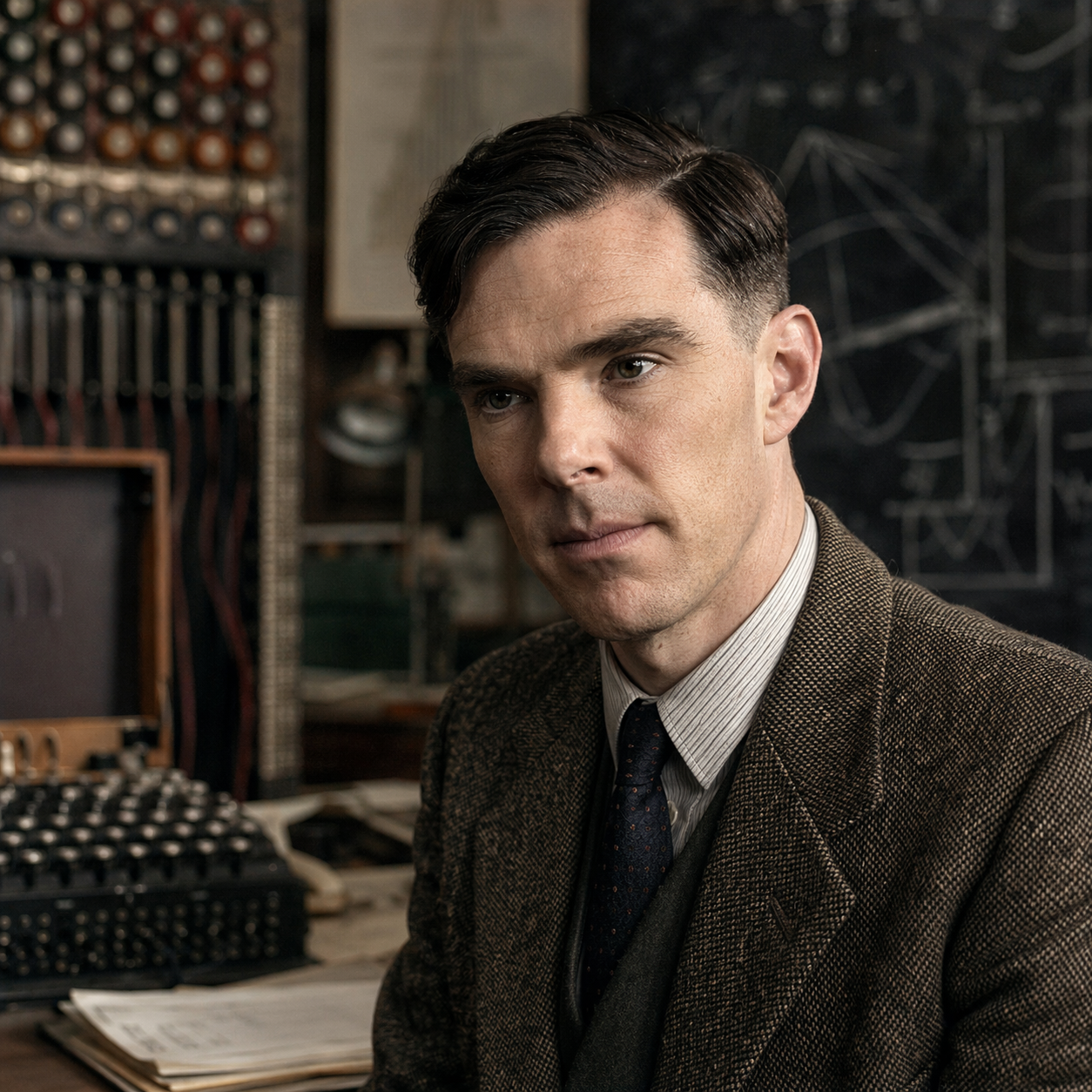
Alan Turing — "No, I am not interested in developing a powerful brain. All I am interested in i…"
No, I am not interested in developing a powerful brain. All I am interested in is a rather crude imitation of a child's brain.
No, I am not interested in developing a powerful brain. All I am interested in is a rather crude imitation of a child's brain.
Click any product to generate a realistic preview. Up to 3 at a time.
* Initial load can take up to 90 seconds — revising the preview in another color is nearly instant.
"The original question, 'Can machines think?' I believe to be too meaningless to deserve discussion."
"The computer is a medium for thought."
"Science is a differential equation. Religion is a boundary condition."
"The machine cannot do anything new."
"I am a homosexual. I have been convicted of gross indecency. I have been subjected to chemical castration."
Found in 1 providers: grok
1 source checked
Rather than chasing a fully-formed, omniscient artificial mind, the smarter path is building something simple that can learn — a blank slate that grows through experience, like a child. Ambition toward raw power misses the point; intelligence emerges from adaptability and learning, not from being born complete. This is a call for humility in approach: start crude, start teachable, and let development do the heavy lifting.
Turing wrote this in his 1950 paper 'Computing Machinery and Intelligence,' where he introduced the Turing Test and proposed the concept of a 'child machine' — a program educated rather than pre-programmed with adult knowledge. His Bletchley Park codebreaking showed that elegant, minimal systems outperform brute force. His mathematical work on universal computation always sought the simplest mechanism capable of complex behavior, not the most powerful one.
In 1950, computers were massive, room-filling calculators — tools for number-crunching, not thinking. The Cold War was intensifying, and Turing had just helped win WWII by cracking Nazi Enigma codes. The term 'artificial intelligence' did not yet exist. Against this backdrop, claiming machines could learn like children was radical. Turing was reimagining the entire purpose of computing when most scientists saw machines as nothing more than fast arithmetic engines.
AI-generated insights based on extensive research and information for context. Factual errors? Email [email protected].
Your cart is empty