Alan Turing — "No, I am not interested in developing a powerful brain. All I am after is just a…"
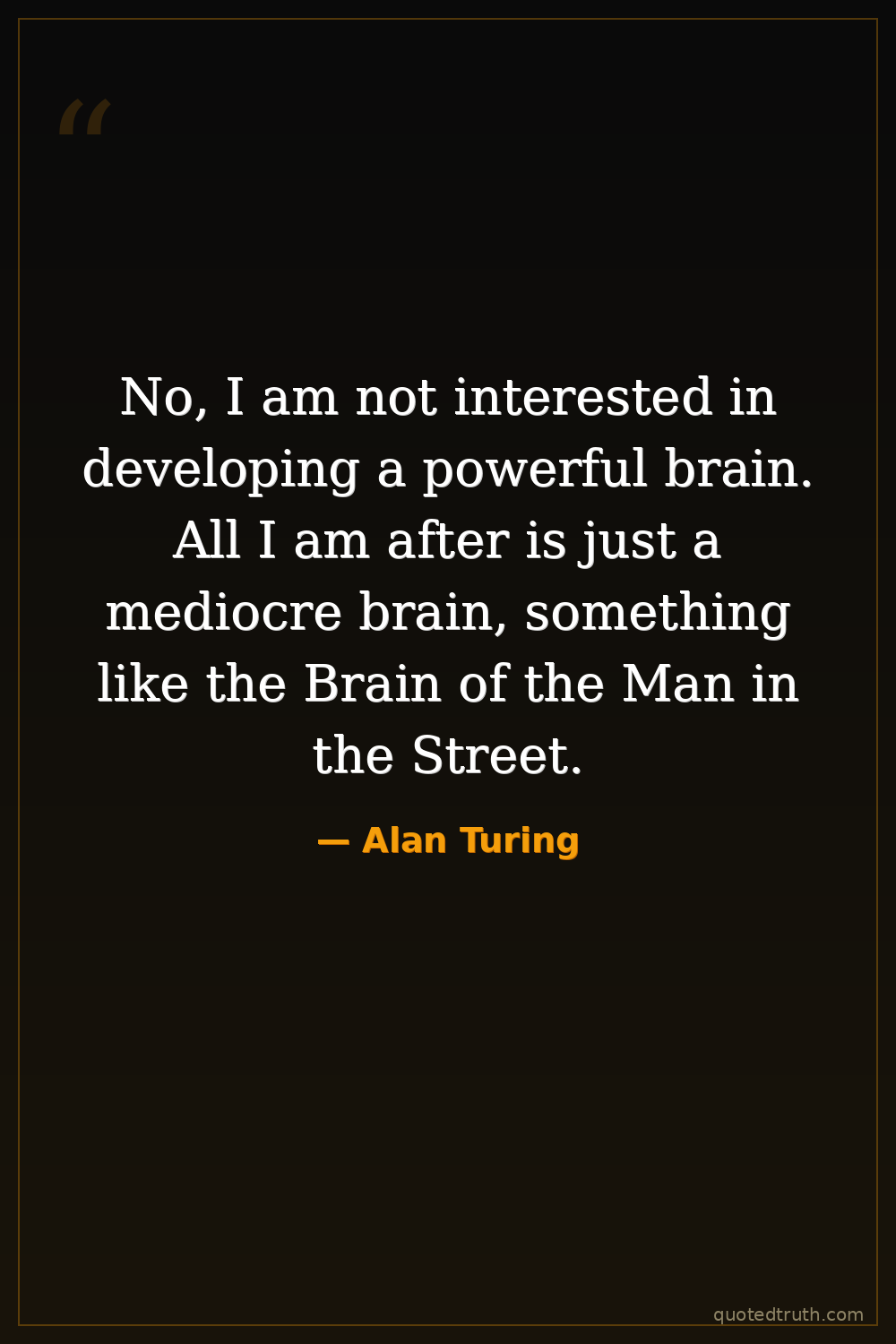
No, I am not interested in developing a powerful brain. All I am after is just a mediocre brain, something like the Brain of the Man in the Street.
No, I am not interested in developing a powerful brain. All I am after is just a mediocre brain, something like the Brain of the Man in the Street.
Click any product to generate a realistic preview. Up to 3 at a time.
* Initial load can take up to 90 seconds — revising the preview in another color is nearly instant.
"The question is not whether machines can think, but whether they can do something that we would call thinking."
"The most beautiful thing we can experience is the mysterious."
"I've now got myself into the kind of trouble that I have always considered to be quite a possibility for me, though I have usually rated it at about 10:1 against."
"No, I'm not interested in developing a powerful brain. All I'm interested in is a moderately trained brain. The kind that would be useful in daily life."
"I expect to lie in the sun, talk French and modern Greek, and make love, though the sex and nationality... has yet to be decided: in fact it is quite possible that this item will be altogether omitted…"
A conversation with Christopher Strachey, quoted in 'Alan Turing: The Enigma' by Andrew Hodges.
Date: Approx. 1950-1951
ShockingFound in 1 providers: grok
1 source checked
Turing is deflecting the grandiose framing of artificial intelligence. He argues you don't need to replicate genius to prove machines can think — ordinary human-level cognition is already an astonishing and sufficient benchmark. It's a strategic lowering of the bar: if a machine can match an average person's reasoning, that alone would be revolutionary and philosophically significant.
Turing proposed the Imitation Game — his test for machine intelligence — rooted in this exact philosophy. He wasn't chasing superhuman AI; he wanted to formalize whether machines could pass as ordinarily human. As a mathematician who cracked Enigma through systematic logic rather than intuition, Turing respected the power of methodical, modest competence over flashy brilliance.
In the late 1940s and early 1950s, computing was brand new and AI was pure speculation. Turing was writing against a backdrop of postwar techno-optimism and deep skepticism about machine thought. Critics dismissed the idea entirely; Turing reframed the debate by grounding it in achievable, relatable human standards rather than science-fiction superintelligence.
AI-generated insights based on extensive research and information for context. Factual errors? Email [email protected].
Your cart is empty