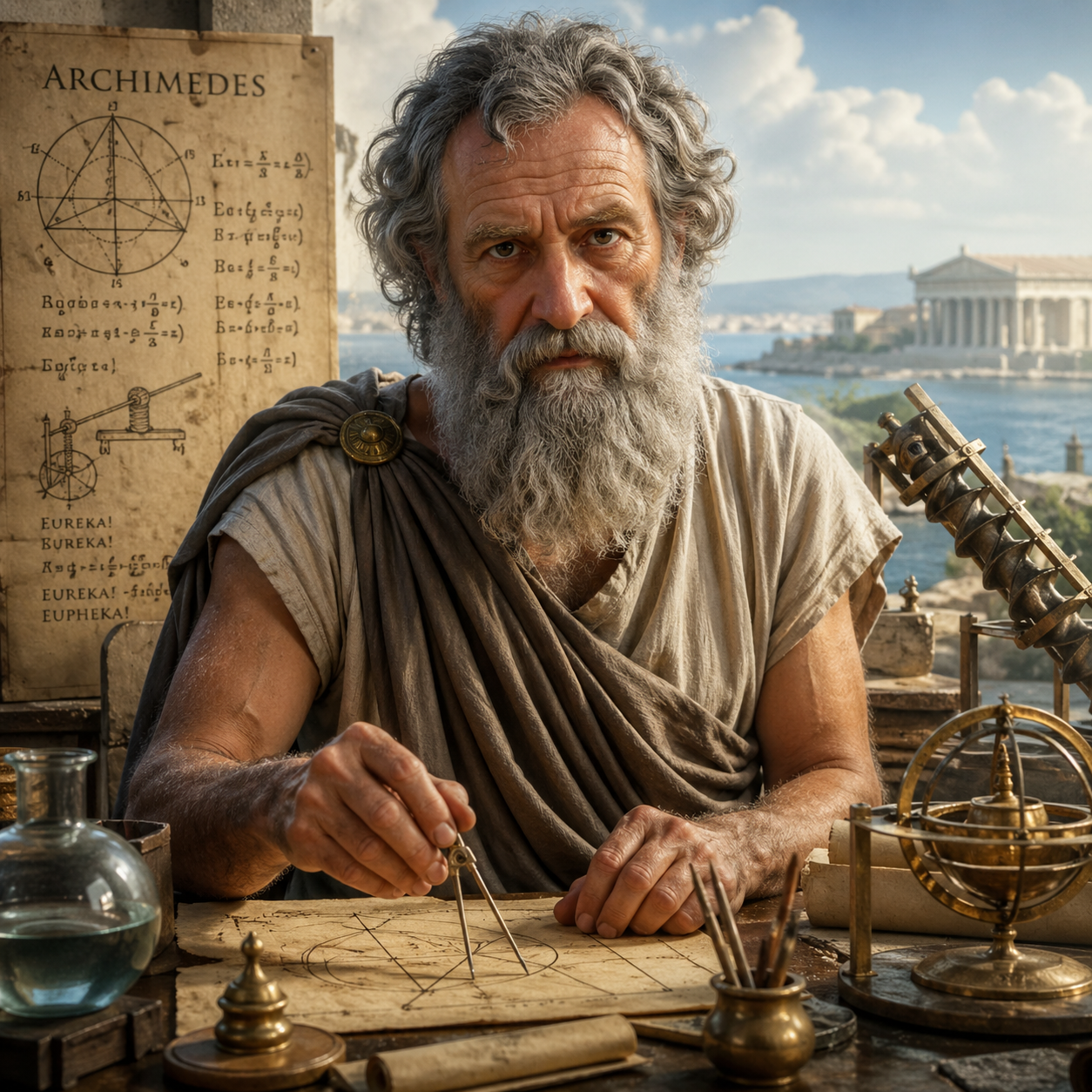
Archimedes — "Noli turbare circulos meos."
Noli turbare circulos meos.
Noli turbare circulos meos.
Click any product to generate a realistic preview. Up to 3 at a time.
* Initial load can take up to 90 seconds — revising the preview in another color is nearly instant.
"It is a property of the circle that the ratio of its circumference to its diameter is the same for all circles."
"The number of grains of sand is not infinite, but finite."
"Any solid lighter than a fluid will, if placed in the fluid, be immersed in it to such an extent that the weight of the solid will be equal to the weight of the fluid displaced."
"The diameter of the Earth is greater than the diameter of the Moon and the diameter of the Sun is greater than the diameter of the Earth."
"Do not disturb my circles!"
His reputed last words, said to a Roman soldier who interrupted his work during the siege of Syracuse.
Date: c. 212 BCE
GeneralFound in 1 providers: gemini
1 source checked
"Do not disturb my circles" — a command to leave focused intellectual work undisturbed. It expresses the idea that genuine concentration on a problem demands more respect than the surrounding world, even mortal danger. The phrase has become shorthand for the mindset of a thinker so absorbed in pursuing truth that external interruptions feel like violations of something sacred and irreplaceable.
Archimedes spent his life in total devotion to mathematics and physics — calculating pi, discovering principles of levers and buoyancy, designing war machines that held Rome at bay for years. Tradition says he spoke these words to a Roman soldier moments before being killed during the sack of Syracuse, still hunched over geometric diagrams in the sand, unwilling to abandon his work even as the city fell.
In 212 BC, Rome sacked Syracuse during the Second Punic War — the titanic struggle against Carthage reshaping the Mediterranean world. Syracuse, a wealthy Greek city-state on Sicily, had aligned with Carthage. Archimedes's ingenious war engines stalled the Roman siege for two years. His death at a soldier's hands became a lasting symbol of military power overriding intellectual civilization, a tension Greeks across the Hellenistic world felt acutely.
AI-generated insights based on extensive research and information for context. Factual errors? Email [email protected].
Your cart is empty